Tag: sfda

  • How to Spot Good Ajwa Dates Before You Buy in Madinah

    How to Spot Good Ajwa Dates Before You Buy in Madinah

    Ajwa is the date most people link with Madinah, and it is the one visitors most want to take home. Because it is popular, shops sell it in every size, box and grade. Some boxes are excellent. Others are mixed, dry or past their best.

    This guide is for residents and guests who want to buy with confidence. It covers what to look at, what to read on the label and how the official grading idea works. For where to buy and other varieties, see our Madinah central dates market guide.

    Quick answer

    Short answer: Good Ajwa dates look even in colour and size, feel soft but not sticky or wet, and show no damage, mould or insects. Buy from a licensed shop, read the label for origin, packing and expiry dates, and taste one before buying a large box. The National Center for Palms and Dates publishes Guideline Standards for Dates as a reference for producers.

    What official standards exist

    The National Center for Palms and Dates (NCPD) publishes Guideline Standards for Dates. They cover dates for direct eating, including whole packed dates, natural or washed, dried or coated. NCPD also offers a Date Classification Tool.

    What the standards look at

    • Who they are for: producers and packers, as a shared reference for quality.
    • What they cover: whole dates for direct eating, packed natural, washed, dried or coated.
    • For shoppers: a graded, labelled box tells you more than a loose pile.

    You don’t need to read the full standard. The same ideas help when you stand at a shop counter.

    Look before you buy

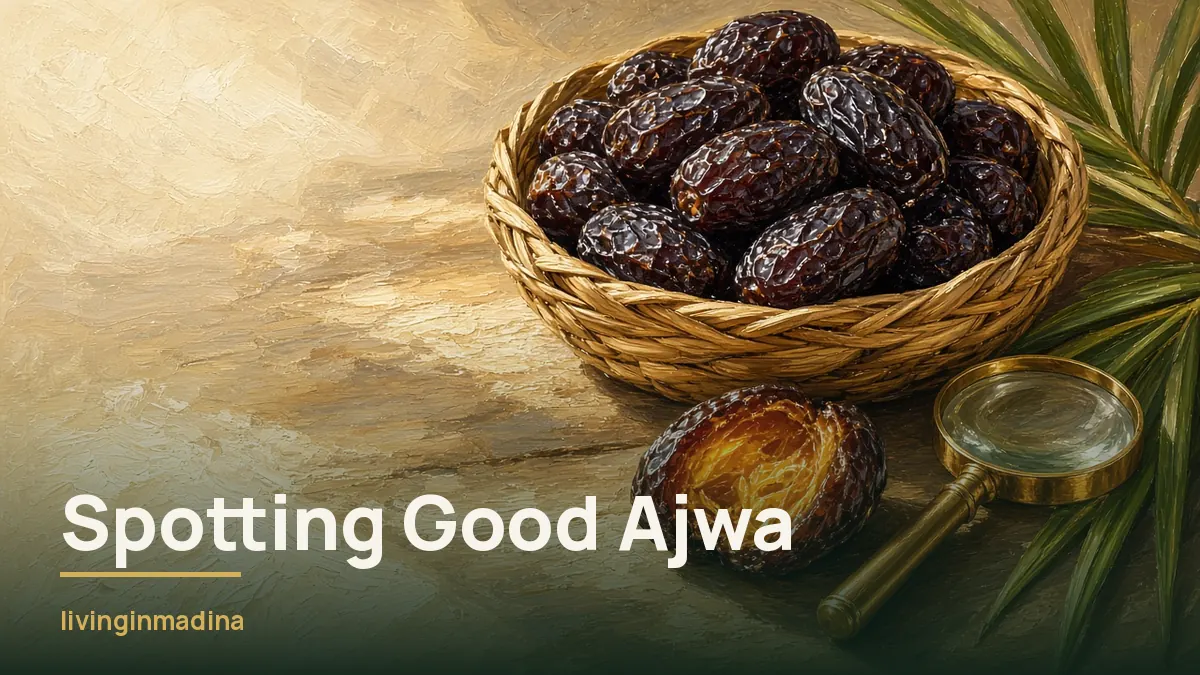
    Start with your eyes. Ajwa is a dark date with fine wrinkles on the skin.

    What to look for

    • Dates of a similar colour and size in the same box
    • Skin that is whole, without tears, white patches or mould
    • No holes, dust or signs of insects
    • No pool of syrup at the bottom of the box
    • A clean, sealed pack if you are buying boxed dates

    A box with very different sizes and colours may be mixed or a lower grade. That isn’t always bad, but it should be priced and labelled as such.

    Feel, smell and taste

    If the shop lets you, hold one date. A good Ajwa feels soft and gives a little when pressed. It shouldn’t feel rock hard, wet or very sticky.

    Smell matters too. Fresh dates smell sweet and clean. A sour or fermented smell is a reason to walk away.

    Many date shops let you taste before you buy. Try one from the actual box, not from a sample tray.

    Read the label

    Food sold in Saudi Arabia is covered by the regulations of the Saudi Food and Drug Authority (SFDA). As a shopper, the simplest habit is to read whatever the box tells you before you pay. A clear label is a good sign.

    Checking a box in a minute

    1

    Look for the variety name, so you know it says Ajwa.

    2

    See who packed it and where it came from, if the box says.

    3

    Look for a date on the box, and pick the freshest you can find.

    4

    Compare the weight or size, so you can compare boxes fairly.

    5

    Keep the receipt in case something is wrong when you open it at home.

    If a box has no label at all, ask where the dates came from. A licensed shop can usually tell you.

    Loose dates or boxed?

    Loose from the counterSealed, labelled box
    Can you taste first?Usually yesSometimes
    Label and datesAsk the sellerPrinted on the box
    Good forEating this weekGifts and travel
    CheckColour, feel, smellLabel, seal, expiry
    Loose or packed Ajwa

    Avoiding a disappointing box

    Mixed boxes are the most common complaint. A top layer of large, even dates can hide smaller ones underneath. If you are buying a big box, ask the seller to open it.

    Prices vary a lot by grade, size and season, so we don’t quote any. Compare a few shops and remember that very cheap “Ajwa” deserves a closer look.

    Tip

    Buying for family abroad? Choose sealed, labelled boxes with a clear expiry date. They travel better and are easier at customs.

    Storing Ajwa at home

    Keep dates in a clean, airtight container away from heat and sunlight. Many families keep a weekly portion out and the rest in the fridge, so they stay soft for longer.

    Settling in Madinah

    Buying dates becomes second nature once you live here. Our guide to moving to Medina covers the other basics of daily life.

    FAQ

    How can I tell real Ajwa dates?

    Look for dark, finely wrinkled dates of even size, buy from a licensed shop, and read the variety name on the label.

    Is there an official grading for dates?

    Yes. NCPD publishes Guideline Standards for Dates and offers a Date Classification Tool.

    What should I check on the label?

    Read it before you buy: look for the variety name, any dates and who packed it. If something is unclear, ask the seller.

    Last checked: 24 October 2026.
  • Drinking Water in Medina: Bottled, Filtered and Zamzam

    Drinking Water in Medina: Bottled, Filtered and Zamzam

    In Medina’s heat, drinking enough water matters every day. New residents often ask where to get drinking water: bottled, filtered at home, or delivered in large bottles. This guide covers the practical options and the official bodies to check with.

    We don’t recommend brands or quote prices, and we don’t make health claims about any type of water.

    Quick answer

    Short answer: Many Medina residents drink bottled water, either in small bottles or in large refillable bottles delivered to the home. Others use home filters. Bottled water is regulated by the Saudi Food and Drug Authority (SFDA), and the mains supply by the National Water Company (NWC). For Zamzam water, buy only from official or clearly authorised sources.

    The main options

    OptionHow it worksThings to check
    Small bottlesBuy in packs from shopsPackaging intact, stored out of the sun
    Large refillable bottlesDelivered to your homeA reputable supplier, clean dispenser
    Home filterFitted to the kitchen tapLicensed installer, filter changes
    Drinking water options

    Bottled water

    Bottled water is easy to find in every supermarket and baqala. The Saudi Food and Drug Authority regulates bottled water and food products. If you have a concern about a bottled water product, you can report it to SFDA.

    Tip

    Store bottled water out of direct sun, and don’t leave it in a hot car for long periods.

    Large bottles and dispensers

    Many households use large refillable bottles with a dispenser. Clean the dispenser regularly, following the manufacturer’s instructions, and use a reputable supplier.

    Home filters

    If you fit a filter, use a reputable installer and follow the manufacturer’s schedule for changing filters. The Saudi Standards, Metrology and Quality Organization (SASO) sets standards for many products sold in the Kingdom.

    Mains water and tanks

    Mains water is supplied by the National Water Company. Many buildings store water in roof or underground tanks. If you’re renting, ask the landlord when the tanks were last cleaned, and contact NWC about supply problems or bills.

    • Ask the landlord about tank cleaning before you move in
    • Report supply problems to NWC
    • Fix leaks quickly, since they waste water and raise bills
    • Check your water bill matches your use

    Zamzam water

    Zamzam water is valued by many residents and visitors. If you buy it, buy only from official or clearly authorised outlets, and check that the packaging is sealed. Be careful with unlabelled containers sold informally.

    Warning

    Don’t buy water of any kind from informal sellers in unlabelled containers. You can’t check where it came from or how it was stored.

    Staying hydrated in the heat

    Our Madinah heat safety guide covers water and heat. Carry water when you go out in summer, especially with children.

    Key takeaways

    • Bottled water: regulated by SFDA
    • Mains supply and bills: National Water Company
    • Product standards: SASO
    • Zamzam: official or authorised outlets only

    Water at work and school

    Ask your employer or your child’s school how drinking water is provided, and send children with a refillable bottle in summer. On long drives, keep extra water in the car, out of direct sun, in case of delays or a breakdown on the road.

    Saving water at home

    Water is precious in a desert city. Fix dripping taps and running toilets quickly, run washing machines and dishwashers with full loads, and water plants in the early morning or evening.

    FAQ

    What water do Medina residents drink?

    Many drink bottled water or large delivered bottles, and some use home filters.

    Who do I contact about a water supply problem?

    The National Water Company (NWC).

    Where can I buy Zamzam water?

    Buy only from official or clearly authorised outlets, in sealed packaging.

    Last checked 20 October 2026 (SFDA and SASO pages opened; NWC page blocked from the box, browser check). No prices or rankings; check details with the official source or provider before you act.

  • Grocery and Market Tips for Daily Life in Madinah

    Grocery and Market Tips for Daily Life in Madinah

    Food shopping shapes family life more than most of us notice. In Madinah, a little planning goes a long way: the right time of day, a clear list and a habit of checking labels save money and keep food safe. This guide covers grocery shopping in Madinah for residents, from reading date labels to buying the city’s famous dates and knowing where to report a problem.

    Quick answer

    Short answer: Shop with a written list, at cooler times of day, and check every expiry date before it goes in the trolley. Buy dates from clean, clearly labelled stalls or packs, and if something is wrong with a product or price, report it only through the official Balagh Tijari app or 1900 (Ministry of Commerce) or Balady/940 (municipal). New to the city? Start with our first-month checklist.

    Key takeaways

    • Month-only dates: a label reading “October” means good until the end of that month (SFDA).
    • “Consume before” a date: the product is good until the end of the previous day (SFDA).
    • Cooked food: don’t leave it at room temperature for more than two hours (SFDA).
    • Consumer complaints: use the Balagh Tijari app or call 1900, not third-party websites (Saudi Gazette).
    • Municipal issues (for example hygiene at a food shop): report via Balady or 940 (MoMAH).

    How everyday grocery shopping works in Madinah

    Most families mix three kinds of shopping. A large supermarket covers the weekly shop, a small neighbourhood shop handles bread, milk and quick top-ups, and delivery apps fill the gaps on busy or very hot days.

    There’s no single “right” place to shop. What matters is that the shop is clean, prices are clearly shown and the products are properly labelled. When you settle into a district, walk your nearest streets once and note where the closest shops are. Pair that with your saved National Address so deliveries find you easily.

    Read the label before it goes in the trolley

    The Saudi Food and Drug Authority (SFDA) explains how to read expiry wording in its food-waste awareness campaign. The details are easy to get wrong in a hurry, so it helps to know them.

    • A date given as month and year only means the food is fine until the end of that month.
    • A full date means it’s fine until the end of that day.
    • “Valid for two years from production” counts forward from the production date.
    • “Consume before” a date means it’s fine until the end of the day before.

    The SFDA also asks shoppers to follow the storage instructions printed on each pack. Its smartphone app has offered a barcode product search that shows details such as validity period and ideal storage temperature.

    Food-safety numbers to remember

    2

    hours max for cooked food at room temperature (SFDA)

    1900

    Ministry of Commerce consumer line

    940

    municipal reports line (Balady)

    Buying Madinah dates with care

    Dates are part of daily life here. Ajwa is a date variety cultivated in the Madinah region, and demand rises in religious seasons such as Ramadan and Hajj, when many visitors buy dates as gifts (Saudipedia).

    In September 2025 the Governor of the Madinah Region inaugurated the city’s new Central Dates Market, part of the wider Food City project, alongside the “Dhat Nakhl” dates forum (Arab News, citing SPA). Food City is planned to add markets for vegetables, fruit, meat and poultry over time.

    For variety names, the Central Dates Market and storage tips, see our Madinah dates guide. Wherever you buy, look for dates that are clean, stored off the ground and sold in packs or containers with clear labelling. Ask what the variety is if it’s not marked. Prices can vary a lot by variety and grade, so compare before you buy in bulk.

    Tip

    Buying dates as a gift for relatives abroad? Choose sealed, labelled packs. They travel better and show the product details clearly.

    Shopping smart in the heat

    For much of the year, Madinah afternoons are very hot. That affects both your comfort and your food. Many residents shop early in the morning or after Isha, when stores and car parks are cooler.

    Pick up chilled and frozen items last, keep an insulated bag in the car, and drive straight home. Never leave groceries, or children, in a parked car. Put cold items away first when you get in.

    Warning

    The Ministry of Commerce says violations should be reported only through its official app or by calling 1900, and that there are no websites for this purpose. Don’t share card details or ID numbers on look-alike “complaint” pages.

    A simple weekly routine

    The SFDA’s shopping advice is aimed at cutting food waste, and it also keeps the household budget steady. Here’s a routine built on it.

    Your weekly grocery shop in four steps

    1

    Check the fridge and cupboard: use older items first and note what’s running low.

    2

    Write a list and stick to it: the SFDA advises a clear list and not shopping while hungry.

    3

    Skip bulk deals you don’t need: discounts that push you to buy more than you’ll use often end in waste (SFDA).

    4

    Store it right at home: follow pack instructions and refrigerate leftovers in sealed containers.

    Large supermarketNeighbourhood shopDelivery app
    Best forWeekly shop, bulk staplesBread, milk, quick top-upsHot days, busy evenings
    Watch forImpulse buys and offersCheck dates on slow-moving stockDelivery fees and substitutions
    TipGo early or late eveningGet to know your local shopCheck chilled items on arrival
    Where to shop: a quick comparison

    If something goes wrong

    If you find an expired product, an unclear price or a misleading offer, the Ministry of Commerce’s Balagh Tijari app lets you file a report, attach photos and track it. You can also call 1900.

    For municipal matters, such as hygiene at a food shop, use the Balady app or portal or call 940. Balady’s report service is free, and you can attach photos and set the location on a map (MoMAH).

    Before you leave the store

    • Expiry dates checked on dairy, meat and bread
    • Chilled and frozen items picked up last
    • Receipt checked against shelf prices
    • Insulated bag ready in the car

    A final word

    Good shopping habits are a small thing that makes daily life in the blessed city calmer. Plan ahead, check labels and use the official channels when you need help.

    Last checked: 12 October 2026. General information only; procedures and apps may change, so confirm on official channels.