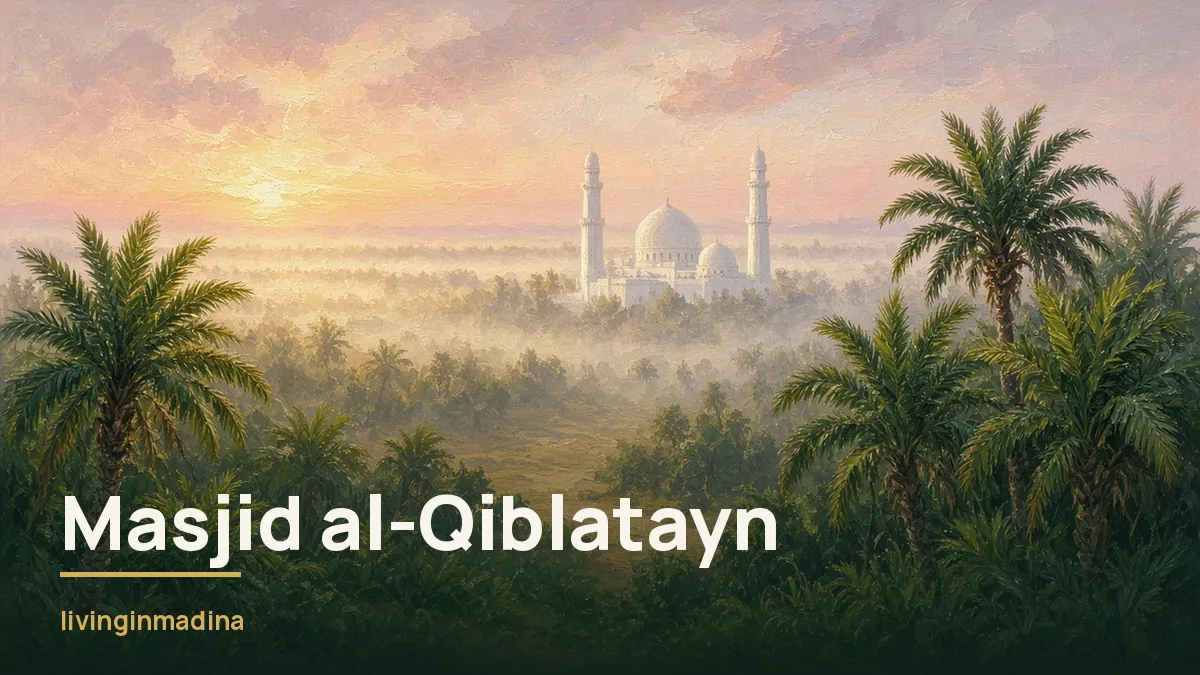
Ask a Madinah taxi driver for “al-Qiblatayn” and he will know exactly where to go. The name means “the two qiblas”, and it recalls the moment Muslims turned from facing Jerusalem to facing the Sacred Mosque in Makkah.
For residents, it is also an easy and meaningful outing with family or guests. This guide covers the history as the official sources tell it, then the practical side of visiting.
Quick answer
Short answer: Masjid al-Qiblatayn is about 3.8 km north-west of the Prophet’s Mosque, according to Visit Saudi. It marks the place linked to the change of qibla in the second year after the Hijrah (624 CE), described in Surah al-Baqarah 2:144. The building today dates from a full rebuild in 1408 AH (1987 CE).
The change of qibla in the Qur’an
Surah al-Baqarah addresses the change of prayer direction in verses 142 to 144. Verse 144 reads, in the translation shown on quran.com:
“Indeed, We see you ˹O Prophet˺ turning your face towards heaven. Now We will make you turn towards a direction ˹of prayer˺ that will please you. So turn your face towards the Sacred Mosque ˹in Mecca˺—wherever you are, turn your faces towards it. Those who were given the Scripture certainly know this to be the truth from their Lord. And Allah is never unaware of what they do.” (Qur’an 2:144, Dr Mustafa Khattab, The Clear Quran)
Before this, Muslims in Madinah prayed facing Bayt al-Maqdis in Jerusalem. After it, the qibla became the Sacred Mosque in Makkah, as it is today.
How the mosque got its name
Visit Saudi says the Prophet ﷺ was visiting the tribe of Banu Salamah and leading them in the Dhuhr prayer facing Jerusalem. After two rak’ahs, the command came, and he turned towards the Kaaba with his companions following. From then on, the mosque was known as the Mosque of the Two Qiblas.
A note on the accounts
Classical sources tell this event in more than one way, with some differences in detail, such as which prayer it was. We give Visit Saudi’s account here. For the different narrations and what they mean, please ask a qualified scholar.
The building through the centuries
Visit Saudi says the original structure dates back to the time of the Prophet ﷺ and has been restored many times since.
Restorations and rebuilds (Visit Saudi)
1
893 AH: the roof was restored by Shahin Al-Jamali.
2
950 AH: the roof was restored again.
3
King Abdulaziz Al Saud: ordered a renovation and expansion, adding a minaret and a staircase.
4
1408 AH (1987 CE): under King Fahd bin Abdulaziz, the mosque was completely rebuilt and expanded, keeping its Islamic character.
What the mosque looks like today
Today’s mosque is known for its twin domes and two minarets. Visit Saudi gives these figures:
Masjid al-Qiblatayn in numbers (Visit Saudi)
4,000 m²
total area, approximately
1,250 m²
main prayer hall
400 m²
women’s prayer gallery
The ground level holds ablution areas and storage, plus homes for the imam and muezzin. The main level is the prayer hall, and the women’s gallery is on the upper level. The two main domes reach 20 m and 17 m, with smaller domes at 12 m, and a central courtyard with greenery brings in light.
Visiting as a resident
Al-Qiblatayn is a working mosque, so plan your visit around the prayers rather than in the middle of one. We have not found official opening hours for visitors, so the safest plan is to arrive a little before a prayer time and stay for it.
Before you go
- Where: south of the Well of Rumah, about 3.8 km north-west of the Prophet’s Mosque (Visit Saudi).
- By bus: the Madinah Bus FAQ lists Masjid al-Qiblatayn among its destinations. There is no cash payment on board, so pay by card or in the app.
- Women: the women’s prayer gallery is on the upper level.
- Dress and manners: the same as any mosque. Our guide to hosting guests at the Prophet’s Mosque has tips for groups.
Tip
Pair al-Qiblatayn with a short history outing on the same morning. Our family weekend plan for Quba and Uhud keeps the walking light, and the Prophet’s Biography Museum suits curious children.
Taking children and older guests
The mosque is compact compared with the Prophet’s Mosque, which makes it easier for grandparents and small children. Go in the cooler hours for much of the year; our heat safety guide explains when to stay indoors.
Use the visit to tell children the story simply: where Muslims faced before, and where we face now. Keep it to what the Qur’an says, and leave questions of rulings to scholars.
FAQ
Why is it called Masjid al-Qiblatayn?
It means “the mosque of the two qiblas”. It is linked to the change of prayer direction from Jerusalem to the Sacred Mosque in Makkah (Qur’an 2:144).
How far is Masjid al-Qiblatayn from Masjid an-Nabawi?
Visit Saudi says about 3.8 km north-west of the Prophet’s Mosque.
Is the building original?
No. Visit Saudi says it was completely rebuilt and expanded in 1408 AH (1987 CE), after several earlier restorations.
Last checked: 30 October 2026, from Quran.com, Visit Saudi and the Madinah Bus FAQ. Bus routes can change, so check the Madinah Bus app before you travel.
Sources
- https://quran.com/2/144
- https://quran.com/2/142-144
- https://www.visitsaudi.com/en/madinah/attractions/masjid-al-qiblatain-in-madinah
- https://madinahbus.mda.gov.sa/Faq
- https://livinginmadina.com/family-weekend-madinah-quba-uhud/
- https://livinginmadina.com/prophets-biography-museum-madinah/
- https://livinginmadina.com/madinah-heat-safety-residents/
Comments
One response to “Masjid al-Qiblatayn: The Mosque of the Two Qiblas”
[…] Masjid al-Qiblatayn: The Mosque of the Two Qiblas […]