By Dr. Malik Sherjeel Awan, PsyD · Last checked 20 November 2026
Published by Dr. Malik Sherjeel Awan, Makkah
Masjid an-Nabawi is the heart of Madinah. The Prophet ﷺ named it among the three mosques worth travelling to (Sahih al-Bukhari 1189), and said one prayer in it is “better than one thousand prayers in any other mosque excepting Al-Masjid-Al-Haram” (Sahih al-Bukhari 1190; Sahih Muslim 1394).
Visitors come for days. Residents come for years, so it’s worth knowing the mosque well: where things are, which services exist, and how to make regular visits easy for the whole family. This guide gathers the essentials from the Ministry of Hajj and Umrah’s Prophet’s Mosque Services Guide and links to our detailed guides on each topic.
Finding your way: gates and numbers
The mosque has 100 gates. Gates are numbered 1 to 42, with letters A to E, giving 100 in total. There are also service-facility gates in the courtyards, numbered 201–236 with letters (such as 7A), and external courtyard gates numbered 301–370.
Gates residents often use as landmarks, from the guide:
- Bab al-Salam (1), western side: the entrance for greeting the Prophet ﷺ
- Bab al-Rahmah (3), western side
- Quba Gate (5) and Makkah Gate (37), southern side
- King Fahd Gate (21), northern side
- King Abdulaziz Gate (34), eastern side
- Jibril Gate (40) and Al-Baqi Gate (41), eastern side
Most gates have ramps for wheelchairs. Our gates guide covers the women’s gates and tips for meeting guests.
Ar-Rawdah Ash-Sharifah
The Prophet ﷺ said: “Between my house and my pulpit there is a garden of the gardens of Paradise” (Sahih al-Bukhari 1196; Sahih Muslim 1391). Visits are booked through the Nusuk app, with separate windows for men and women. The services guide notes the times “may change due to organizational factors”, so confirm in Nusuk. See our Rawdah permit guide.
The guide also gives practical advice: voluntary prayers in the Rawdah are especially virtuous, while obligatory prayers are best in the first row, even outside the Rawdah.
Greeting the Prophet ﷺ
According to the guide, visitors are directed to a designated entry point and follow a set path to Bab al-Salam (Gate 1). The corridor leads to Al-Muwajahah Ash-Sharifah, where visitors greet the Messenger ﷺ, and visitors leave through Al-Baqi Gate (41). Follow the staff and the flow. It’s a short, calm walk when everyone keeps moving.
Services inside the mosque
Friday sermon translation
The Friday sermon is translated live. You can listen on the Manarah platform, the Al-Haramain YouTube channel, and FM radio frequencies listed in the guide. English, for example, is on FM 105.5. That’s useful for non-Arabic-speaking guests.
Qur’ans and learning
- Qur’ans in many languages, translated commentaries and Braille copies are available. All are waqf, so they mustn’t be taken out of the mosque.
- Qur’an circles for visitors help with recitation, starting with Al-Fatihah.
- The Prophet’s Mosque Library is open 24 hours. The men’s library is on the roof level via Gate 11. The women’s library is near gates 16 and 24.
Zamzam
Zamzam coolers are spread throughout the mosque. The guide says more than 30,000 bottles are handed out daily. Free filling pumps are near external gates 309–310 on the southern side. Use the coolers only for drinking, not for wudu.
Fatwa services
Fatwa phone booths are placed near the gates, and there are fatwa desks inside the mosque. The guide lists toll-free numbers within the Kingdom: 8001222400 and 8001222100.
For women
The guide lists women’s prayer areas in the north-east (internal gates 23–27 and 28–31) and north-west (gates 11–14 and 15–17). A women’s lost-and-found desk is near internal gate 28 on the eastern side, and a Women Beneficiaries Care Center is near internal gate 27. Women book the Rawdah through Nusuk like men, in their own windows.
For elderly and disabled visitors
The guide lists:
- dedicated prayer areas with ramps in the eastern and northern expansions and near the gates
- free wheelchair loan offices near external gate 344 (east) and 308–309 (south)
- fixed chairs near entrances for older visitors
- a prayer room for deaf and hard-of-hearing worshippers on the western roof, with the Friday sermon in sign language
- accessible restrooms in all restroom areas
See our accessibility guide.
Health and safety
- As-Safiyah Health Center, near external gates 304–305 (south)
- Jibril Gate Health Center, near external gates 358–359 (east, by Al-Baqi)
Lost people: the Lost Persons Guidance Office is next to courtyard gate 365. Lost children are cared for at offices in the women’s prayer areas 13 and 29, and at the main centre by the Al-Baqi wall, opposite courtyard gate 354. If you find a lost child, take them to the nearest security officer. The guide recommends a card or bracelet with the parent’s phone number on every child.
Lost property: report it at external gates 366–367 (south). Haram Security’s Lost and Found Office is in building 1, opposite courtyard gate 367. See our lost and found guide.
Families with young children
The Children’s Hospitality Center, near gates 339–340 on the northern side, offers a safe space for children so parents can pray. Check its current hours and age rules on site.
Courtyards, shade and facilities
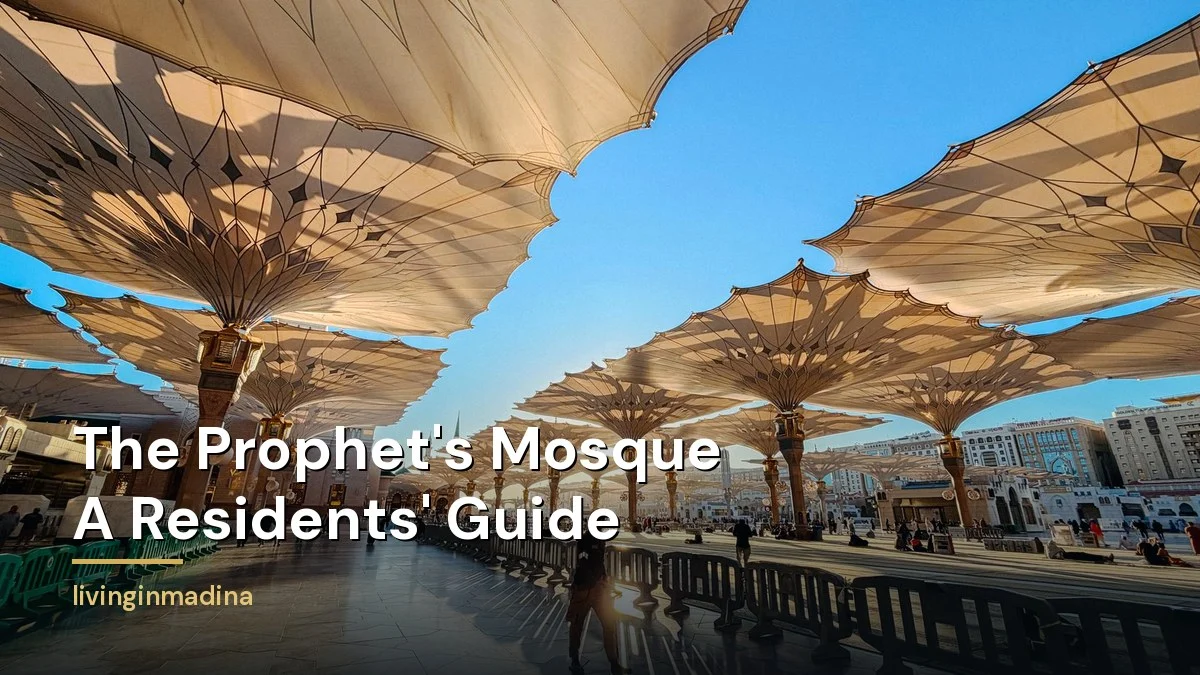
The courtyards have 262 giant umbrellas, which open early in the day for shade and close in the evening. 21 service complexes around the courtyards hold restrooms, wudu areas and underground parking. They’re numbered from 200 upwards, with codes such as 3A or 3B.
Parking
The guide lists 24 parking units, about 184 cars each, with entrances on all four sides. Fees in the guide are SAR 1 an hour for the first two hours, SAR 2 an hour from the third to the eighth hour, and SAR 3 an hour after that, subject to change. You can pay with the Mawgif app. On Fridays and in peak seasons, consider leaving the car. See our Friday prayer and parking guide.
Al-Baqi
Al-Baqi, the cemetery of Madinah since the Prophet’s time, lies south-east of the mosque. The guide notes that many Companions and some of the Mothers of the Believers are buried there, and that the Prophet ﷺ often visited and prayed for its people. Visit respectfully and follow the staff and posted rules.
Key numbers from the guide
| Number | For |
|---|---|
| 911 | Emergencies and security |
| 937 | Medical advice and health inquiries |
| 1966 | Inquiries and complaints (within the Kingdom) |
A resident’s rhythm
Living in Madinah, you’ll find your own pattern: a favourite gate, a regular spot, the prayers you never miss there. In Ramadan and the Hajj season, the mosque belongs to its guests as much as to you. Plan around the crowds using our Masjid an-Nabawi crowd calendar for Hajj 2027.
Related reading
- Masjid an-Nabawi gates guide
- Rawdah permit through Nusuk
- Visiting the Prophet’s Mosque for the first time (madinamakkah.com)
General information from the Ministry of Hajj and Umrah’s services guide. Locations, times and fees can change, so follow signs and staff on site.
Sources
- Ministry of Hajj and Umrah, Prophet’s Mosque Services Guide (sermon translation, Qurans, circles, Rawdah, visiting the grave, Zamzam, library, health centres, women’s guide, disability services, lost persons and children, service complexes, Children’s Hospitality Center, gates, umbrellas, Al-Baqi, parking, phone numbers): https://haj.gov.sa/-/media/Project/HAJJ/PDF-and-FILES/Awareness-Guides/Masjid-Nabawi-Services-Guide/English/EN-masjid-nabawi-services-Guide.pdf
- Saudi Press Agency, Rawdah hours and Nusuk permit (5 Dec 2025): https://spa.gov.sa/en/N2459265
- Sahih al-Bukhari 1189, 1190, 1196; Sahih Muslim 1391, 1394 (sunnah.com)