Category: Living Tips

Quick answer
Practical tips for daily life in Madinah: groceries and markets, weather through the year, Ramadan and Taraweeh, apps every resident uses, museums and weekend trips. Each tip links the official source behind it.

Key takeaways

Weather forecasts and warnings come from the National Center for Meteorology.

Tawakkalna and Absher cover most everyday government services.

Check current prices in shops and apps rather than relying on old figures.

Start with these guides

Taking Dates Home From Madinah: Packing, Customs and What to Check First

Taking dates home from Madinah? How to buy packed, labelled dates, pack them for a flight, what Saudi customs says about personal luggage and what to check.

Finding Trusted Local Services Near Where You Live in Madinah

Before you hire local services in Madinah, check licences on official platforms: commercial registration, Balady, Musaned, REGA brokers and SCFHS.

Weekend Trips From Madinah: Yanbu, AlUla and Nearby Escapes

Weekend trips from Madinah: Yanbu on the Red Sea and AlUla’s heritage landscapes, how to plan the drive, bookings, weather checks and road safety tips.

The Prophet’s Biography Museum in Madinah: A Resident’s Visiting Guide

Just south of the Prophet’s Mosque, the Prophet’s Biography Museum in Madinah tells the story of the Prophet Muhammad ﷺ and Islamic civilization with interactive screens, panoramas and 3D models. Its full name is the International Fair and Museum of the Prophet’s Biography and Islamic Civilization, and it is overseen by the Muslim World League.

More guides in this section

Visiting the King Fahd Quran Printing Complex in Madinah: A Resident’s Guide

Living in Madinah puts one of the most remarkable places in the Muslim world within easy reach: the King Fahd Quran Printing Complex, officially the King Fahd Glorious Quran Printing Complex. It runs a daily visits program, so residents can see how copies of the Quran are printed, checked and sent around the world.

How Much Salary Do You Need to Live in Madinah?

How much salary do you need to live in Madinah? A step-by-step way to work it out from real costs, what to check in a job offer and benefits to count.

Cost of Living in Medina 2026: How to Check Budgets for Singles, Couples and Families

Cost of living in Medina 2026: how to check a realistic budget for singles, couples and families, using official price data and quotes for your own home.

Taraweeh and Iftar at the Prophet’s Mosque: A Resident’s Practical Guide to Medina

Praying Taraweeh at the Prophet’s Mosque is a highlight of Ramadan for Medina residents. Doing it every night, or with children and elderly parents, takes some planning. The mosque, its courtyards and the roads around them fill quickly after iftar. This is a practical guide to getting there, getting in and getting home.

Further reading in this section

Ramadan in Madinah for Residents: The Complete Guide

Ramadan in Madinah is one of the most moving experiences a resident can have. It’s also the month when the city’s routine turns upside down: offices open later, roads empty at noon and fill after iftar, and the area around the Prophet’s Mosque welcomes worshippers from across the world.

Madinah’s Weather Through the Year: A Resident’s Seasonal Planning Guide

Madinah’s climate shapes almost everything about daily life, from when families go out to how homes are cooled. Knowing the pattern helps you plan school runs, outings, visits to the Haram and even grocery trips.

Grocery and Market Tips for Daily Life in Madinah

Food shopping shapes family life more than most of us notice. In Madinah, a little planning goes a long way: the right time of day, a clear list and a habit of checking labels save money and keep food safe.

The Tawakkalna App for Madinah Residents: How to Register and What It Is For

The Tawakkalna app is Saudi Arabia’s national comprehensive app. Its official site says it brings government services, information, documents, and publications into one place for citizens, residents, and visitors (Tawakkalna official site). For a Madinah household, that can mean fewer apps to juggle and your documents ready on your phone.

Older guides in this section

Madinah Heat Safety: Everyday Tips for Residents and Families

Madinah heat safety is part of daily life for residents, whether you’re walking to the Prophet’s Mosque, doing the school run, or taking children to the park. This guide puts the Saudi Ministry of Health’s advice into a simple routine for families.

How to Use the Sehhaty App in Madinah: A Resident’s Guide

The Ministry of Health (MOH) health line and the Sehhaty app in Madinah (Medina) let you speak to a doctor or report a health service problem without leaving home. This guide explains what the MOH says each channel is for, so your family knows where to turn.

Madinah Dates for Residents: Ajwa and Other Varieties, the Central Dates Market, and How to Store Them

Dates are part of daily life in Madinah, from the plate offered to guests to the box you send to family abroad. For residents, the useful questions are practical ones: which varieties to know, where the main market is, and how to keep a good batch fresh.

A Calm Family Weekend in Madinah: Quba, Uhud and Practical Planning Tips

One of the quiet blessings of living in Madinah is that some of Islam’s most significant places are part of the everyday landscape. On a free weekend, many families combine worship, a little history and time outdoors. This guide suggests a gentle, child-friendly way to do that, built around Quba Mosque and Mount Uhud.

Official services to use

Official links

National Center for Meteorology: weather forecasts and warnings

Saudi Food and Drug Authority: food safety

Absher: residency, licence and family services

Sehhaty (Ministry of Health): appointments and health records

Check before you act
Rules, timetables and fees change. Always confirm details on the official page linked in each guide before you rely on them.

Explore the site

All latest guides

Home

Sources

https://www.ncm.gov.sa/en

https://www.sfda.gov.sa/en

https://www.absher.sa/wps/wcm/connect/individuals/contents/individuals/about+absher_en

https://www.moh.gov.sa/en/eservices/sehhaty/pages/default.aspx

  • Hajj Season 2027 in Madinah: The Complete Residents’ Guide

    Hajj Season 2027 in Madinah: The Complete Residents’ Guide

    By Dr. Malik Sherjeel Awan, PsyD · Last checked 15 November 2026 · Check official announcements before you plan

    The Hajj rites happen in Makkah, but Madinah feels Hajj season too. Many pilgrims visit the Prophet’s Mosque before or after Hajj, so the city fills up in waves, and residents’ routines shift with them. This guide helps you plan for Hajj 2027, whether you’re staying home, hosting, working or going on Hajj yourself.

    Key dates (expected)

    On the Umm al-Qura calendar, Hajj 1448 is expected on:

    • Day of Arafah: Saturday 15 May 2027
    • Eid al-Adha: Sunday 16 May 2027
    • Hajj days: 14–19 May 2027

    All dates are subject to moon sighting and may move by a day.

    The pilgrim waves

    Pilgrim groups arrive in Madinah in two waves: some come before Hajj and travel on to Makkah, and others come after Hajj before flying home. Exact dates depend on each country’s flight schedules and each group’s itinerary, so there’s no single official “crowd calendar”. As a rough guide, expect busier weeks in the run-up to Hajj and again after Eid.

    What residents usually notice:

    • Masjid an-Nabawi is fuller, especially at Maghrib, Isha and Fajr, and on Fridays.
    • Hotels and roads in the central area are busier, with more buses around the Haram.
    • Shops and restaurants near the mosque are crowded at prayer times.

    Praying at the Prophet’s Mosque

    Rawdah visits

    Visits to the Rawdah are booked through Nusuk, and slots are in high demand in pilgrim season. Book well in advance and arrive on time. Our Rawdah permit guide for Madinah residents explains how it works.

    Hosting guests during Hajj season

    Madinah is often where families from abroad meet their relatives in the Kingdom. Know the rules before you plan:

    • Madinah and Makkah are treated differently. In 1447, the Ministry of Interior’s restrictions applied to entering or staying in Makkah and the holy sites. From 1 Dhu al-Qa’dah, holders of every visa type except Hajj visas couldn’t enter or stay in Makkah.
    • Visit visas don’t permit Hajj. For 1447, the Ministry of Interior announced fines of up to SAR 20,000 for visit-visa holders who tried, and deportation with a 10-year ban for residents caught performing Hajj illegally.
    • If relatives come on a visit visa, plan a Madinah-based stay, or a Makkah visit outside the restricted period.

    See Hosting visiting parents in Madinah.

    Going on Hajj from Madinah

    Residents register through Nusuk like everyone else in the Kingdom. See How Madinah Residents Register for Hajj 1448 on Nusuk. For the journey itself (miqat at Dhul Hulayfah, transport and timing), see Travelling From Madinah to Makkah for Hajj.

    Getting around

    • Expect heavier traffic around the Haram, the airport and the train station during arrival and departure waves.
    • The Haramain High Speed Railway carries large numbers of pilgrims in the season. SPA reported more than 1.16 million passengers during the Hajj 1447 season. Book early if you need to travel. See Haramain train from Madinah: tickets and timings.
    • Airport runs take longer, so leave extra time.

    Heat

    May and June in Madinah are hot. Carry water, avoid midday walks, and check on older neighbours. Our Madinah heat safety guide has practical tips, and the Ministry of Health’s pilgrims’ health page has heat advice that applies to residents too. In an emergency, call 911.

    Worship at home: the first ten days

    You don’t need to be on Hajj to share in the season. The Prophet ﷺ said no good deeds are better than those done in the first ten days of Dhu al-Hijjah (Sahih al-Bukhari 969). He also said he hoped fasting on the Day of Arafah would expiate the sins of the year before and the year after (Sahih Muslim 1162). Rulings on the Eid sacrifice differ between schools, so consult a scholar for your situation.

    Work and school

    • Eid al-Adha holidays are announced by the relevant ministries. Follow official announcements and your employer’s notices.
    • Seasonal work in hospitality and pilgrim services picks up. Use official job channels only.
    • School holidays: Plan childcare and family time around the official school calendar.

    Your own wellbeing

    As a psychologist, I often hear Madinah residents describe Hajj season as both beautiful and tiring. The city’s mood is uplifting, but crowds, noise and longer journeys add up. Plan a few quiet evenings, keep children’s sleep routines steady, and don’t feel guilty about praying locally on the busiest nights. Welcoming guests and looking after yourself can go together.

    Residents’ checklist

    1. Note the expected dates and watch for official announcements.
    2. Book Rawdah slots and train tickets early.
    3. Brief visiting relatives on visa rules before they book.
    4. Decide whether you’ll register for Hajj on Nusuk.
    5. Plan Eid: childcare, the sacrifice, and family visits.
    6. Prepare for the heat.

    FAQ

    Are there entry restrictions on Madinah during Hajj season? The 1447 restrictions announced by the Ministry of Interior applied to Makkah and the holy sites. Check the 1448 announcements.

    When is Masjid an-Nabawi busiest? Around the pilgrim arrival and departure waves before and after Hajj, and on Fridays. Exact dates depend on group schedules.

    Can my visiting parents perform Hajj with me? Not on a visit visa. Hajj needs a Hajj permit or Hajj visa.

    Related reading

    General information only. Rules change every season. Check official announcements, and consult a scholar on religious rulings.

    Sources

    • Umm al-Qura Dhu al-Hijjah 1448 calculated dates: aladhan.com
    • Ministry of Interior Hajj 1447 arrangements (Makkah entry restrictions, Umrah permit pause): pep.gov.sa
    • Saudi Press Agency, visit-visa holders barred from Makkah and holy sites (1447): spa.gov.sa
    • Ministry of Hajj and Umrah, domestic Hajj registration 1447: haj.gov.sa
    • Saudi Press Agency, Haramain High Speed Railway carried over 1.16 million passengers in Hajj 1447 season: spa.gov.sa
    • Saudi MOH pilgrims’ health page: moh.gov.sa
    • Hadith: Sahih al-Bukhari 969 (first ten days of Dhu al-Hijjah): sunnah.com
    • Hadith: Sahih Muslim 1162 (fasting the Day of Arafah): sunnah.com
  • Healthcare in Madinah: Sehhaty, Clinics and Hospitals

    Healthcare in Madinah: Sehhaty, Clinics and Hospitals

    By Dr. Malik Sherjeel Awan, PsyD · Checked on 16 November 2026 · Health services change, so check official MOH pages before you rely on them

    Please read this first. This page is about how to reach healthcare in Madinah. It is not medical advice, it doesn’t explain how to treat any condition, and it doesn’t replace emergency services, your doctor or Ministry of Health instructions. In an emergency, call 911.

    New residents in Madinah often ask the same questions: who do I call, which app do I use, and where’s the nearest hospital? This guide gives you a simple order to follow, from emergencies to routine care, and links to our detailed guides on Sehhaty and children’s vaccinations.

    If it is an emergency

    If someone may be in danger, for example they’ve collapsed, are struggling to breathe or have been badly hurt:

    1. Call 911. As checked on 16 November 2026, the General Directorate of Civil Defense says to call 911 in the Madinah region (as well as Makkah, Riyadh and the Eastern region). It’s the one number to remember.
    2. Or go to the nearest hospital emergency department, if that’s faster and safe.
    3. Follow the operator’s instructions.

    Save 911 in every family member’s phone, and make sure anyone who helps in your home knows it too. Our sister site’s Makkah emergency numbers guide explains how the official numbers work. The numbers are national, though the hospitals listed there are Makkah’s.

    If it is not an emergency: 937 and Sehhaty

    For health questions that aren’t emergencies, start with the Ministry of Health:

    • Call 937. As checked on 15 November 2026, the MOH says its 937 service works 24/7, offers phone consultations with doctors, gives guidance in poisoning cases, and takes complaints and feedback. Dial 937 inside the Kingdom, or 00966920005937 from abroad.
    • Use Sehhaty for appointments, records and vaccinations (see below).

    In short:

    • Life-threatening → 911 or the nearest emergency department.
    • Unsure, or need advice → 937.
    • Routine care, appointments, vaccinations → Sehhaty or a licensed clinic.

    Using Sehhaty as a Madinah resident (and booking child vaccinations)

    Sehhaty is the Ministry of Health’s app. The MOH lists it as an official channel, and its services (checked on 15 November 2026) include:

    • appointments at government health centres,
    • medical reports and your health record,
    • dependents, to manage your family members,
    • vaccinations,
    • prescriptions and sick leave documents.

    Download it only from the official app stores and sign in as the app prompts, using your iqama details. Our step-by-step guide, how to use the Sehhaty app in Madinah, walks you through setup. InfoSaudia’s Sehhaty guide for residents covers the kingdom-wide features.

    For children’s vaccinations, Sehhaty lets you see your children’s records and book appointments at a health centre. Our guide to booking child vaccinations on Sehhaty in Madinah explains the steps. The schedule itself is set by the Ministry of Health, so follow what Sehhaty and your health centre tell you.

    Set Sehhaty up in your first month, alongside your National Address. It’s one of the steps in our first-month checklist.

    Government hospitals and the Madinah Health Cluster

    Public hospitals and primary health centres in Madinah are run under the Madinah Health Cluster, under the Ministry of Health.

    We only name facilities we can find in official sources. The Ministry of Health’s list of hospitals serving pilgrims in Madinah includes, among others:

    • King Fahad General Hospital (the airport’s official taxi list places it in the Al Naseem district),
    • Uhud (Ohud) General Hospital (placed by the airport list in the Al Aziziyah area),
    • Al-Miqat Hospital and Madinah General Hospital,
    • the Women’s, Maternity and Children Hospital and the Cardiac Centre.

    Facilities and services change over time, so before you go, confirm the current location and contact details on the Ministry of Health’s interactive map of health facilities. We don’t publish hospital phone numbers here because we couldn’t confirm them on an official page.

    We also don’t rank hospitals or recommend one for a particular condition. That’s for you and your doctor to decide, based on your needs and your insurance.

    Finding a licensed clinic or pharmacy, including near the Prophet’s Mosque

    For day-to-day care, many residents use private clinics and pharmacies through their insurance:

    • Choose licensed clinics and pharmacies (licensed by the Ministry of Health).
    • Check your insurance network before you book.
    • Keep receipts and reports for claims and follow-up.

    If you’re at the Prophet’s Mosque and someone needs help, tell the mosque staff straight away, and call 911 if it’s an emergency. Our businesses directory lists everyday services in the city, which can help you find pharmacies and clinics near you. Always confirm a clinic’s licence and opening hours directly.

    If you have a complaint about a health service, the MOH accepts complaints through 937 and by email at 937@moh.gov.sa.

    When you visit a clinic for the first time, ask at reception what they need from you (iqama, insurance card, any referral) and whether your insurer needs to approve the visit in advance. Clinics and insurers handle this differently, so it’s worth asking before the appointment rather than at the payment desk.

    Insurance, iqama and what to take with you

    • If you work in the private sector, the Council of Health Insurance (CHI) says your employer must provide health insurance for you as a non-Saudi employee and for your eligible dependents (checked on 15 November 2026). Ask HR for your card, the policy’s provider network and what’s covered.
    • If a family member isn’t covered by your employer’s policy, ask your insurer or CHI what applies to them.
    • If relatives visit on a visit visa, check the insurance that comes with their visa before they travel.

    Planning ahead as a family. A little preparation in your first weeks makes any later visit much calmer:

    • add every family member as a dependent in Sehhaty,
    • note your nearest government health centre and how to get there,
    • check which clinics and hospitals are in your insurance network,
    • save 911 and 937 in everyone’s phone, including older children’s,
    • keep a short written note of each person’s regular medicines and allergies, agreed with your doctor.

    Take these to any appointment, for each family member:

    • iqama (or passport and visa for visitors),
    • insurance card,
    • a list of current medicines and allergies, checked with your doctor,
    • any recent reports or test results.

    Visitors and pilgrims (brief)

    • In an emergency, call 911.
    • The 937 line serves pilgrims too. The MOH says it takes calls in several languages and, in the Hajj season, helps search for pilgrims admitted to hospital.
    • Check the MOH’s pilgrims’ health pages on moh.gov.sa before and during the trip.

    Crowds, access around the Prophet’s Mosque and hospital workloads all change in Ramadan and the Hajj season. Our Hajj season guide for Madinah residents explains what to expect. If you’re hosting pilgrims, point them to our sister site’s Madinah visit guide.

    A word on mental health

    As a clinical psychologist, I see how much pressure a move puts on families: new paperwork, new schools, and a health system you don’t know yet. If you or someone at home feels persistently anxious, low or unable to cope, please treat it as seriously as a physical symptom. Book with a licensed doctor through Sehhaty or your insurance, or call 937 to ask where to go. Asking early is the sensible thing to do.

    FAQs

    Which hospitals are in Madinah? Ministry of Health material names public hospitals including King Fahad Hospital, Ohud Hospital and the Maternity and Children Hospital. Facilities change, so check the current list on the MOH facilities map or the Madinah Health Cluster’s official page.

    Is there a hospital near the Prophet’s Mosque? If you’re at the mosque, tell the staff straight away, and in an emergency call 911. For hospitals, check the MOH facilities map for the facility closest to where you are. We don’t publish a “nearest hospital” claim we can’t verify.

    How do I contact King Fahad General Hospital or Uhud General Hospital? Use the contact details on the Ministry of Health’s interactive map or website, or call 937 for help. We haven’t listed phone numbers because we couldn’t confirm current ones on an official page.

    How do I use Sehhaty in Madinah? Download the official Sehhaty app, sign in with your iqama details and add your dependents. See our Sehhaty guide for Madinah.

    How are child vaccinations booked? Through Sehhaty, at a government health centre. Our child vaccinations guide has the steps.

    What number do I call in an emergency? 911. As checked on 16 November 2026, Civil Defense lists 911 for the Madinah region.


    This page explains how to access healthcare services in Madinah. It is not medical advice and does not replace emergency services, your doctor or official Ministry of Health guidance. Checked on 15 November 2026.

    Sources

    • General Directorate of Civil Defense (8 Oct 2025): 998.gov.sa
    • Ministry of Health, 937 Services (24/7; consultations through doctors; poisoning advice; complaints): moh.gov.sa
    • Ministry of Health, Contact Us (937 inside the Kingdom; 00966920005937 from outside; 937@moh.gov.sa): moh.gov.sa
    • Ministry of Health, 937 channels guide (09 May 2025): moh.gov.sa
    • Ministry of Health news (9 Nov 2017), Madinah Health Affairs hospitals named: moh.gov.sa
    • Prince Mohammad bin Abdulaziz International Airport taxi page (King Fahad Hospital / Al Naseem District and Ohud Hospital / Al Aziziyah used as official destination labels): madinahairport.com
    • Council of Health Insurance: chi.gov.sa
    • Ministry of Health, 937 Call Center Services for Pilgrims: moh.gov.sa
    • Ministry of Health, hospitals serving pilgrims in Makkah, Madinah and Jeddah (Arabic list, 2022): moh.gov.sa
    • Ministry of Health, interactive maps of health facilities: moh.gov.sa
  • Apps Every Madinah Resident Should Install (Beyond Absher and Tawakkalna)

    Apps Every Madinah Resident Should Install (Beyond Absher and Tawakkalna)

    Most new residents install Absher and Tawakkalna in their first week. Then a few weeks later they find they also need an app to pay for parking, another to book the Rawdah and another to see a doctor.

    This list gathers the apps that come up again and again in Madinah daily life, with what each one is for, as of 31 Oct 2026. Install them from the official app stores and check the developer name before you download.

    Quick answer

    Short answer: Beyond Absher and Tawakkalna, most Madinah residents use Nafath (secure login), Sehhaty (health centre appointments), Nusuk (Rawdah visits), Mawgif (parking at the Prophet’s Mosque), the Madinah Bus app (routes and stations) and a National Address account. Ejar matters when you rent, and the National Center for Meteorology posts weather warnings.

    Start with the two you already have

    If you’re new, set these up first, because several other apps rely on them.

    Sehhaty, for example, needs an Absher account, and Tawakkalna sends its sign-up code to the mobile number registered in Absher.

    The apps for daily life in Madinah

    Key takeaways

    • Nafath: secure national login. The Tawakkalna site lists Nafath as one way to sign in.
    • Sehhaty: book, change or cancel appointments at primary healthcare centres (Ministry of Health)
    • Nusuk: book a Rawdah visit at the Prophet’s Mosque, and use the fast track when you are close by
    • Mawgif: pay for parking at the Prophet’s Mosque car parks from your phone
    • Madinah Bus app: station locations and routes for the city buses
    • National Address: your official short address from Saudi Post (SPL)

    Nafath

    Many government apps let you sign in with Nafath instead of a password. The Tawakkalna site, for example, lets you log in with your ID number and a Nafath code. Set it up once and keep it on your main phone.

    Health and the Rawdah: Sehhaty and Nusuk

    Sehhaty

    The Ministry of Health’s page says Sehhaty lets you book, change and cancel appointments at primary healthcare centres. You can find the nearest centre, add your dependents to the same centre and book for them too. The ministry lists the service as free, and you need an Absher account. Our child vaccinations guide shows one common use.

    Nusuk

    For residents, Nusuk is mainly the Rawdah app. Its Rawdah page says you can book once a year through the main booking service, and the fast track releases new slots every 20 minutes for visitors near the mosque. You can add up to four companions to a booking, as long as they accept from their own Nusuk accounts.

    The same page mentions an Explore service that lists services, markets and restaurants in Madinah. Our Rawdah permit guide covers the booking screens.

    Getting around: Mawgif and the Madinah Bus app

    Mawgif

    The ministry’s Prophet’s Mosque services guide says you can download the Mawgif app to pay for parking in the mosque’s car parks without using the payment machines. It saves time on busy Fridays.

    Madinah Bus app

    The ministry’s Madinah guide says the city buses link key places in Madinah and tells visitors to download the bus app to see station locations and routes. Our transport guide explains how the buses fit with the train station and airport.

    Set up in this order

    1

    Absher: register first, because other apps rely on it.

    2

    Nafath: activate it for easy, secure logins.

    3

    Tawakkalna: sign in and check your digital documents.

    4

    National Address: register through Saudi Post so deliveries and official mail reach you.

    5

    Sehhaty: register yourself and your dependents.

    6

    Nusuk, Mawgif and the Madinah Bus app: add these when you start visiting the mosque and getting around the city.

    When you rent, and when the weather turns

    National Address. Saudi Post says your short address is 4 letters and 4 numbers, and that using it helps deliveries reach you without extra calls. Our first month in Madinah checklist explains when to register.

    Ejar. If you rent, our housing checklist explains where Ejar fits and what to check before you sign.

    Weather warnings. The National Center for Meteorology’s website has an Early Warnings section for dust and rain. Our Madinah weather by month page helps you plan around the heat.

    Tip

    Before you install, check the developer name in the app store. Official government apps are published by the relevant ministry or authority, and their app store pages link back to that body’s official website.

    FAQ

    Do I need Absher before other apps?

    For several of them, yes. The Ministry of Health says Sehhaty needs an Absher account, and Tawakkalna sends its sign-up code to your Absher-registered number.

    Which app books the Rawdah?

    Nusuk. It offers a yearly booking and a fast track for visitors near the Prophet’s Mosque.

    Can I pay for parking at the Prophet’s Mosque by app?

    Yes. The ministry’s services guide says you can pay through the Mawgif app instead of the machines.

    Last checked: 31 October 2026, from the Tawakkalna, Ministry of Health, Nusuk, Saudi Post and National Center for Meteorology websites and the Ministry of Hajj and Umrah guides. App features change, so check each app’s own help pages.

    From our sister guides: Nafath explained (Infosaudia); Absher services residents use most (Infosaudia); Booking an Umrah permit on Nusuk from Makkah (Living in Makkah).

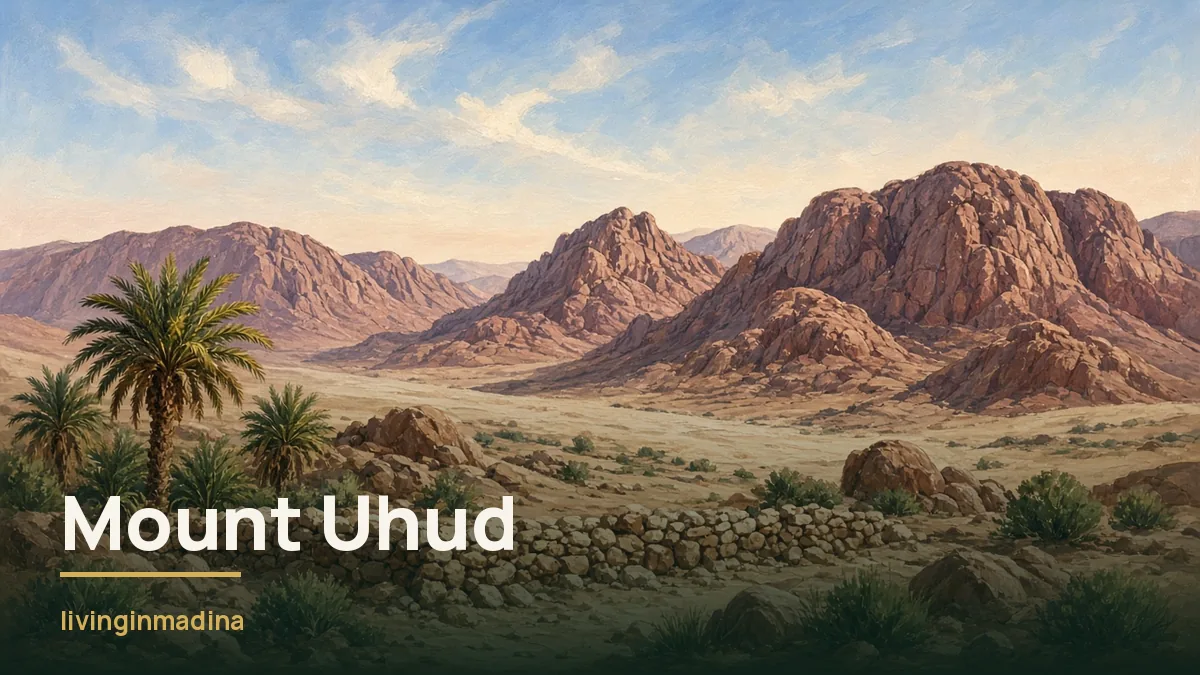
  • Mount Uhud: History and Visiting Etiquette for Madinah Residents

    Mount Uhud: History and Visiting Etiquette for Madinah Residents

    Mount Uhud’s long red ridge is part of daily life in Madinah. This guide gives the story in brief, from the Qur’an and authentic hadith, and explains how to visit calmly and respectfully, as of 31 Oct 2026.

    Quick answer

    Short answer: Mount Uhud lies about 4 km north of the Prophet’s Mosque, according to the Ministry of Hajj and Umrah’s Madinah guide. The Battle of Uhud was fought beside it, and 70 Companions were martyred there. The ministry says it is sunnah to greet the deceased and pray for them at the Martyrs’ Cemetery. Keep the visit to that: greet, make du’a, reflect, and leave.

    Where Mount Uhud is

    The ministry’s guide places Mount Uhud about 4 km north of the Prophet’s Mosque, with the Cemetery of the Uhud Martyrs about 5 km north. The guide says the mountain is named for its isolation, because it stands apart from the hills around it.

    Close by is a small hill known as the Mount of the Archers. The Visit Madinah platform describes it as a small mountain south of Uhud, with a wide view over the area.

    Key takeaways

    • Distance: about 4 km north of the Prophet’s Mosque (Ministry of Hajj and Umrah)
    • Martyrs’ Cemetery: about 5 km north of the Prophet’s Mosque
    • Martyrs: 70 Companions, according to the ministry’s guide
    • Archers’ Hill: a small hill beside Uhud where 50 archers were posted
    • Nearby mosque: Sayyid al-Shuhada Mosque, which Visit Madinah says opened in Rajab 1438 AH

    The battle in brief

    The Qur’an speaks about Uhud in Surah Al ‘Imran, in verses 121 to 175. The passage opens with this verse:

    وَإِذْ غَدَوْتَ مِنْ أَهْلِكَ تُبَوِّئُ ٱلْمُؤْمِنِينَ مَقَٰعِدَ لِلْقِتَالِ ۗ وَٱللَّهُ سَمِيعٌ عَلِيمٌ (Qur’an 3:121)

    Meaning (our own words): it recalls the morning the Prophet ﷺ left his household to set the believers in their positions for battle; Allah hears and knows all.

    The ministry’s guide tells the story simply. The Prophet ﷺ placed 50 archers on the small hill under Abdullah ibn Jubayr. When the battle first turned in the Muslims’ favour, some of the archers came down to gather the spoils. Khalid ibn al-Walid, who had not yet accepted Islam, then led his cavalry around and attacked.

    The Qur’an describes that turning point in verse 152:

    وَلَقَدْ صَدَقَكُمُ ٱللَّهُ وَعْدَهُۥٓ إِذْ تَحُسُّونَهُم بِإِذْنِهِۦ ۖ حَتَّىٰٓ إِذَا فَشِلْتُمْ وَتَنَٰزَعْتُمْ فِى ٱلْأَمْرِ وَعَصَيْتُم مِّنۢ بَعْدِ مَآ أَرَىٰكُم مَّا تُحِبُّونَ ۚ مِنكُم مَّن يُرِيدُ ٱلدُّنْيَا وَمِنكُم مَّن يُرِيدُ ٱلْءَاخِرَةَ ۚ ثُمَّ صَرَفَكُمْ عَنْهُمْ لِيَبْتَلِيَكُمْ ۖ وَلَقَدْ عَفَا عَنكُمْ ۗ وَٱللَّهُ ذُو فَضْلٍ عَلَى ٱلْمُؤْمِنِينَ (Qur’an 3:152)

    Meaning (our own words): Allah kept His promise while the believers were overcoming the enemy by His leave, until they lost heart, disputed over the command and disobeyed after being shown what they wished for. Some wanted this world and some the Hereafter. He then turned them back from the enemy to test them, and He has pardoned them; Allah is generous to the believers.

    The martyrs of Uhud

    Seventy Companions were martyred. The Visit Madinah platform names Hamza ibn Abd al-Muttalib, Mus’ab ibn Umayr, Abdullah ibn Jubayr and Hanzala among them. About the martyrs, the Qur’an says in verse 169:

    وَلَا تَحْسَبَنَّ ٱلَّذِينَ قُتِلُوا۟ فِى سَبِيلِ ٱللَّهِ أَمْوَٰتًۢا ۚ بَلْ أَحْيَآءٌ عِندَ رَبِّهِمْ يُرْزَقُونَ (Qur’an 3:169)

    Meaning (our own words): do not think those killed in the way of Allah are dead; they are alive with their Lord, receiving provision.

    For the fuller story, read the passage with a trusted tafsir or visit the Prophet’s Biography Museum.

    A mountain that loves us

    Anas ibn Malik reported that the Messenger of Allah ﷺ said: «إِنَّ أُحُدًا جَبَلٌ يُحِبُّنَا وَنُحِبُّهُ». In our own words: Uhud is a mountain that loves us, and we love it. (Sahih Muslim 1393; also Sahih al-Bukhari 4083)

    Visiting etiquette

    The ministry’s guide says it is sunnah for visitors to offer greetings and supplications for the deceased.

    1

    Come with the right intention. You are there to greet the martyrs, pray for them and reflect, as the guide describes.

    2

    Stand at the cemetery boundary and greet. Use the greeting the Prophet ﷺ taught (see below).

    3

    Make du’a for them and for all Muslims who have passed away. Keep it quiet and personal.

    4

    Reflect. Verse 152 speaks of obedience and not chasing worldly gain.

    5

    Leave the site as you found it. Don’t climb the walls or take stones away.

    The Prophet ﷺ taught his Companions this greeting for visiting graves (Sahih Muslim 975):

    السَّلاَمُ عَلَيْكُمْ أَهْلَ الدِّيَارِ مِنَ الْمُؤْمِنِينَ وَالْمُسْلِمِينَ وَإِنَّا إِنْ شَاءَ اللَّهُ لَلَاحِقُونَ أَسْأَلُ اللَّهَ لَنَا وَلَكُمُ الْعَافِيَةَ

    Meaning (our own words): Peace be upon you, people of these dwellings, believers and Muslims. We will, Allah willing, join you. I ask Allah for well-being for us and for you.

    A similar greeting, which includes asking Allah to have mercy on those of us who went before and those who come later, is in Sahih Muslim 974b. This is the same greeting taught for visiting any Muslim graves; it is not a special rite for Uhud.

    Note

    This page sticks to greeting, supplication and reflection. For any question about what is permitted at graves, ask a qualified scholar.

    Planning a visit with family

    Uhud is out in the open, with little shade. In the hot months, go early in the morning or after Asr, and carry water. Our Madinah heat safety guide and weather by month help you choose a good day.

    • Water and a hat or umbrella for each person
    • Comfortable shoes for uneven ground
    • A quiet word with guests beforehand about greeting and du’a only
    • Modest clothing, as you would wear to the mosque

    The Visit Madinah platform lists buses, the tourist bus, cars and taxis as ways to get there, and says the Sayyid al-Shuhada Mosque has parking.

    Bringing visitors? See hosting guests at the Prophet’s Mosque and our family weekend in Madinah.

    FAQ

    How far is Mount Uhud from Masjid an-Nabawi?

    The Ministry of Hajj and Umrah’s Madinah guide says about 4 km north, with the Martyrs’ Cemetery about 5 km north.

    What should I say when visiting the Uhud martyrs?

    Use the general greeting for any Muslim graves from Sahih Muslim 975. In our own words: “Peace be upon you, people of these dwellings, believers and Muslims. We will, Allah willing, join you. I ask Allah for well-being for us and for you.” Then make du’a for them. It is not a special rite for Uhud.

    Last checked: 16 November 2026, from the Ministry of Hajj and Umrah Madinah guide, the Qur’an and hadith sources linked above, and the Visit Madinah platform. Follow signs and staff on the day.

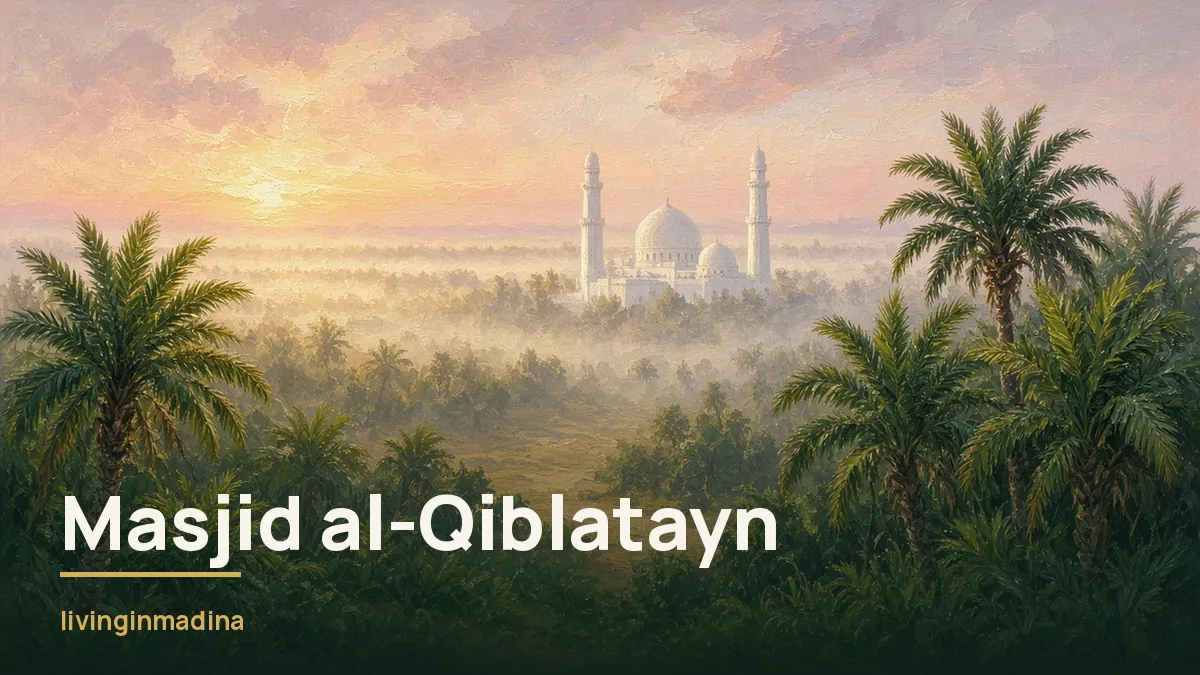
  • Masjid al-Qiblatayn: The Mosque of the Two Qiblas

    Masjid al-Qiblatayn: The Mosque of the Two Qiblas

    Ask a Madinah taxi driver for “al-Qiblatayn” and he will know exactly where to go. The name means “the two qiblas”, and it recalls the moment Muslims turned from facing Jerusalem to facing the Sacred Mosque in Makkah.

    For residents, it is also an easy and meaningful outing with family or guests. This guide covers the history as the official sources tell it, then the practical side of visiting.

    Quick answer

    Short answer: Masjid al-Qiblatayn is about 3.8 km north-west of the Prophet’s Mosque, according to Visit Saudi. It marks the place linked to the change of qibla in the second year after the Hijrah (624 CE), described in Surah al-Baqarah 2:144. The building today dates from a full rebuild in 1408 AH (1987 CE).

    The change of qibla in the Qur’an

    Surah al-Baqarah addresses the change of prayer direction in verses 142 to 144. Verse 144 reads, in the translation shown on quran.com:

    “Indeed, We see you ˹O Prophet˺ turning your face towards heaven. Now We will make you turn towards a direction ˹of prayer˺ that will please you. So turn your face towards the Sacred Mosque ˹in Mecca˺—wherever you are, turn your faces towards it. Those who were given the Scripture certainly know this to be the truth from their Lord. And Allah is never unaware of what they do.” (Qur’an 2:144, Dr Mustafa Khattab, The Clear Quran)

    Before this, Muslims in Madinah prayed facing Bayt al-Maqdis in Jerusalem. After it, the qibla became the Sacred Mosque in Makkah, as it is today.

    How the mosque got its name

    Visit Saudi says the Prophet ﷺ was visiting the tribe of Banu Salamah and leading them in the Dhuhr prayer facing Jerusalem. After two rak’ahs, the command came, and he turned towards the Kaaba with his companions following. From then on, the mosque was known as the Mosque of the Two Qiblas.

    A note on the accounts

    Classical sources tell this event in more than one way, with some differences in detail, such as which prayer it was. We give Visit Saudi’s account here. For the different narrations and what they mean, please ask a qualified scholar.

    The building through the centuries

    Visit Saudi says the original structure dates back to the time of the Prophet ﷺ and has been restored many times since.

    Restorations and rebuilds (Visit Saudi)

    1

    893 AH: the roof was restored by Shahin Al-Jamali.

    2

    950 AH: the roof was restored again.

    3

    King Abdulaziz Al Saud: ordered a renovation and expansion, adding a minaret and a staircase.

    4

    1408 AH (1987 CE): under King Fahd bin Abdulaziz, the mosque was completely rebuilt and expanded, keeping its Islamic character.

    What the mosque looks like today

    Today’s mosque is known for its twin domes and two minarets. Visit Saudi gives these figures:

    Masjid al-Qiblatayn in numbers (Visit Saudi)

    4,000 m²

    total area, approximately

    1,250 m²

    main prayer hall

    400 m²

    women’s prayer gallery

    The ground level holds ablution areas and storage, plus homes for the imam and muezzin. The main level is the prayer hall, and the women’s gallery is on the upper level. The two main domes reach 20 m and 17 m, with smaller domes at 12 m, and a central courtyard with greenery brings in light.

    Visiting as a resident

    Al-Qiblatayn is a working mosque, so plan your visit around the prayers rather than in the middle of one. We have not found official opening hours for visitors, so the safest plan is to arrive a little before a prayer time and stay for it.

    Before you go

    • Where: south of the Well of Rumah, about 3.8 km north-west of the Prophet’s Mosque (Visit Saudi).
    • By bus: the Madinah Bus FAQ lists Masjid al-Qiblatayn among its destinations. There is no cash payment on board, so pay by card or in the app.
    • Women: the women’s prayer gallery is on the upper level.
    • Dress and manners: the same as any mosque. Our guide to hosting guests at the Prophet’s Mosque has tips for groups.

    Tip

    Pair al-Qiblatayn with a short history outing on the same morning. Our family weekend plan for Quba and Uhud keeps the walking light, and the Prophet’s Biography Museum suits curious children.

    Taking children and older guests

    The mosque is compact compared with the Prophet’s Mosque, which makes it easier for grandparents and small children. Go in the cooler hours for much of the year; our heat safety guide explains when to stay indoors.

    Use the visit to tell children the story simply: where Muslims faced before, and where we face now. Keep it to what the Qur’an says, and leave questions of rulings to scholars.

    FAQ

    Why is it called Masjid al-Qiblatayn?

    It means “the mosque of the two qiblas”. It is linked to the change of prayer direction from Jerusalem to the Sacred Mosque in Makkah (Qur’an 2:144).

    How far is Masjid al-Qiblatayn from Masjid an-Nabawi?

    Visit Saudi says about 3.8 km north-west of the Prophet’s Mosque.

    Is the building original?

    No. Visit Saudi says it was completely rebuilt and expanded in 1408 AH (1987 CE), after several earlier restorations.

    Last checked: 30 October 2026, from Quran.com, Visit Saudi and the Madinah Bus FAQ. Bus routes can change, so check the Madinah Bus app before you travel.

  • Taking Dates Home From Madinah: Packing, Customs and What to Check First

    Taking Dates Home From Madinah: Packing, Customs and What to Check First

    Hardly anyone leaves Madinah without dates. Residents send them to family abroad, and visitors fill a spare bag before flying home. A box of dates is easy to buy. Getting it home in good condition, without trouble at either airport, takes a little planning.

    This guide covers the practical side: what to buy, how to pack it and what Saudi customs says about personal luggage. It also covers the checks that only your airline and your destination country can answer.

    Quick answer

    Short answer: Buy sealed, labelled boxes, keep your receipt and pack the dates in your checked bag, cushioned well. Saudi customs (ZATCA) treats personal luggage and gifts as non-commercial when they’re for personal use. Travellers must disclose luggage or gifts in commercial quantities, beyond personal use, valued above SAR 3,000 (ZATCA, checked 24 Oct 2026). Your destination country’s food import rules and your airline’s baggage allowance decide the rest, so check both before you buy in bulk.

    Step 1: buy dates that travel well

    Sealed, factory-packed boxes travel better than loose dates in a bag. They’re cleaner, they’re less likely to leak syrup or pick up odours, and a printed label tells customs officers abroad what’s inside. Many countries ask travellers to declare food, and a labelled box makes that conversation simple.

    When you buy, look for a clear product name, a packing or expiry date, and the producer’s details on the box. The Saudi Food and Drug Authority (SFDA) sets the rules for food labelling and safety in the Kingdom. Its regulations page is a good reference if you want to know what a compliant label should show. For choosing the dates themselves, see our Madinah dates and central market guide.

    At a glance

    • Buy: sealed, labelled boxes, and keep the receipt.
    • Pack: checked bag, cushioned, away from heavy items.
    • Saudi customs rule: personal, non-commercial quantities are fine; commercial quantities valued above the SAR 3,000 disclosure threshold must be disclosed (ZATCA guidelines, accessed 30 Oct 2026).
    • Check before buying in bulk: your airline’s allowance and your destination’s food rules.

    Step 2: what Saudi customs says

    The Zakat, Tax and Customs Authority (ZATCA) explains how it treats travellers’ personal luggage and gifts. The exemption applies when the goods have no commercial traits. That means they’re for personal use, in non-commercial quantities, and not on the prohibited or restricted lists. ZATCA also says travellers should carry supporting documents such as receipts, along with a passport, national ID or iqama.

    ZATCA’s disclosure guidance applies to travellers using air, land and sea ports. It lists, among other things, luggage or gifts in commercial quantities, or samples beyond personal use, valued above SAR 3,000 or its equivalent: a disclosure rule, not a fee (ZATCA guidelines, accessed 30 Oct 2026). ZATCA warns that failing to disclose something that should be declared can lead to penalties. Its declaration page explains that you can complete many declarations electronically, through its app or website.

    In practice, a few boxes for family and friends is usually treated as personal use. If you’re carrying an unusually large amount, or dates meant for resale, read ZATCA’s pages first and declare where required.

    Step 3: pack them properly

    Packing dates for a flight

    1

    Keep boxes sealed until you arrive. Don’t repack loose dates into plastic bags.

    2

    Cushion them with clothes in your checked bag, so the boxes don’t crush or split.

    3

    Put the receipt in your hand luggage, where you can reach it.

    4

    Weigh your bag at home, because dates are heavier than they look.

    5

    Keep heavy items apart, so nothing sits on top of the boxes.

    Step 4: the checks only you can make

    Two rules depend on where you’re flying, and they change. Your airline sets your baggage allowance, so check it on your booking before you buy in bulk. Your destination country sets its own rules on bringing in food, and some ask travellers to declare all food items on arrival. Check that country’s official customs or agriculture website before you travel, and declare the dates if you’re asked to.

    Warning

    Don’t rely on what friends were allowed to bring last year. Airline allowances and food import rules change, and they differ between countries and even between airports.

    Sending dates instead of carrying them

    If your bag is already full, you can post or courier the dates. Ask the carrier what paperwork it needs for food, since the destination country’s import rules still apply. Sealed, labelled boxes and a receipt make the parcel easier to clear.

    Before you leave Madinah

    • Sealed, labelled boxes, with the receipt kept.
    • Quantity within personal use. If it’s large, you’ve checked ZATCA’s disclosure rules.
    • Airline baggage allowance checked.
    • Destination country’s food import rules checked.
    • Boxes packed and cushioned in your checked bag.

    Can you carry dates in hand luggage?

    Usually, yes. Whole dates are a solid food, and airport security normally treats them like any other packed snack. Things like date syrup, date paste or soft date spreads may count as liquids or gels, so they can fall under the cabin liquid limits. Pack those in your checked bag.

    Hand luggage works well for one or two small sealed boxes you want to keep safe. For larger amounts, a checked bag is easier, as long as the boxes are cushioned. Either way, your airline and departure airport have the final say on cabin items, and your destination country decides what food you can bring in. Some countries ask you to declare all food on arrival, so keep the boxes sealed and labelled.

    Still choosing what to buy? Our Madinah Central Dates Market guide covers where to buy, the market’s timings and how to tell the varieties apart.

    Sources and last checked

    Last checked 20 November 2026 against ZATCA’s pages on travellers’ luggage, disclosure and declaration, and the SFDA regulations page. Rules can change, so check them again before you travel. Related on this site: How to spot good Ajwa dates before you buy in Madinah.

  • Finding Trusted Local Services Near Where You Live in Madinah

    Finding Trusted Local Services Near Where You Live in Madinah

    Sooner or later every household needs help: an air-conditioning repair, a delivery from an online shop, a property broker, a home helper or a clinic. In Madinah, as across the Kingdom, most of these providers must be registered with an official body. This guide shows how to check local services in Madinah yourself, using free government platforms, before you pay or sign anything.

    Quick answer

    Short answer: Ask any provider for their licence or registration number, then check it on the official platform for that sector: the Ministry of Commerce for commercial registration, Balady for a shop’s municipal licence, Musaned for domestic-worker recruitment, REGA for property brokers and SCFHS for health practitioners. Report problems only through official channels.

    Key takeaways

    • Company check: look up the commercial registration on the Ministry of Commerce’s official website.
    • Shop licence: Balady’s inquiry shows a commercial activity licence’s status and expiry (Balady).
    • Domestic workers: Musaned lists licensed recruitment offices (Musaned).
    • Complaints: use the Ministry of Commerce’s Balagh Tijari app for commercial issues, and Balady’s reporting service for municipal issues.

    Why checking local services in Madinah matters

    A licence or registration number tells you that a provider is known to the authorities, and it gives you a clear route if something goes wrong. It also protects you from paying cash to someone you can’t trace later.

    The check usually takes a minute or two on your phone. Make it a habit before any job that involves your home, your money, your family’s health or a contract you’ll sign.

    Match the provider to the right platform

    Each sector has its own official register. The table below is a quick map. Use it with the steps further down.

    Provider typeWhere to checkWhat you’ll see
    Any registered businessMinistry of Commerce CR inquiry (official MC website)Registration data and status
    Shop or workshop premisesBalady licence inquiryMunicipal licence status and expiry
    Online storeE-commerce authenticationWhether the store is authenticated
    Domestic-worker recruitmentMusanedLicensed recruitment offices
    Property brokerREGA broker inquiryBroker licence details
    Which official platform to check

    Home repairs, workshops and shops

    For a maintenance company, cleaning service or workshop, ask for the commercial registration (CR) number. The Ministry of Commerce’s inquiry service returns the registration details, so you can see that the name on the invoice matches a real, active business.

    If the provider works from a shop or workshop, Balady’s commercial activity licence inquiry shows the municipality, licence status and expiry date.

    Tip

    Ask for a written quote that shows the business name and CR number. It makes the online check easy and gives you a record if you need to complain later.

    Online shops and home delivery

    Many Madinah families buy online, often from stores they first meet on social media. That convenience is real, but so is the risk of paying someone you can’t trace.

    Before paying a store you found on social media, look for its official registration details and confirm them on the Ministry of Commerce’s own website. Pay through the store’s own checkout, not by a direct bank transfer to a personal account.

    Home helpers and drivers

    If your family plans to hire a domestic worker, use Musaned, the official platform for recruitment. It lists licensed recruitment offices and supports electronic contracts, according to the official Musaned platform, run under the Ministry of Human Resources and Social Development.

    Avoid informal “agents” who offer workers outside the official system. If anything is unclear, ask through Musaned’s own channels.

    Warning

    Report a commercial violation only through the Ministry of Commerce’s official Balagh Tijari app. Ignore look-alike “complaint” pages that ask for card or ID details.

    Property brokers and health practitioners

    Looking for a home through a broker? REGA’s real estate broker inquiry lets you check a broker’s licence before you deal with them. Once you have the keys, our first-month checklist covers the next steps.

    For health care, the Saudi Commission for Health Specialties offers a free, instant check of a practitioner’s registration validity by ID, Iqama, passport or SCFHS file number (SCFHS). Most families will simply use licensed clinics and their insurance network.

    Check any provider in four steps

    1

    Ask for the number: CR, licence, broker or membership number, in writing.

    2

    Pick the platform: use the comparison table above to match the sector.

    3

    Check the details match: name, activity and expiry date should match the quote or invoice.

    4

    Keep records and report officially: save receipts, and use Balagh Tijari or Balady’s reporting service if something goes wrong.

    A final word

    Most providers in Madinah work honestly, and a quick check simply confirms it. Verifying first keeps your home, money and family safe, and it supports the businesses that do things properly.

    Last checked: 16 November 2026. General information only; services and platforms may change, so confirm on the official site before you act.

  • Weekend Trips From Madinah: Yanbu, AlUla and Nearby Escapes

    Weekend Trips From Madinah: Yanbu, AlUla and Nearby Escapes

    One of the pleasures of living in Madinah is how much is within reach for a weekend. The Red Sea coast and some of the Kingdom’s most striking heritage landscapes are a drive away.

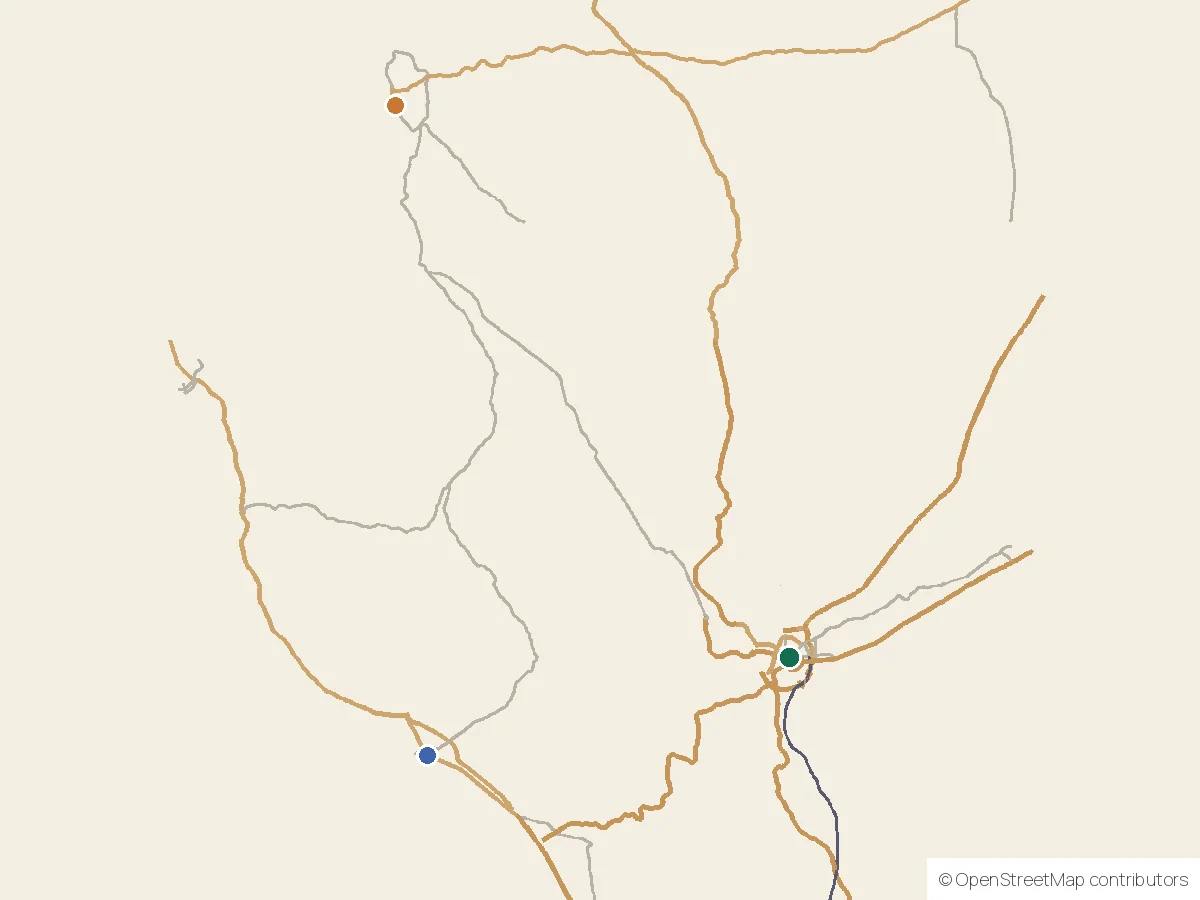
    Map of day-trip routes from Madinah to Yanbu and AlUla
    Map data © OpenStreetMap contributors (ODbL). Map drawn by Living in Madina from OpenStreetMap data.
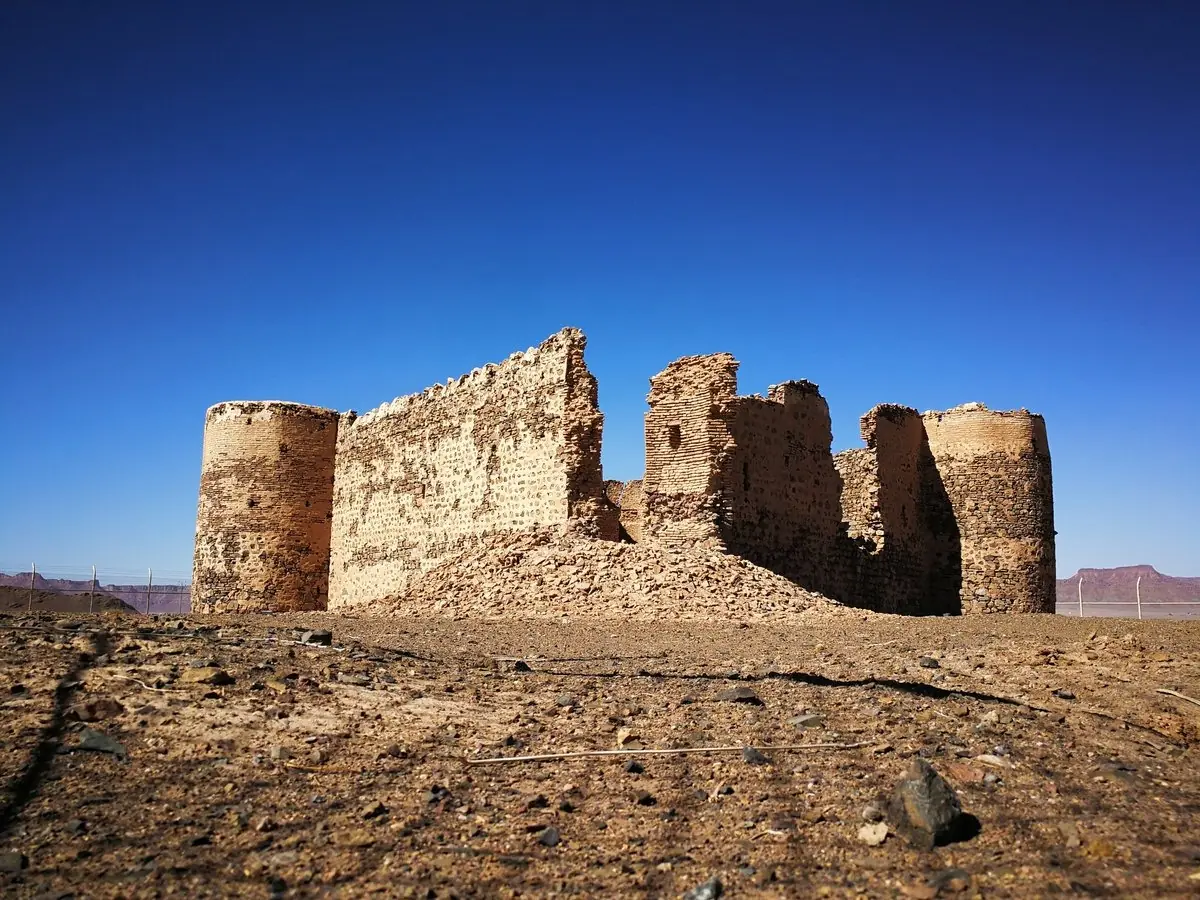
    Historic fort on a rocky hill in AlUla
    Photo: Al ula1.jpg by @goufily on Wikimedia Commons, CC BY 2.0. Resized to 1200×900, converted to WebP.

    This guide covers two favourites, Yanbu and AlUla, using official tourism sources. We don’t quote hotel or activity prices, which change by season.

    Quick answer

    Short answer: Yanbu, on the Red Sea, is roughly 220 km from Madinah according to the Ministry of Hajj and Umrah, and is known for its beaches and diving. AlUla, north of Madinah, is known for its heritage sites and desert landscapes; plan it with the Royal Commission for AlUla’s trip planner. Check the weather, book ahead and drive safely.

    Yanbu

    Visit Saudi’s Yanbu page describes Yanbu as a Red Sea destination for diving and relaxation. The Ministry of Hajj and Umrah’s Madinah page puts the port of Yanbu at about 220 km from Madinah.

    • Check sea and weather conditions before swimming or diving
    • Use licensed dive centres and follow their safety briefings
    • Bring sun protection and plenty of water
    • Book accommodation early for long weekends and holidays

    AlUla

    Visit Saudi’s AlUla page highlights its ancient heritage and desert landscapes. The Royal Commission for AlUla’s trip planner covers getting there, accommodation and planning. Many heritage sites need tickets booked in advance, so check before you go.

    Tip

    AlUla’s best-known sites often need timed tickets. Book them before you set off, especially in the cooler season.

    Choosing between them

    YanbuAlUla
    Best forSea, beaches, divingHeritage sites, desert scenery
    PlanningWeather and sea checksTimed tickets, trip planner
    Official infoVisit SaudiVisit Saudi, Royal Commission for AlUla
    Yanbu vs AlUla

    Planning the drive

    1

    Check the route and journey time in a maps app.

    2

    Check the National Center for Meteorology for heat, dust and rain alerts.

    3

    Service your car, and check the tyres and spare.

    4

    Plan fuel and rest stops on longer stretches.

    5

    Leave early, and avoid driving tired at night.

    Warning

    Watch for camels and other animals on desert roads, especially at dusk and at night.

    When to go

    The cooler months are the most comfortable for both trips. In summer, plan beach time for early morning and evening, and avoid long outdoor walks in the midday heat.

    Key takeaways

    • Yanbu: about 220 km, Red Sea coast
    • AlUla: heritage and desert landscapes, north of Madinah
    • Best season: the cooler months
    • Official planning: Visit Saudi, Royal Commission for AlUla

    Other nearby escapes

    Closer to home, Madinah’s parks and walkways make good half-day outings. Our family parks guide has ideas. Visit Saudi’s Madinah pages list more places across the region.

    Travelling with family

    Pack snacks, water and entertainment for children. Plan regular stops, and book family-friendly accommodation ahead of school holidays.

    Where to stay

    Both destinations have hotels, resorts and other accommodation. Book through official or well-known booking channels, read recent reviews, and check cancellation terms before paying. For AlUla, the Royal Commission’s trip planner lists accommodation options.

    Respecting heritage sites

    At heritage sites, stay on marked paths, don’t touch or climb on rock carvings and monuments, and follow guides’ and rangers’ instructions. Take all your rubbish with you, in towns, on beaches and in the desert.

    FAQ

    How far is Yanbu from Madinah?

    About 220 km, according to the Ministry of Hajj and Umrah’s Madinah page.

    Do I need tickets for AlUla?

    Many heritage sites need tickets booked in advance. Check the Royal Commission for AlUla’s trip planner.

    When is the best time for a weekend trip?

    The cooler months are most comfortable for both Yanbu and AlUla.

    Last checked 16 November 2026. Check official tourism sites and booking pages before you travel.

  • The Prophet’s Biography Museum in Madinah: A Resident’s Visiting Guide

    The Prophet’s Biography Museum in Madinah: A Resident’s Visiting Guide

    Just south of the Prophet’s Mosque, the Prophet’s Biography Museum in Madinah tells the story of the Prophet Muhammad ﷺ and Islamic civilization with interactive screens, panoramas and 3D models. Its full name is the International Fair and Museum of the Prophet’s Biography and Islamic Civilization, and it is overseen by the Muslim World League. For residents it is an easy visit after a prayer, and a good stop for guests.

    Quick answer

    Quick answer

    Short answer: The museum is on the southern side of the Prophet’s Mosque. You need to book a ticket on the official ticket page. Tours are guided, take 30 to 60 minutes depending on the ticket, and run in nine languages including English and Urdu (museum FAQ).

    Key takeaways

    • Location: southern side of the Prophet’s Mosque, in the qibla direction.
    • Tickets: booking required; current prices are on the official ticket page, and entry is free for children under seven and people with disabilities.
    • Languages: Arabic, English, Urdu, Indonesian, French, Turkish, Russian, Persian and Tajik.
    • Length: 30 to 60 minutes, depending on the ticket.

    Where it is

    The museum’s FAQ says it is on the southern side of the Prophet’s Mosque, facing the Noble Rawdah (museum FAQ). Arab News described it as next to the southern squares of the mosque when it welcomed Hajj pilgrims in 2022 (Arab News).

    What is inside

    According to the museum, the displays use interactive screens, panoramic screens and interactive 3D models that show Makkah and Madinah in the time of the Prophet ﷺ. A hologram display presents his furniture and belongings, and the visit ends with a cinematic presentation. There is also a gift shop and a photo corner.

    Visit Madinah describes several digital halls, each on one area of the Prophet’s biography and Islamic civilization, with more than 25 main pavilions. Arab News noted a hall with rare items linked to the Two Holy Mosques. The Panorama of the Noble Prophetic Chamber is a separate immersive section with its own ticket options.

    Tickets and tours

    Ticket (as listed in the museum FAQ)What it coversPrice
    Entrance ticketStandard guided visitSee ticket page
    Panorama of the Noble Prophetic ChamberThe panorama, as part of the “Taybah: Lights and Traces” tourSee ticket page
    “Awe and Remembrance” all-inclusiveThe panorama and all other sectionsSee ticket page
    Children under seven; people with disabilitiesEntryFree
    Ticket types listed on the museum FAQ (checked 17 October 2026)

    Each guided tour has a set start time, shown on the ticket page. Book online, pick the language your group needs, and arrive a little early.

    Note

    Good to know

    The museum FAQ lists Sunday to Thursday 8:00 am to 10:30 pm, Friday 1:00 pm to 10:30 pm and Saturday 4:30 pm to 11:30 pm. Times can change, so check the ticket page for the day you want.

    Tips for residents and guests

    • Pair it with a prayer. Because it is beside the mosque, many people visit before or after a prayer. Leave enough time so a tour does not overlap the next prayer.
    • Choose the language for your group. Urdu and English tours make it easy to bring relatives from South Asia or the UK.
    • Prepare children. The screens and models hold children’s attention, but a short explanation beforehand helps them understand what they are seeing.
    • Hosting guests? Combine the visit with a Rawdah permit. See our Rawdah permit guide and our guide to hosting guests.

    Tip

    Tip

    In Ramadan the area around the mosque is much busier. Our Taraweeh and iftar guide explains how residents plan around the crowds.

    FAQ

    Do I need a ticket for the Prophet’s Biography Museum?

    Yes. The museum FAQ says a ticket must be booked to enter, through the official ticket page.

    How much does it cost?

    Prices depend on the ticket type and are listed on the official ticket page. Children under seven and people with disabilities enter free.

    Are tours available in Urdu and English?

    Yes. The museum lists tours in nine languages, including Arabic, English and Urdu.

    How long does a visit take?

    Between 30 and 60 minutes, depending on the type of ticket.

    Last checked 16 November 2026.

  • Visiting the King Fahd Quran Printing Complex in Madinah: A Resident’s Guide

    Visiting the King Fahd Quran Printing Complex in Madinah: A Resident’s Guide

    Living in Madinah puts one of the most remarkable places in the Muslim world within easy reach: the King Fahd Quran Printing Complex, officially the King Fahd Glorious Quran Printing Complex. It runs a daily visits program, so residents can see how copies of the Quran are printed, checked and sent around the world. Here is how to plan a visit, based on official and news sources.

    Quick answer

    Short answer: Request your visit through the complex’s official portal at visit.qurancomplex.gov.sa before you go. Tours show printing, review and verification, translation of the meanings into other languages, and distribution. Visiting times have been reported in two daily sessions, so confirm the current times on the portal.

    Key takeaways

    • Book first: visit requests go through the official portal; the complex also publishes a visit app in Arabic.
    • What you see: printing stages, review and verification, translations, and distribution.
    • Two sessions a day: Okaz reported 6:00 to 10:00 am and 4:00 to 7:00 pm in August 2025.
    • Good for guests: official Umrah programs include it alongside Quba Mosque and Uhud.

    What the complex does

    The Saudi Press Agency describes visitors being briefed on the complex’s work to preserve the Quran: printing, translation into many languages, review and verification, and distribution to Muslims around the world (SPA). Okaz, reporting from Madinah, adds that the complex prints the Quran in different sizes and in different riwayat (recognised transmissions of the recitation), and that visitors see the machines used at each stage (Okaz, August 2025).

    What you will see on the tour

    Based on those reports, a visit usually covers:

    • The printing stages and the equipment used.
    • Review and verification: the careful checking that each copy goes through.
    • Translation of the meanings of the Quran into world languages.
    • Distribution of copies to Muslims around the world.

    Arab News reported that a group of 250 Umrah guests from several countries toured the complex in March 2025 and were briefed on the same process (Arab News).

    How to book a visit

    Booking in four steps

    1. Open the official portal at visit.qurancomplex.gov.sa, or the complex’s Visit Quran Press in Madinah app (Arabic).
    2. Choose your date and session, and enter the details the portal asks for, including the size of your group.
    3. Keep your confirmation on your phone for the day.
    4. Check the times again the day before, especially around Ramadan, Hajj and public holidays.

    Good to know

    Visiting hours have been published differently in different places over time. Okaz reported two daily sessions in August 2025: 6:00 to 10:00 am and 4:00 to 7:00 pm. Treat the official portal as the final word.

    Tips for families and guests

    • Go early in the day in the warmer months, and carry water. Our heat safety guide has more tips.
    • Prepare children by explaining what they will see and why the work matters, so they can follow the tour.
    • Dress modestly and follow staff guidance on photography and where you can walk.
    • Plan the rest of the day. Official Umrah programs have paired the complex with Quba Mosque, Mount Uhud and the Prophet’s Biography exhibition. Our family weekend guide to Quba and Uhud can help you plan.

    Tip

    Hosting relatives from abroad? A visit here fits well into a guest itinerary. See our guide to hosting guests in Madinah for etiquette and Rawdah planning.

    Getting there

    The complex is in Madinah and is easy to find on a map app under its official name. If you do not drive, our transport guide explains the Madinah Bus network and other options.

    FAQ

    Can residents visit the King Fahd Quran Printing Complex?

    Yes. The complex runs a daily visits program and takes visit requests through its official portal, visit.qurancomplex.gov.sa.

    What are the visiting hours?

    Okaz reported two daily sessions in August 2025, 6:00 to 10:00 am and 4:00 to 7:00 pm. Times can change, so check the portal before you go.

    Is the tour suitable for children?

    It can be, especially for school-age children, because the printing and checking stages are easy to follow by watching. Explain beforehand what they will see, and keep younger children close.

    Do I need to speak Arabic?

    The visit app is in Arabic. The complex receives visitors from many countries, so ask about language help when you book.

    Last checked 16 November 2026. The complex’s main website did not load for us on that date, so confirm details on the visit portal.