By Dr. Malik Sherjeel Awan, PsyD · Last checked 17 November 2026 · Always confirm times in the Nusuk app
Published by Dr. Malik Sherjeel Awan, Makkah
Praying in Ar-Rawdah Ash-Sharifah is one of the hopes of every resident and visitor. The Prophet ﷺ said: “Between my house and my pulpit there is a garden of the gardens of Paradise” (Sahih al-Bukhari 1196; Sahih Muslim 1391).
During the Hajj season, large numbers of pilgrims pass through Madinah, and Rawdah slots are in heavy demand. This guide builds on our general Rawdah permit guide. It covers what changes in the Hajj months and how residents can plan around them.
Hajj 1448 is expected around 14–19 May 2027, subject to moon sighting. The 1448 Rawdah arrangements haven’t been announced, so the details below come from the 1447 (2026) season.
The basics still apply
- The permit is booked in the official Nusuk app, choosing the men’s or women’s service.
- A permit is needed for the Rawdah area only. Praying elsewhere in Masjid an-Nabawi doesn’t need one.
- Men and women have separate time windows, so a mixed family makes separate bookings.
- Book only in Nusuk. Anyone selling slots or “booking help” isn’t official.
In December 2025, the General Authority for the Care of the Affairs of the Two Holy Mosques said the Nusuk permit was valid once every 365 days, alongside an instant access route when you are near the mosque. In January 2025, the Ministry had added instant booking and a waitlist inside Nusuk. Rules like these change, so check what the app offers you on the day.
When the pilgrims arrive
Madinah’s Hajj season has two waves:
- Before Hajj. In 1447, the first Hajj pilgrim groups arrived in Madinah on 18 April 2026 (1 Dhu al-Qa’dah). Many pilgrims spend days in Madinah before travelling to Makkah.
- After Hajj. In early June 2026, the Authority and SPA reported large numbers of pilgrims arriving at the Prophet’s Mosque after completing Hajj, including at the first Friday prayer after Hajj.
If 1448 follows the same pattern, expect the busiest Rawdah demand from around early April to mid-June 2027. Those dates are an estimate, not an announcement.
1447 Hajj-season time windows
On 24 May 2026, the Authority announced these windows for the Hajj season:
| Day | Men | Women |
|---|---|---|
| Saturday to Thursday | 2:00 am until Fajr, and 11:20 am until Isha | After Fajr until 11:00 am, and after Isha until 2:00 am |
| Friday | 2:00 am until Fajr, and 9:00 am until Isha | After Fajr until 9:00 am, and after Isha until 2:00 am |
The Ministry of Hajj and Umrah’s Prophet’s Mosque Services Guide lists different windows from another period. That’s a reminder that times change. The guide itself says to confirm the appointment in Nusuk before you visit.
Do pilgrims need anything extra?
In 1447, the Ministry of Hajj and Umrah said carrying and activating the Nusuk card was mandatory for Hajj pilgrims entering the Prophet’s Mosque, including Al-Rawdah. That card belongs to pilgrims from abroad. As a resident you use your Nusuk account and Rawdah permit as normal, but if you’re hosting pilgrim relatives, remind them to carry their card.
How residents can plan
Think about timing
Residents usually have more chances across the year than pilgrims, who often have only a few days. If you can, plan your own visit for the quieter months and leave the peak-season slots for guests who may never return.
If you do want a slot in the season
- Check the app early and at different times of day, rather than refreshing constantly.
- Be flexible. Late-night windows can be easier to fit around work and school for some families.
- Use the waitlist if the app offers it.
- Book the family on the same day, in their separate windows, so you only travel to the Haram once.
On the day
- Go to the entry point the app or staff direct you to. In December 2025, entry was announced through the southern courtyards, but arrangements change, so follow the signs and staff on the day.
- Arrive early, travel light and carry water in the heat.
- Agree a meeting gate number with your family before you separate. See our gates guide.
- Be patient. Staff manage the flow inside, and the visit is short.
Elderly relatives
The December 2025 announcement said elderly visitors may enter using wheelchairs, subject to the rules. The services guide lists free wheelchair loan offices in the courtyards. See our accessibility guide.
Adab in a crowded season
The Rawdah is small, and everyone around you has waited for this moment. Pray calmly, don’t push, avoid filming that disturbs others, and leave when staff ask. The services guide also notes that obligatory prayers are best performed in the first row, even outside the Rawdah.
If someone gets lost
The services guide lists a Lost Persons Guidance Office and Lost Children Care Centers, and asks that a lost child be taken to the nearest security officer. Put a card or bracelet with your phone number on young children. Important numbers from the guide: 937 for medical advice, 911 for emergencies, and 1966 for Ministry of Hajj and Umrah inquiries within the Kingdom.
FAQ
Do I need a permit to pray in the Prophet’s Mosque during Hajj?
Not for the mosque in general. The permit is for the Rawdah area.
Can I book for my visiting parents?
Check what the Nusuk app offers for booking on behalf of family members, and follow its limits. See our general Rawdah guide.
Are the times the same every year?
No. The 1447 Hajj-season windows differed from other published windows. Check Nusuk.
Is the Rawdah closed during Hajj?
No closure was announced in 1447. The Authority published Hajj-season visiting windows instead.
Related reading
- Rawdah visit for overseas pilgrims (madinamakkah.com)
General information only. Rawdah arrangements are set by the General Authority for the Care of the Affairs of the Two Holy Mosques and can change at short notice. The Nusuk app and staff on site take priority.
Sources
- Saudi Press Agency, Al-Rawdah Al-Sharifah visit times for the 1447 Hajj season via Nusuk (24 May 2026): https://www.spa.gov.sa/en/N2597065
- Saudi Press Agency, Rawdah visiting hours; permit via Nusuk ‘valid once every 365 days’ or instant access near the mosque; entry via southern courtyards; wheelchairs for elderly (5 Dec 2025): https://spa.gov.sa/en/N2459265
- Ministry of Hajj and Umrah, Prophet’s Mosque Services Guide (Rawdah booking via Nusuk; grouping point in southern courtyards; times may change; lost persons and lost children offices; phone numbers 937, 911, 1966): https://haj.gov.sa/-/media/Project/HAJJ/PDF-and-FILES/Awareness-Guides/Masjid-Nabawi-Services-Guide/English/EN-masjid-nabawi-services-Guide.pdf
- Ministry of Hajj and Umrah, Nusuk card mandatory for pilgrims’ entry to the Prophet’s Mosque including Al-Rawdah (1447) via DARP: https://pep.gov.sa/en/news/952
- Saudi Press Agency, first pilgrim groups welcomed in Makkah and Madinah (18 Apr 2026): https://spa.gov.sa/en/N2564848 ; Prophet’s Mosque welcomes pilgrims after Hajj (2 Jun 2026): https://spa.gov.sa/en/N2604867
- Gulf News, instant booking and waitlist added to Nusuk for Al-Rawdah (Jan 2025): https://gulfnews.com/world/gulf/saudi/saudi-arabia-adds-instant-booking-and-waitlist-options-for-al-rawdah-al-sharifa-via-nusuk-app-1.500024193
- Sahih al-Bukhari 1196; Sahih Muslim 1391 (sunnah.com)
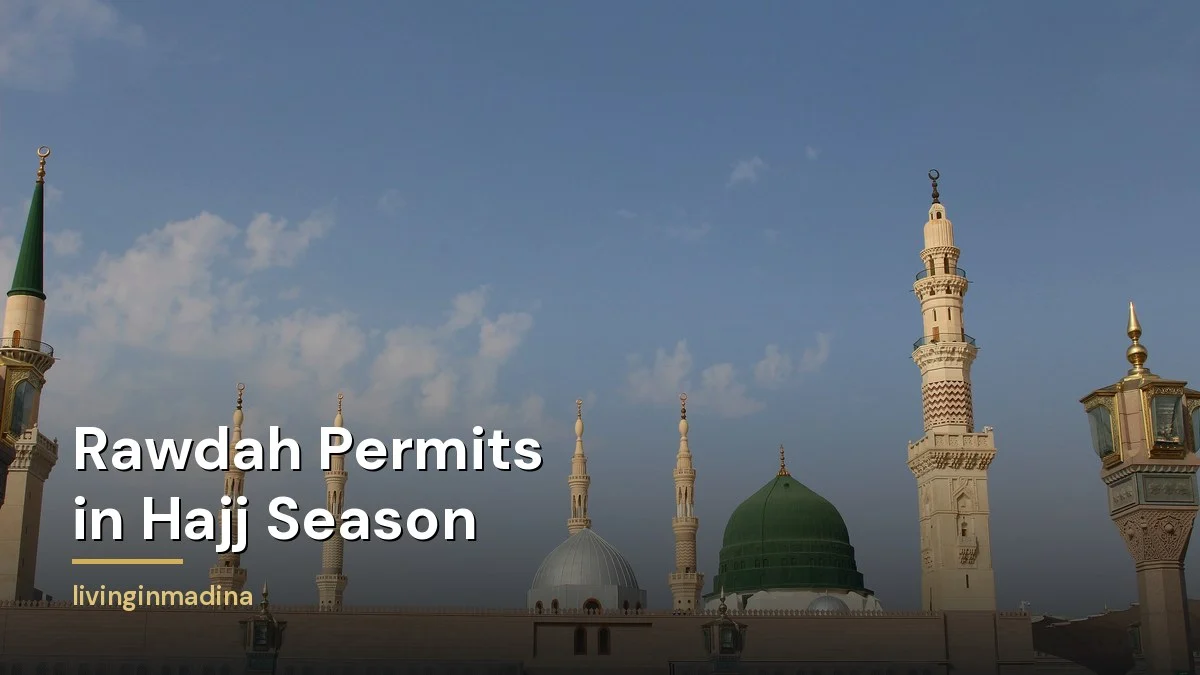
Featured image: Green Dome at the Prophet's Mosque by TheHadiRahim, via Wikimedia Commons, CC0; cropped, with title added.