Category: Masjid an-Nabawi

Quick answer
Resident-focused guides to Masjid an-Nabawi in Madinah: booking the Rawdah on Nusuk for yourself and your guests, and the etiquette and logistics of hosting visitors. Booking rules come from Nusuk and the official authority for the Prophet’s Mosque.

Key takeaways

Rawdah visits are booked through the Nusuk app.

Permit rules and time slots are set officially and can change.

Plan travel to the mosque outside peak prayer times where you can.

Start with these guides

Booking the Rawdah for Family and Guests on Nusuk: A Resident’s Walkthrough

Hosting family in Madinah? How to add relatives and guests as companions on Nusuk, book one Rawdah slot together and plan the visit without stress.

Hosting Guests in Madinah: Prophet’s Mosque Etiquette, Dress and Rawdah Planning for Residents

When relatives or friends come to stay, a visit to Masjid an-Nabawi is usually the highlight of their trip. As the local host, you can help them arrive prepared, behave with the right adab and avoid stressful mistakes. This guide covers what to tell guests before they go.

Visiting the Rawdah as a Madinah Resident: Booking Your Permit on Nusuk

Living in Madinah means Masjid an-Nabawi is close by, and many residents hope to pray in Ar-Rawdah Ash-Sharifah. Visits to the Rawdah are organized through a permit system. The official route is the Nusuk app, under the Ministry of Hajj and Umrah.

Related guides from other sections

Living Near the Prophet’s Mosque in Madinah With Family: A Practical Guide

What it’s really like for a family to live near the Prophet’s Mosque in Madinah: crowds, children’s services, parking and checking a lease before you sign.

Hosting Visiting Parents in Madinah: A Resident’s First-Week Plan

Parents visiting you in Madinah? Plan the airport pickup, the nearest parking and gates at the Prophet’s Mosque, the Rawdah booking and rest days.

Child Vaccinations in Madinah: The National Schedule and Booking on Sehhaty

A guide for Madinah parents to the MOH national child vaccination schedule, booking a primary health centre visit on Sehhaty and keeping records digital.

Taking Dates Home From Madinah: Packing, Customs and What to Check First

Taking dates home from Madinah? How to buy packed, labelled dates, pack them for a flight, what Saudi customs says about personal luggage and what to check.

More related guides

Living in Quba, Madinah: Rent, Schools and Daily Life

Living in Quba, Madinah: where the area is, how to check rent and schools, getting around by bus and car, and daily life for families near Quba Mosque.

How to Spot Good Ajwa Dates Before You Buy in Madinah

How to tell good Ajwa dates in Madinah: what to look at, feel and read on the label, how official grading works, and how to avoid mixed or poor boxes.

Drinking Water in Medina: Bottled, Filtered and Zamzam

Drinking water in Medina: bottled water and SFDA, home filters, water tanks, the National Water Company for supply issues, and buying Zamzam water.

Short-Term Rentals in Medina for Residents: Monthly Stays and Rules

Short-term rentals in Medina for residents: how licensed holiday units differ from monthly leases, the Ministry of Tourism rules and safe booking.

More related guides

Finding Trusted Local Services Near Where You Live in Madinah

Before you hire local services in Madinah, check licences on official platforms: commercial registration, Balady, Musaned, REGA brokers and SCFHS.

Absher for Medina Residents: Services You Will Actually Use

Absher for Medina residents: the services you will actually use, from family iqama renewal to traffic fines and passports, plus account safety tips.

Weekend Trips From Madinah: Yanbu, AlUla and Nearby Escapes

Weekend trips from Madinah: Yanbu on the Red Sea and AlUla’s heritage landscapes, how to plan the drive, bookings, weather checks and road safety tips.

Is Madina Cheaper Than Makkah or Jeddah? A Resident Comparison

Is Madina cheaper than Makkah or Jeddah? Why no official city table exists, how to compare rent, transport and schooling and what national data shows.

Official services to use

Official links

Nusuk Rawdah booking: book a Rawdah visit

Prophet’s Mosque information (Ministry of Hajj and Umrah): mosque services

Madinah Bus: routes and service information

Check before you act
Rules, timetables and fees change. Always confirm details on the official page linked in each guide before you rely on them.

Explore the site

All latest guides

Home

Sources

https://www.nusuk.sa/rawdah

https://haj.gov.sa/en/Al-Madinah-Al-Munawwarah/Information-About-the-Prophets-Mosque?masjidNabawiInfoTab=mosque-services

https://madinahbus.mda.gov.sa/

  • Women’s Access at Masjid an-Nabawi: A Practical Guide for Residents

    Women’s Access at Masjid an-Nabawi: A Practical Guide for Residents

    By Dr. Malik Sherjeel Awan, PsyD · Last checked 22 November 2026 · Confirm religious details with a qualified scholar

    Published by Dr. Malik Sherjeel Awan, Makkah

    Women who live in Madinah go to the Prophet’s Mosque for ordinary prayers, for Friday, and, when they can book it, for the Rawdah. This guide gathers official practical rules from the Ministry of Hajj and Umrah FAQ, opened on 22 November 2026 (page last updated 15 November 2026). It is not a fatwa, and it does not invent gate numbers or women’s-section maps. Follow official signs and staff on the day, and ask a qualified scholar about your own religious questions.

    For the wider resident picture, see the residents’ mosque guide when you use it alongside this page, Rawdah permits for residents, and the gates guide.

    Praying in the Mosque

    The Ministry FAQ says it is not required to book a time to pray in the Prophet’s Mosque. Booking is required for prayer in the Rawdah. In other words, ordinary prayer in the Mosque and a Rawdah visit are different official processes.

    Use the official women’s entrances and sections as they are marked on the day. This article does not number those gates, because official organisation can change and we did not independently verify a complete, current official gate list on 22 November 2026. The live gates guide and official signage are the practical references. If a volunteer or official steward directs you, follow that direction.

    For Friday, allow more time and read getting to Friday prayer. Crowds are dense, and meeting points should be agreed before you arrive.

    The Rawdah: official permit rules

    The same official FAQ states:

    • a permit is required to pray in the Rawdah
    • for the age groups it names, this applies from five years and older
    • there is a 30-day interval between visits to the Rawdah
    • there is no feature to modify a Rawdah prayer time; you may cancel before the permit time in the Nusuk app and issue a new permit
    • if you are late, official permit-timing rules still apply; do not expect entry on an expired slot

    Book only through official Nusuk. Do not pay a third party for a “private slot.” Residents should use the same official app as visitors, and should keep the phone charged, with a screenshot as a backup if the signal drops.

    Bring only what you need. Official staff may manage bags and flow on the day.

    Official wording about salutations at the Prophet’s grave

    The Ministry FAQ includes this question and answer, quoted here as official administrative wording:

    The FAQ asks whether it is required to book a permit to pray and visit the Prophet’s grave, and answers that booking is not required, “noting that sending salutations to the Prophet (peace be upon him) is allowed for men only.”

    That is the official FAQ text as it stood when the page was opened on 22 November 2026. This article does not add a ruling, a defence or a criticism of that wording. If you have a religious question about how you should give greetings, ask a qualified scholar, and follow official organisation on the ground.

    This site will not describe shrine practices, and it will not invent a women’s route that official pages have not published.

    Going with children or with limited mobility

    The FAQ says children are allowed in the courtyards of the Prophet’s Mosque. The official five-year rule above applies to Rawdah permits. Agree a meeting point, and do not rely on a phone call in a dense crowd.

    For wheelchairs and older relatives, see accessibility at the Prophet’s Mosque. Official access can be slower on Fridays and in Ramadan; leave extra time and follow staff.

    If you are hosting guests, share official Rawdah rules early. See hosting guests: etiquette at the Prophet’s Mosque.

    A calm resident routine

    1. For ordinary prayer, go through official women’s entrances and follow signs. No permit is required for general prayer, according to the FAQ.
    2. For the Rawdah, book official Nusuk, respect the 30-day interval, and cancel in the app if you must change a slot before it starts.
    3. On Fridays and in Ramadan, treat the journey as a peak-time trip.
    4. Confirm any religious detail that matters to you with a scholar, and confirm any access detail with official signage.

    Dress modestly and comfortably for walking, and keep valuables to a minimum. Official security may inspect bags. If you lose a companion, go to official help points rather than pushing against the flow. In very dense crowds, it can be wiser to pray in a quieter official women’s section and to leave the Rawdah for a booked, calmer slot.

    Residents sometimes feel pressure to “get everything in” when family visits. Official 30-day Rawdah rules still apply to you even if a guest’s stay is short. Explain that early so no one is disappointed at the door.

    This guide will not comment on government policy. It reports official FAQ wording so residents can plan, and it leaves religious judgment to qualified scholars.

    FAQ

    Do women need a permit to pray in the Prophet’s Mosque?
    The official FAQ says a permit is not required to pray in the Mosque generally. A Rawdah permit is required.

    How often can I book the Rawdah?
    The FAQ states a 30-day interval between visits.

    Can I change a Rawdah time?
    The FAQ says there is no modify feature. You may cancel before the time starts and book again.

    Which gate should women use?
    Follow official signs, staff and the gates guide on this site. This article does not invent a numbered list.

    Related reading

    General information only, not a fatwa. Official FAQ and mosque organisation take priority. Ask a qualified scholar about religious details.

    Sources

    • Ministry of Hajj and Umrah FAQ (page last updated 15 November 2026, opened 22 November 2026): prayer in the Prophet’s Mosque does not require a permit; Rawdah prayer requires a permit for ages 5 and older; 30 days between Rawdah visits; no feature to modify Rawdah times, cancel before the time and rebook; sending salutations to the Prophet described as allowed for men only; children allowed in the courtyards: https://haj.gov.sa/en/FAQ
  • The Prophet’s Mosque: A Residents’ Complete Guide

    The Prophet’s Mosque: A Residents’ Complete Guide

    By Dr. Malik Sherjeel Awan, PsyD · Last checked 20 November 2026

    Published by Dr. Malik Sherjeel Awan, Makkah

    Masjid an-Nabawi is the heart of Madinah. The Prophet ﷺ named it among the three mosques worth travelling to (Sahih al-Bukhari 1189), and said one prayer in it is “better than one thousand prayers in any other mosque excepting Al-Masjid-Al-Haram” (Sahih al-Bukhari 1190; Sahih Muslim 1394).

    Visitors come for days. Residents come for years, so it’s worth knowing the mosque well: where things are, which services exist, and how to make regular visits easy for the whole family. This guide gathers the essentials from the Ministry of Hajj and Umrah’s Prophet’s Mosque Services Guide and links to our detailed guides on each topic.

    Finding your way: gates and numbers

    The mosque has 100 gates. Gates are numbered 1 to 42, with letters A to E, giving 100 in total. There are also service-facility gates in the courtyards, numbered 201–236 with letters (such as 7A), and external courtyard gates numbered 301–370.

    Gates residents often use as landmarks, from the guide:

    • Bab al-Salam (1), western side: the entrance for greeting the Prophet ﷺ
    • Bab al-Rahmah (3), western side
    • Quba Gate (5) and Makkah Gate (37), southern side
    • King Fahd Gate (21), northern side
    • King Abdulaziz Gate (34), eastern side
    • Jibril Gate (40) and Al-Baqi Gate (41), eastern side

    Most gates have ramps for wheelchairs. Our gates guide covers the women’s gates and tips for meeting guests.

    Ar-Rawdah Ash-Sharifah

    The Prophet ﷺ said: “Between my house and my pulpit there is a garden of the gardens of Paradise” (Sahih al-Bukhari 1196; Sahih Muslim 1391). Visits are booked through the Nusuk app, with separate windows for men and women. The services guide notes the times “may change due to organizational factors”, so confirm in Nusuk. See our Rawdah permit guide.

    The guide also gives practical advice: voluntary prayers in the Rawdah are especially virtuous, while obligatory prayers are best in the first row, even outside the Rawdah.

    Greeting the Prophet ﷺ

    According to the guide, visitors are directed to a designated entry point and follow a set path to Bab al-Salam (Gate 1). The corridor leads to Al-Muwajahah Ash-Sharifah, where visitors greet the Messenger ﷺ, and visitors leave through Al-Baqi Gate (41). Follow the staff and the flow. It’s a short, calm walk when everyone keeps moving.

    Services inside the mosque

    Friday sermon translation

    The Friday sermon is translated live. You can listen on the Manarah platform, the Al-Haramain YouTube channel, and FM radio frequencies listed in the guide. English, for example, is on FM 105.5. That’s useful for non-Arabic-speaking guests.

    Qur’ans and learning

    • Qur’ans in many languages, translated commentaries and Braille copies are available. All are waqf, so they mustn’t be taken out of the mosque.
    • Qur’an circles for visitors help with recitation, starting with Al-Fatihah.
    • The Prophet’s Mosque Library is open 24 hours. The men’s library is on the roof level via Gate 11. The women’s library is near gates 16 and 24.

    Zamzam

    Zamzam coolers are spread throughout the mosque. The guide says more than 30,000 bottles are handed out daily. Free filling pumps are near external gates 309–310 on the southern side. Use the coolers only for drinking, not for wudu.

    Fatwa services

    Fatwa phone booths are placed near the gates, and there are fatwa desks inside the mosque. The guide lists toll-free numbers within the Kingdom: 8001222400 and 8001222100.

    For women

    The guide lists women’s prayer areas in the north-east (internal gates 23–27 and 28–31) and north-west (gates 11–14 and 15–17). A women’s lost-and-found desk is near internal gate 28 on the eastern side, and a Women Beneficiaries Care Center is near internal gate 27. Women book the Rawdah through Nusuk like men, in their own windows.

    For elderly and disabled visitors

    The guide lists:

    • dedicated prayer areas with ramps in the eastern and northern expansions and near the gates
    • free wheelchair loan offices near external gate 344 (east) and 308–309 (south)
    • fixed chairs near entrances for older visitors
    • a prayer room for deaf and hard-of-hearing worshippers on the western roof, with the Friday sermon in sign language
    • accessible restrooms in all restroom areas

    See our accessibility guide.

    Health and safety

    • As-Safiyah Health Center, near external gates 304–305 (south)
    • Jibril Gate Health Center, near external gates 358–359 (east, by Al-Baqi)

    Lost people: the Lost Persons Guidance Office is next to courtyard gate 365. Lost children are cared for at offices in the women’s prayer areas 13 and 29, and at the main centre by the Al-Baqi wall, opposite courtyard gate 354. If you find a lost child, take them to the nearest security officer. The guide recommends a card or bracelet with the parent’s phone number on every child.

    Lost property: report it at external gates 366–367 (south). Haram Security’s Lost and Found Office is in building 1, opposite courtyard gate 367. See our lost and found guide.

    Families with young children

    The Children’s Hospitality Center, near gates 339–340 on the northern side, offers a safe space for children so parents can pray. Check its current hours and age rules on site.

    Courtyards, shade and facilities

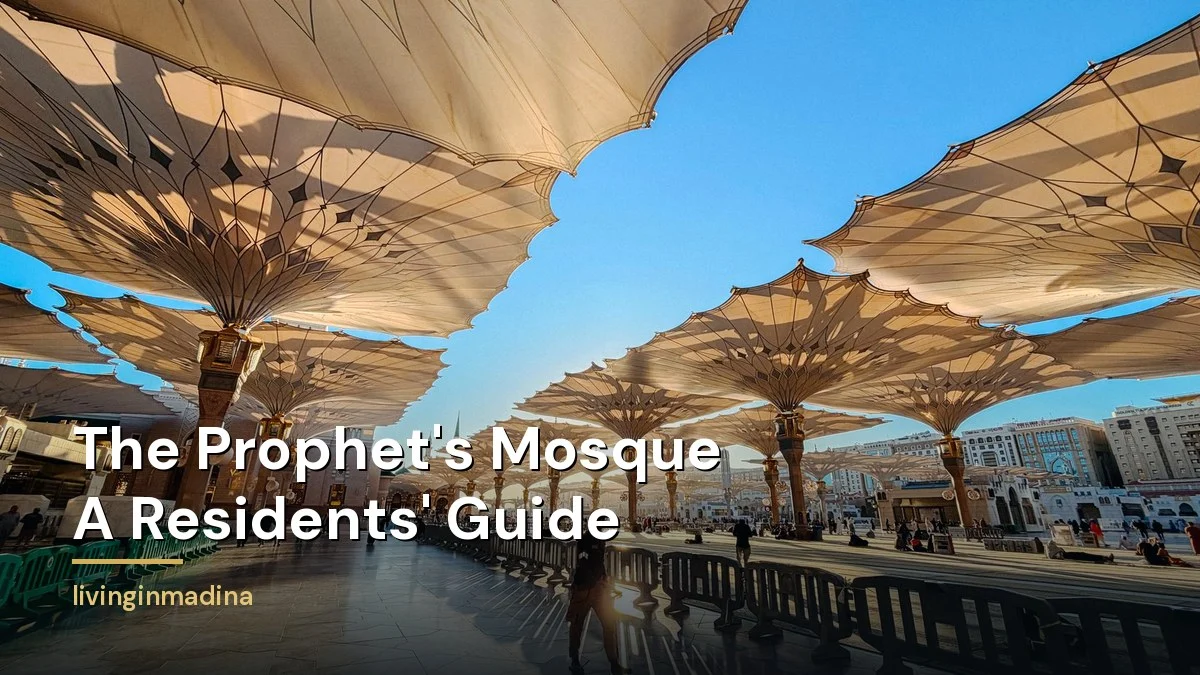
    The courtyards have 262 giant umbrellas, which open early in the day for shade and close in the evening. 21 service complexes around the courtyards hold restrooms, wudu areas and underground parking. They’re numbered from 200 upwards, with codes such as 3A or 3B.

    Parking

    The guide lists 24 parking units, about 184 cars each, with entrances on all four sides. Fees in the guide are SAR 1 an hour for the first two hours, SAR 2 an hour from the third to the eighth hour, and SAR 3 an hour after that, subject to change. You can pay with the Mawgif app. On Fridays and in peak seasons, consider leaving the car. See our Friday prayer and parking guide.

    Al-Baqi

    Al-Baqi, the cemetery of Madinah since the Prophet’s time, lies south-east of the mosque. The guide notes that many Companions and some of the Mothers of the Believers are buried there, and that the Prophet ﷺ often visited and prayed for its people. Visit respectfully and follow the staff and posted rules.

    Key numbers from the guide

    NumberFor
    911Emergencies and security
    937Medical advice and health inquiries
    1966Inquiries and complaints (within the Kingdom)

    A resident’s rhythm

    Living in Madinah, you’ll find your own pattern: a favourite gate, a regular spot, the prayers you never miss there. In Ramadan and the Hajj season, the mosque belongs to its guests as much as to you. Plan around the crowds using our Masjid an-Nabawi crowd calendar for Hajj 2027.

    Related reading

    General information from the Ministry of Hajj and Umrah’s services guide. Locations, times and fees can change, so follow signs and staff on site.

    Sources

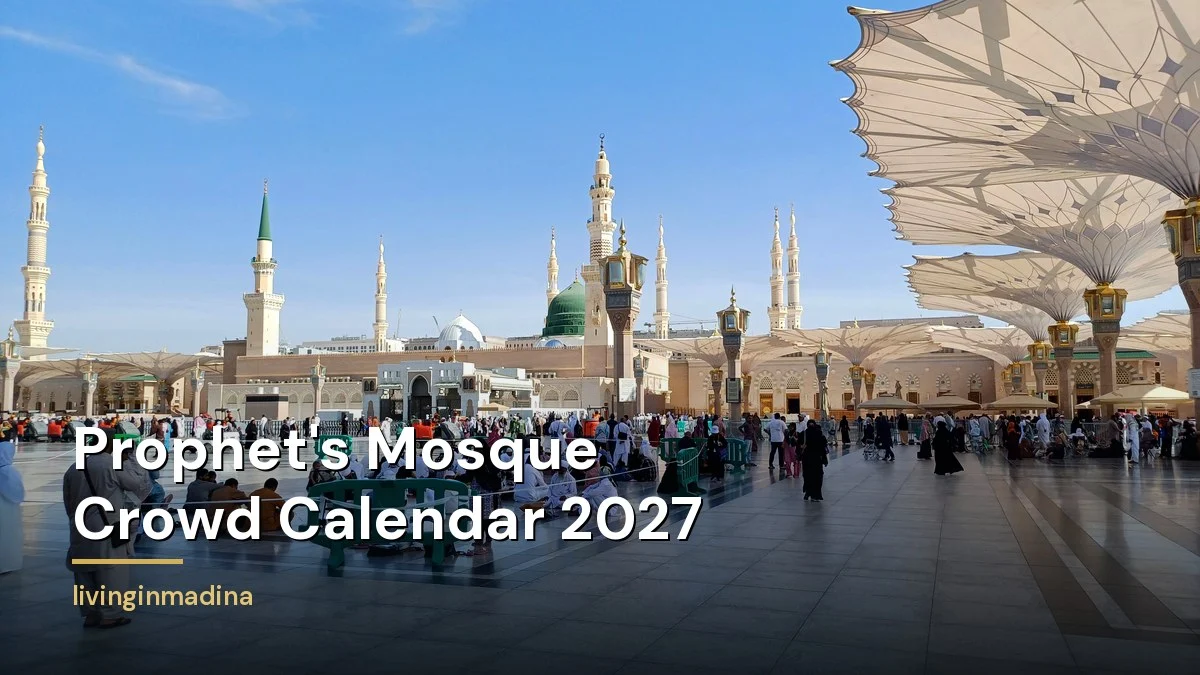
  • Prophet’s Mosque Crowd Calendar: Before and After Hajj 2027

    Prophet’s Mosque Crowd Calendar: Before and After Hajj 2027

    By Dr. Malik Sherjeel Awan, PsyD · Last checked 18 November 2026 · Dates depend on the moon sighting

    Published by Dr. Malik Sherjeel Awan, Makkah

    The Prophet ﷺ said: “One prayer in my Mosque is better than one thousand prayers in any other mosque excepting Al-Masjid-Al-Haram” (Sahih al-Bukhari 1190; Sahih Muslim 1394). For residents of Madinah, that closeness is a daily blessing, and it helps to know when the mosque will be at its fullest.

    This calendar maps the expected busy periods of 1448 (2027), from Ramadan through the weeks after Hajj. It uses the Umm al-Qura calendar and the pattern reported by the Saudi Press Agency in 1447. Hajj 1448 is expected around 14–19 May 2027. All dates may shift by a day or so with the moon sighting.

    The year at a glance

    PeriodExpected dates (2027)What drives the crowdHow busy for residents
    Ramadan 1448about 8 Feb – 9 MarResidents, Umrah visitors, Taraweeh and the last ten nightsVery busy, especially the last ten nights
    Eid al-Fitrabout 9 MarEid prayerVery busy on Eid morning
    Late Shawwalmid-March to early AprilUmrah visitors leaving before the Hajj seasonEasing
    Pre-Hajj wavefrom about 8 April (1 Dhu al-Qa’dah)Hajj pilgrims arriving in Madinah before MakkahBuilding through April and early May
    Hajj daysabout 14–19 MayPilgrims in Makkah and the holy sitesOften a short lull in Madinah
    Post-Hajj wavefrom about 20 May into JunePilgrims arriving in Madinah after HajjVery busy, especially Fridays
    Early Muharram 1449from about 6 JunePilgrims gradually departingSlowly easing

    “Expected dates” are calendar conversions and estimates based on 1447, not official announcements.

    What happened in 1447

    • 18 April 2026 (1 Dhu al-Qa’dah): SPA reported the first groups of pilgrims arriving in Makkah and Madinah.
    • 24 May 2026: the Authority announced special Hajj-season Rawdah windows.
    • 2 June 2026: SPA reported the Prophet’s Mosque welcoming pilgrims who had completed Hajj, with field teams working around the clock.
    • 5 June 2026: SPA documented large crowds at the first Friday prayer after Hajj. Security Aviation patrols monitored traffic and high-density areas around the central area.

    Map that onto 1448 and the first Friday after the days of tashriq would be around Friday 21 May 2027. Expect it to be one of the busiest Fridays of the year.

    Daily and weekly patterns

    Through the busy months, a few patterns tend to repeat:

    • Fridays are the fullest days. Arrive early and expect to pray in the courtyards.
    • Times around the obligatory prayers are busier than mid-morning and the hours after Isha.
    • Rawdah windows shape where crowds gather. In the 1447 Hajj season, men’s windows ran from 2:00 am to Fajr and from 11:20 am to Isha, and women’s from after Fajr to 11:00 am and after Isha to 2:00 am (Friday hours differed). See Rawdah permits in Hajj season.
    • Heat pushes people indoors in the afternoon. The courtyards’ 262 giant umbrellas open early in the day for shade and close in the evening, according to the Ministry’s services guide.

    These are general patterns, not guarantees. A large group arriving can change any hour.

    Planning for residents

    Choose your prayers

    In the busiest weeks, many families pick one or two prayers a day at the Prophet’s Mosque and pray the rest at their local masjid. That keeps the habit going without hours in traffic.

    Plan your parking or go without the car

    The services guide lists 24 parking units around the mosque with entrances on all four sides, and hourly fees that rise the longer you stay. The guide lists SAR 1 an hour for the first two hours, SAR 2 an hour from the third to the eighth, and SAR 3 an hour after the ninth. Fees may change, and the Mawgif app can be used to pay. In peak weeks, the bus, a taxi or walking can be quicker than queuing for a car park. See our Friday prayer and parking guide.

    Agree a meeting point

    With guests and children, agree a numbered gate to meet at, and send a photo of it. Crowds make phone calls hard.

    Work and school

    If your commute passes the central area, leave extra time from April to June. Public schools’ Eid al-Adha break starts on 1 Dhu al-Hijjah 1448 (about 7 May 2027), according to the Ministry of Education calendar, which eases school-run traffic over the Hajj weeks.

    Making space for guests

    Many pilgrims save for years to pray here, sometimes once in their lives. In the peak weeks, residents can help by:

    • leaving the front rows and the Rawdah for visitors when possible
    • giving directions and water to those who look lost
    • being patient in the crowd

    Choosing a quieter hour isn’t a lesser act. It is a kindness to the guests of the Prophet’s city.

    FAQ

    When is the Prophet’s Mosque least crowded in 2027?
    Outside Ramadan and the Hajj waves. The weeks after the post-Hajj departures, and the mid-morning hours on ordinary days, are usually calmer.

    Is Madinah busier before or after Hajj?
    Both waves are busy. In 1447, SPA highlighted very large crowds after Hajj, including the first Friday after the rites.

    Are these dates official?
    No. They are Umm al-Qura conversions and estimates based on 1447. Watch official announcements for 1448.

    Related reading

    General information only. Arrangements at the Prophet’s Mosque are set by the General Authority for the Care of the Affairs of the Two Holy Mosques. Follow its announcements and the staff on site.

    Sources

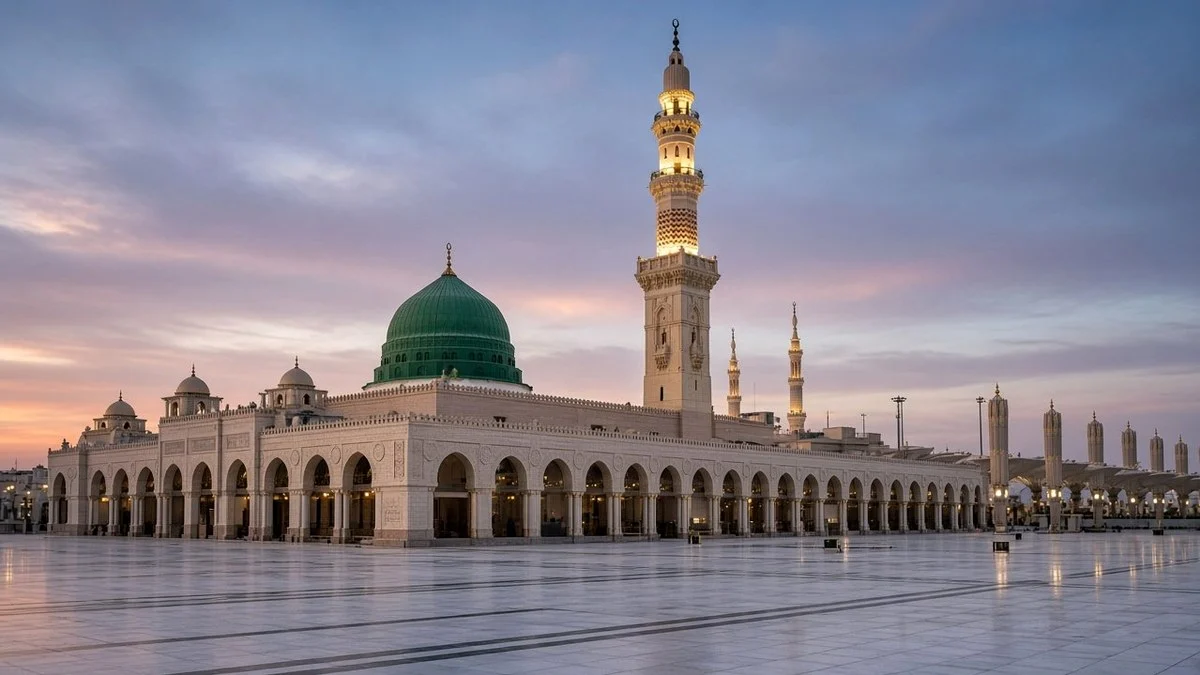
    Featured image: "Masjid al-Nabawi 2024 (11)" by Radosław Botev, via Wikimedia Commons, CC BY 3.0 PL; cropped, with title added.

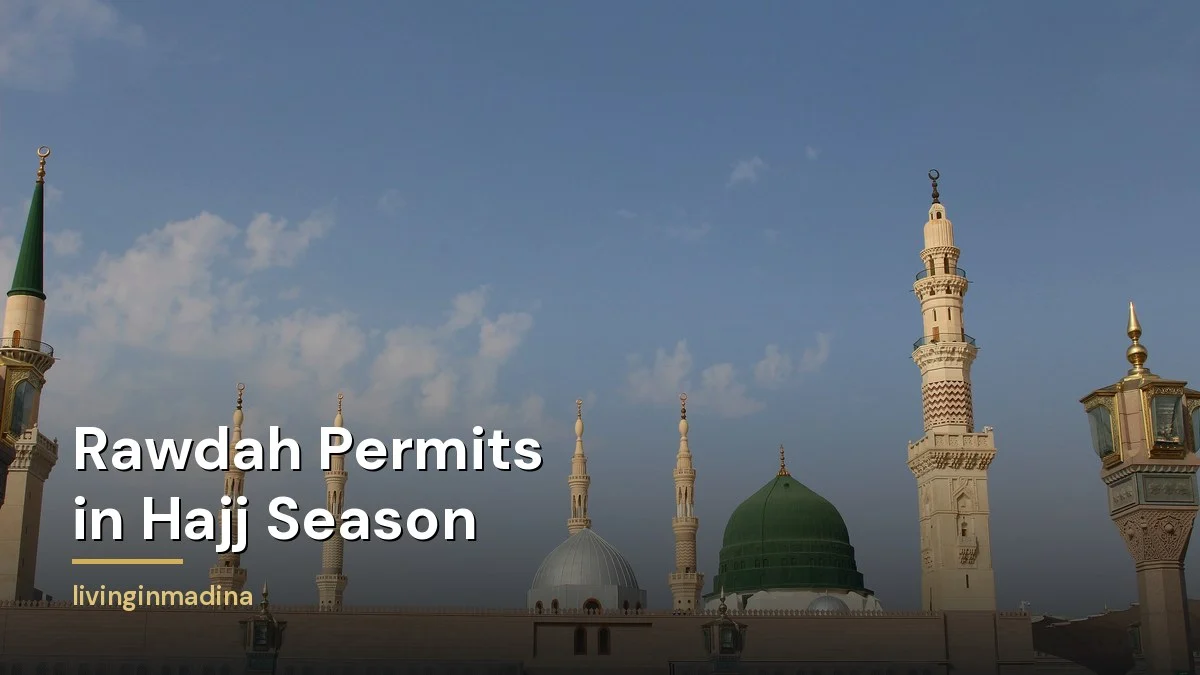
  • Rawdah Permits During Hajj Season: A Guide for Madinah Residents

    Rawdah Permits During Hajj Season: A Guide for Madinah Residents

    By Dr. Malik Sherjeel Awan, PsyD · Last checked 17 November 2026 · Always confirm times in the Nusuk app

    Published by Dr. Malik Sherjeel Awan, Makkah

    Praying in Ar-Rawdah Ash-Sharifah is one of the hopes of every resident and visitor. The Prophet ﷺ said: “Between my house and my pulpit there is a garden of the gardens of Paradise” (Sahih al-Bukhari 1196; Sahih Muslim 1391).

    During the Hajj season, large numbers of pilgrims pass through Madinah, and Rawdah slots are in heavy demand. This guide builds on our general Rawdah permit guide. It covers what changes in the Hajj months and how residents can plan around them.

    Hajj 1448 is expected around 14–19 May 2027, subject to moon sighting. The 1448 Rawdah arrangements haven’t been announced, so the details below come from the 1447 (2026) season.

    The basics still apply

    • The permit is booked in the official Nusuk app, choosing the men’s or women’s service.
    • A permit is needed for the Rawdah area only. Praying elsewhere in Masjid an-Nabawi doesn’t need one.
    • Men and women have separate time windows, so a mixed family makes separate bookings.
    • Book only in Nusuk. Anyone selling slots or “booking help” isn’t official.

    In December 2025, the General Authority for the Care of the Affairs of the Two Holy Mosques said the Nusuk permit was valid once every 365 days, alongside an instant access route when you are near the mosque. In January 2025, the Ministry had added instant booking and a waitlist inside Nusuk. Rules like these change, so check what the app offers you on the day.

    When the pilgrims arrive

    Madinah’s Hajj season has two waves:

    1. Before Hajj. In 1447, the first Hajj pilgrim groups arrived in Madinah on 18 April 2026 (1 Dhu al-Qa’dah). Many pilgrims spend days in Madinah before travelling to Makkah.
    2. After Hajj. In early June 2026, the Authority and SPA reported large numbers of pilgrims arriving at the Prophet’s Mosque after completing Hajj, including at the first Friday prayer after Hajj.

    If 1448 follows the same pattern, expect the busiest Rawdah demand from around early April to mid-June 2027. Those dates are an estimate, not an announcement.

    1447 Hajj-season time windows

    On 24 May 2026, the Authority announced these windows for the Hajj season:

    DayMenWomen
    Saturday to Thursday2:00 am until Fajr, and 11:20 am until IshaAfter Fajr until 11:00 am, and after Isha until 2:00 am
    Friday2:00 am until Fajr, and 9:00 am until IshaAfter Fajr until 9:00 am, and after Isha until 2:00 am

    The Ministry of Hajj and Umrah’s Prophet’s Mosque Services Guide lists different windows from another period. That’s a reminder that times change. The guide itself says to confirm the appointment in Nusuk before you visit.

    Do pilgrims need anything extra?

    In 1447, the Ministry of Hajj and Umrah said carrying and activating the Nusuk card was mandatory for Hajj pilgrims entering the Prophet’s Mosque, including Al-Rawdah. That card belongs to pilgrims from abroad. As a resident you use your Nusuk account and Rawdah permit as normal, but if you’re hosting pilgrim relatives, remind them to carry their card.

    How residents can plan

    Think about timing

    Residents usually have more chances across the year than pilgrims, who often have only a few days. If you can, plan your own visit for the quieter months and leave the peak-season slots for guests who may never return.

    If you do want a slot in the season

    • Check the app early and at different times of day, rather than refreshing constantly.
    • Be flexible. Late-night windows can be easier to fit around work and school for some families.
    • Use the waitlist if the app offers it.
    • Book the family on the same day, in their separate windows, so you only travel to the Haram once.

    On the day

    • Go to the entry point the app or staff direct you to. In December 2025, entry was announced through the southern courtyards, but arrangements change, so follow the signs and staff on the day.
    • Arrive early, travel light and carry water in the heat.
    • Agree a meeting gate number with your family before you separate. See our gates guide.
    • Be patient. Staff manage the flow inside, and the visit is short.

    Elderly relatives

    The December 2025 announcement said elderly visitors may enter using wheelchairs, subject to the rules. The services guide lists free wheelchair loan offices in the courtyards. See our accessibility guide.

    Adab in a crowded season

    The Rawdah is small, and everyone around you has waited for this moment. Pray calmly, don’t push, avoid filming that disturbs others, and leave when staff ask. The services guide also notes that obligatory prayers are best performed in the first row, even outside the Rawdah.

    If someone gets lost

    The services guide lists a Lost Persons Guidance Office and Lost Children Care Centers, and asks that a lost child be taken to the nearest security officer. Put a card or bracelet with your phone number on young children. Important numbers from the guide: 937 for medical advice, 911 for emergencies, and 1966 for Ministry of Hajj and Umrah inquiries within the Kingdom.

    FAQ

    Do I need a permit to pray in the Prophet’s Mosque during Hajj?
    Not for the mosque in general. The permit is for the Rawdah area.

    Can I book for my visiting parents?
    Check what the Nusuk app offers for booking on behalf of family members, and follow its limits. See our general Rawdah guide.

    Are the times the same every year?
    No. The 1447 Hajj-season windows differed from other published windows. Check Nusuk.

    Is the Rawdah closed during Hajj?
    No closure was announced in 1447. The Authority published Hajj-season visiting windows instead.

    Related reading

    General information only. Rawdah arrangements are set by the General Authority for the Care of the Affairs of the Two Holy Mosques and can change at short notice. The Nusuk app and staff on site take priority.

    Sources

    Featured image: Green Dome at the Prophet's Mosque by TheHadiRahim, via Wikimedia Commons, CC0; cropped, with title added.

  • Masjid an-Nabawi Gates: How the Numbers Work and Finding Your Way

    Masjid an-Nabawi Gates: How the Numbers Work and Finding Your Way

    Every resident of Madinah has a favourite gate, and most have had a phone call from a guest saying “I’m at the gate” without knowing which one. The Prophet’s Mosque has a large number of gates, and once you understand how they are numbered, meeting people and finding your way gets much easier.

    This guide explains the numbering, the best-known gates and some practical habits for residents and their visitors.

    Quick answer

    Short answer: The Ministry of Hajj and Umrah says the Prophet’s Mosque has 100 gates and its courtyards have 40 more. Every gate shows its number beside the door, and many also have a name. Agree on a gate number, not just a name, when meeting family.

    How the gates are numbered

    According to the Ministry of Hajj and Umrah, all gates of the Prophet’s Mosque carry numbers visible next to each door. The courtyard gates have their numbers on the outer wall of the courtyards, and many also carry names linked to holy places or historical figures.

    Gates of the Prophet’s Mosque (MoHU)

    100

    gates of the mosque

    40

    courtyard gates

    The ministry’s Prophet’s Mosque Services Guide explains that the mosque gates are numbered from 1 to 42 and divided across five letters (A to E), bringing the total to 100 gates. Codes that combine a number and a letter, such as 7A or 9B, are used for the service facility gates in the courtyards.

    The best-known gates

    The services guide lists these gates, which make useful reference points for residents and guests.

    Well-known gates (MoHU services guide)

    • Bab al-Salam (باب السلام), gate 1: on the western side; the guide describes it as one of the oldest gates, established during the era of Caliph Umar Ibn Al-Khattab.
    • Bab al-Rahmah (باب الرحمة), gate 3: on the western side.
    • Bab Quba (باب قباء), gate 5: on the southern side.
    • King Fahd Gate (بوابة الملك فهد), gate 21: on the northern side.
    • King Abdulaziz Gate (بوابة الملك عبدالعزيز), gate 34: on the eastern side.
    • Bab Jibril (باب جبريل), gate 40, and Bab al-Baqi’ (باب البقيع), gate 41: on the eastern side, towards al-Baqi’.

    Women’s gates

    The ministry’s Prophet’s Mosque Services Guide lists these gates for women:

    Women’s gates (MoHU services guide)

    • Sultan Abdul Majid Gate (Women): gate 13.
    • Umar Ibn Al-Khattab Gate (Women): gate 17.
    • Uthman Ibn Affan Gate (Women): gate 25.
    • Ali Ibn Abi Talib Gate (Women): gate 29.

    The guide also lists Bab al-Nisa’ (Nisa Gate) as gate 39, and it notes offices at the Western Women’s Prayer Area No. 13 and the Eastern Women’s Prayer Area No. 29. Signs at the doors show which areas are for women.

    Tip

    When bringing female relatives, agree on which women’s gate they will use and a nearby courtyard gate number where you will meet afterwards.

    Accessible entrances

    The Ministry says wheelchairs are available at specific gates, including Bab al-Salam, Bab al-Rahmah, Bab Quba, King Fahd Gate, King Abdulaziz Gate and Bab Jibril. Our guide to hosting visiting parents covers planning a visit with elderly relatives.

    Meeting guests without stress

    Busy prayer times make it easy to lose people. A clear plan before you go in saves a lot of phone calls.

    Agreeing a meeting point

    1

    Pick a courtyard gate number: for example, a numbered gate on the side you entered.

    2

    Send a photo of the number: so everyone recognises the plaque.

    3

    Set a time, not “after prayer”: crowds take time to clear.

    4

    Agree a backup: a second gate number if the first is crowded.

    5

    Share live location: if phones are allowed and charged.

    Note

    If someone gets separated, stay calm and go to the agreed backup point first. The services guide says a lost child should be taken to the nearest security officer. For help, go to the Haram Security Lost and Found Office on the southern side in building 1, opposite courtyard gate 367.

    Habits that help residents

    Most residents settle on one or two gates that suit their parking, bus stop or walking route. Use the same ones each time, and teach children the number.

    Guests from abroad often remember gate names better than numbers, so share both. Our page on hosting guests at the Prophet’s Mosque has more etiquette tips.

    Before you leave home

    A few minutes of planning at home saves a lot of searching later, especially if you are bringing guests who have never visited.

    Gate planning for a visit

    • Decide which gate you will enter by and which you will leave by
    • Agree a meeting gate in case anyone gets separated
    • Share the gate number by message with everyone in the group
    • Check the women’s entrances you will use, if the group is mixed
    • Plan where you will be dropped off and picked up

    Gates near the most popular areas get very crowded before and after prayers. If you are flexible, a gate a little further along the wall can be calmer, and the extra walk is often quicker than queuing.

    For a wider look at hosting visitors, see our guide to Prophet’s Mosque etiquette for hosts, which covers dress, behaviour and planning a first visit with guests.

    FAQ

    How many gates does Masjid an-Nabawi have?

    The Ministry of Hajj and Umrah says 100 gates for the mosque, plus 40 courtyard gates.

    Are gate numbers shown on the doors?

    Yes. The ministry says every gate has its number displayed beside it.

    Last checked: 2 November 2026, from Ministry of Hajj and Umrah pages. Gate arrangements can change during busy seasons; follow signs on the day.

    Also visiting Makkah: Wheelchairs and electric carts at Masjid al-Haram (Living in Makkah).

  • Lost and Found at Masjid an-Nabawi: Lost Items, Lost Children and Visitor Help

    Lost and Found at Masjid an-Nabawi: Lost Items, Lost Children and Visitor Help

    It happens to almost every family in Madinah at some point. A phone slips out of a pocket during Taraweeh, a bag is left by a pillar, or a grandparent takes the wrong gate and can’t find the group.

    The Prophet’s Mosque has dedicated offices for each of these situations. This guide lists where they are, based on the Ministry of Hajj and Umrah’s services guide and Nusuk, as of 31 Oct 2026.

    Quick answer

    Short answer: Report lost belongings to the Lost and Found Department, reached from external gates 366–367 on the south side. Women can also report at the women’s desk near internal gate 28 (Ali ibn Abi Talib Gate) on the east side. For a lost person, go to the Lost Persons Guidance Office next to courtyard gate 365. Take a lost child to the nearest security officer.

    Lost belongings

    There are two places to report a lost item, both on the south side of the mosque.

    Key takeaways

    • Lost and Found Department: reached from external gates 366–367, south side (ministry guide and Nusuk)
    • Haram Security Lost and Found Office: building No. 1, south side, opposite courtyard gate 367
    • Women’s lost and found: near internal gate 28, Ali ibn Abi Talib Gate, east side (ministry guide and Nusuk)
    • Lost Persons Guidance Office: next to courtyard gate 365 and facility building 202
    • Lost Children Care Center: main office on the Al-Baqi wall, opposite courtyard gate 354

    Go in person as soon as you can, and describe the item clearly: colour, brand, what was inside and roughly where and when you lost it. If you find something, hand it to these offices or to staff rather than leaving it on a shelf.

    If you’re not sure how the gate numbers work, our Masjid an-Nabawi gates guide explains the numbering.

    If a person is lost

    The ministry’s guide says anyone who is lost, is looking for a missing person, or finds a lost visitor they can’t help should go to the Lost Persons Guidance Office, next to courtyard gate 365 and facility building 202.

    This matters most with elderly parents and first-time guests. Agree on a meeting point before you go in. Our guide to hosting visiting parents has more on keeping a group together.

    If a child is lost

    The guide lists a main Lost Children Care Center on the Al-Baqi wall, opposite courtyard gate 354. There are also offices in the eastern women’s prayer area (No. 29) and the western women’s prayer area (No. 13).

    1

    Before you go: give each young child a card or bracelet with their name, your name and your phone number, as the guide recommends.

    2

    Agree a meeting point: pick a gate number your children can remember.

    3

    If you find a lost child: take them to the nearest security officer, who will work with the service centre to reunite the family.

    4

    If your child is missing: tell the nearest security officer, then go to the Lost Children Care Center.

    Nusuk adds that children are not allowed into the Rawdah, and that a Children’s Hospitality Center runs in the northern courtyards. The guide puts it near gates 339–340.

    Shoes: avoid losing them in the first place

    Lost shoes are the most common small loss. A few simple habits help:

    • Carry your shoes in a small cloth or plastic bag and keep them with you
    • If you use a shoe rack, note the rack and the gate number before you walk away
    • Wear shoes that slip on and off easily
    • Leave and collect through the same gate where you can

    Other help near the mosque

    The ministry’s guide lists several service points for visitors.

    NeedWhere to go (ministry guide)
    General questions, booklets, translationComprehensive Service Center, near external gate 329 (north)
    Help for pilgrims and Umrah visitorsService centres near gate 332 (north) and gates 365–366 (south)
    Nusuk helpNusuk Care Center, external gate 352 (east, near Al-Baqi)
    Women’s prayer area servicesWomen Beneficiaries Care Center, near internal gate 27 (Bab Uthman)
    Guidance and awarenessMain Awareness Center at gate 12 (west)
    Zamzam to fill your own bottlePumps near external gates 309–310 (south)
    Visitor service points at the Prophet’s Mosque

    The guide also says all Qur’ans in the mosque are waqf and must not be taken out. If you pick one up by mistake, return it to a shelf.

    FAQ

    Where is the lost and found at Masjid an-Nabawi?

    On the south side. The Lost and Found Department is reached from external gates 366–367, and the Haram Security office is in building No. 1, opposite courtyard gate 367.

    Is there a lost and found for women?

    Yes. The ministry’s guide and Nusuk both point women to the desk near internal gate 28, Ali ibn Abi Talib Gate, on the east side.

    What should I do if I find a lost child?

    Take the child to the nearest security officer. The guide says they will coordinate with the service centre to reunite the family.

    Last checked: 31 October 2026, from the Ministry of Hajj and Umrah services guide and the Nusuk Rawdah page. Office locations can change in busy seasons, so follow the signs and ask staff.

  • Friday at the Prophet’s Mosque: Getting There, Parking and Leaving

    Friday at the Prophet’s Mosque: Getting There, Parking and Leaving

    Friday is the day the whole city seems to head to the Prophet’s Mosque at once. The roads into the central area slow down, the car parks fill up and the courtyards spread out far beyond the doors.

    None of that has to spoil the day. With a plan for getting there, parking and leaving, Friday at the mosque can be the calm, happy family outing it should be. This guide covers the practical side only; for anything about the prayer itself, ask a qualified scholar.

    Quick answer

    Short answer: Leave early, and decide on bus or car before you set off. The Ministry of Hajj and Umrah’s guide lists underground parking on all four sides of the mosque, with four main road entrances and payment by machine or the Mawgif app. The Friday sermon is translated live on the Manarah Al-Haramain platform and on FM radio. Agree a gate number for meeting up afterwards.

    Bus or car?

    Nusuk lists the main ways to reach the mosque as Madinah Bus, taxis, ride-hailing apps and your own car. All of them carry a fee.

    Madinah BusYour own car
    Best forAvoiding the car-park queueElderly relatives, small children
    PayingNo cash on board: card, phone or bus cardMachines or the Mawgif app
    Watch out forCrowded stops after the prayerFull car parks close to prayer time
    Getting there on a Friday

    The Madinah Bus FAQ says buses run daily from 6:00 am to midnight, except routes that run 24 hours, and the Prophet’s Mosque is one of its main destinations. You can pay with mada or credit cards, Apple Pay, the virtual card in the Madinah Bus app or the Madinah Bus card. For other options from your district, see our transport guide.

    Parking at the Prophet’s Mosque

    The ministry’s Prophet’s Mosque Services Guide says the car parks are spread around all four sides of the mosque. You can come up into the courtyards from the service buildings.

    Car parks under the courtyards (MoHU services guide)

    24

    parking units

    184

    cars per unit, about

    48

    self-payment machines

    The guide says 8 of the 24 units are for subscribers and 16 are for immediate payment. There are dedicated spaces for people with special needs, and you can pay through the Mawgif app instead of a machine. Nusuk adds that escalators take you up from the underground car parks to the courtyards.

    The four main car-park entrances (MoHU services guide)

    • West: the Umar Ibn Al-Khattab entrance and exit.
    • North: enter from Khadijah Bint Khuwaylid Street, exit onto Abu Bakr As-Siddiq Street.
    • South: the Quba entrance and exit.
    • South: the Prince Abdul Mohsen Road entrance and exit.

    Tip

    Pick the entrance on the side of the city you will drive home to. On Friday, the exit queue matters as much as the way in.

    Timing your arrival

    We don’t give prayer times here, as they change through the year. Check the time of the adhan in an official source on the day, then work backwards.

    A calm Friday plan

    1

    Check the time: look up the adhan time on the day, not from memory.

    2

    Leave early: the car parks and nearby roads get busier as the prayer gets closer.

    3

    Park or get off on your side: use the entrance nearest your route home.

    4

    Agree a gate number: see our gates guide for how the numbers work.

    5

    Set a meeting time: say “20 minutes after the prayer at gate X”, not just “after”.

    Inside: the sermon, shade and water

    The services guide says the Friday sermon is translated live on the Manarah Al-Haramain platform and its YouTube channel. It is also broadcast on FM radio: English on 105.5, Urdu on 105, French on 99.5, Turkish on 107, Hausa on 107.3, Persian on 107 and Malayalam on 99. A small radio with earphones is handy for guests who don’t follow Arabic.

    The guide also lists 262 giant umbrellas that shade the courtyards, opening early in the day. Zamzam coolers are spread around for drinking. Even so, the courtyards are hot for much of the year, so read our heat safety guide before taking older relatives.

    Note

    Nusuk says prams are only allowed in the outer courtyards, and food and drink are for the outer courtyards too. If you are bringing elderly family, our accessibility guide covers wheelchairs, carts and lifts.

    Leaving without stress

    The moment the prayer ends, thousands of people head for the same gates, escalators and bus stops. There is no prize for being first out.

    Sit a while, let the first wave pass, then walk to your agreed gate. If you came by car, the exit ramps are usually calmer once the first rush has gone.

    If someone in your group goes missing, the guide points to the Lost Persons Guidance Office next to courtyard gate 365 and facility building 202. The main Lost Children Care Center office is on the Al-Baqi’ wall, opposite courtyard gate 354, and a lost child should be taken to the nearest security officer. Lost items can be reported to Lost and Found, reached from external gates 366–367 on the south side.

    FAQ

    Is there parking under Masjid an-Nabawi?

    Yes. The ministry’s guide lists 24 parking units around all four sides of the mosque, and Nusuk says escalators lead up to the courtyards.

    Can I hear the Friday sermon in English?

    Yes. The guide lists a live English translation on FM 105.5, as well as the Manarah Al-Haramain platform and its YouTube channel.

    Do I need a permit to enter the mosque on Friday?

    No. Nusuk says everyone may enter the Prophet’s Mosque at any time without a permit. Only the Rawdah needs a booking.

    Last checked: 30 October 2026, from the Ministry of Hajj and Umrah services guide, Nusuk and the Madinah Bus FAQ. Parking fees are not quoted; check the machine or app on the day.

  • Accessibility at Masjid an-Nabawi: Wheelchairs, Carts and Elderly Visitors

    Accessibility at Masjid an-Nabawi: Wheelchairs, Carts and Elderly Visitors

    When your parents or grandparents come to stay, the first question is often a simple one: can they manage the walk to the Prophet’s Mosque? The courtyards are wide, and from the car park to a prayer row can be a long way for older knees.

    The good news is that the mosque has a lot of help in place, most of it free. This guide gathers what the official guides say, as of 30 Oct 2026, so you can plan the visit before you leave home.

    Quick answer

    Short answer: Wheelchairs are lent free of charge at the Prophet’s Mosque, and staff run golf carts for elderly and disabled visitors. The Ministry of Hajj and Umrah’s guide puts the two wheelchair offices near external gate 344 (east) and gates 308–309 (south, near the Zamzam fountain). Most gates have ramps, and gates 9 and 33 have lifts.

    What help is available

    The Ministry of Hajj and Umrah’s Prophet’s Mosque Services Guide has a section on facilities for people with disabilities. Nusuk’s Rawdah page adds that push wheelchairs and golf carts serve disabled, sick and elderly visitors, all free of charge.

    Accessibility at a glance (MoHU services guide)

    2,500

    mobile carts lent free to visitors

    10

    prayer spots near gates, with ramps

    100

    places in the room for deaf visitors

    The guide says the golf carts are driven by mosque staff, and the roughly 2,500 mobile carts are lent to help visitors move around. It also lists dedicated prayer areas for people with disabilities: three in the eastern expansion, four in the northern expansion and ten locations near the gates.

    Where to collect a wheelchair

    There are two wheelchair offices in the services guide. Both lend wheelchairs free of charge for use in the mosque courtyards.

    Wheelchair offices (MoHU services guide)

    • North and east courtyards: near external gate 344, on the eastern side of the mosque.
    • South and west courtyards: near external gates 308–309, on the southern side, near the Zamzam fountain.
    • Wheelchair gates: the ministry’s information page names Al-Salam, Siddiq, Al-Rahmah, Al-Baqi’, King Abdulaziz, Jibreel and King Fahd gates.

    If you are parking on the south side, the 308–309 office is the easier one. Nusuk names the southern car parks B1 and A1 as the closest to the Rawdah.

    Ramps, lifts and seating

    The guide says access for people with disabilities and the elderly is available through most gates, which have dedicated ramps. For upper levels, it lists lifts at gate 33 (east) and gate 9 (west).

    Gates listedSide
    Lifts33, 9East, west
    Escalators10West
    Escalators36, 6South
    Escalators27, 15 (women)North
    Escalators32East
    Getting between levels (MoHU services guide)

    Fixed chairs for elderly and disabled visitors sit on platforms near the mosque entrances, according to the guide. It also says every men’s and women’s restroom area has facilities for the elderly and people with special needs.

    Help for deaf and hard-of-hearing visitors

    The guide describes a specially equipped room on the roof for about 100 people, where deaf and hard-of-hearing visitors can pray and follow the Friday sermon in sign language. It is on the western roof, reached through internal gate 6, according to the guide.

    Planning a visit with elderly family

    Older visitors tire faster than they expect, especially in the heat. A little planning in advance makes the day calmer for everyone.

    A calm visit with elderly parents

    1

    Choose your side: park or get dropped near the wheelchair office you plan to use.

    2

    Collect the chair first: then head to a ramped gate from the ministry’s list.

    3

    Agree a meeting gate: note the number on the plaque in case you are split up.

    4

    Keep it short: one prayer and home is plenty for a first visit.

    5

    Know the health centres: the guide lists As-Safiyah (external gates 304–305, south) and Jibril Gate (external gates 358–359, east).

    Nusuk says there is dedicated parking and facilities for disabled visitors. Prams and pushchairs are only allowed in the outer courtyards, so a family with a toddler and a grandparent may need to split up inside.

    Tip

    Visit at a quieter prayer for the first trip, and save busy times such as Friday for once your parents know the route.

    The Rawdah with older parents

    Nusuk says you can book the Rawdah for up to four other visitors in a group, as long as they approve being added from their own Nusuk accounts. The person who made the booking confirms it for everyone. Children are not allowed into the Rawdah, so arrange who stays with them.

    Our Rawdah permit guide for residents walks through the booking screens. For a full first-week plan, see hosting visiting parents in Madinah.

    Note

    If someone gets lost, the guide sends lost people to the Lost Persons Guidance Office next to courtyard gate 365 and facility building 202. A lost child should be taken to the nearest security officer.

    Heat and rest

    Even with umbrellas and cool water, the walk across the courtyards can wear older visitors out. Our heat safety guide explains when to stay indoors, and our page on hosting guests at the Prophet’s Mosque covers pacing a group.

    FAQ

    Are wheelchairs free at Masjid an-Nabawi?

    Yes. The ministry’s guide and Nusuk both say wheelchairs are lent free of charge.

    Are there golf carts for elderly visitors?

    Yes. Nusuk says golf carts serve disabled, sick and elderly visitors for free, and the guide says mosque staff drive them.

    Which gates have lifts?

    The services guide lists gate 33 on the east side and gate 9 on the west side.

    Last checked: 30 October 2026, from the Ministry of Hajj and Umrah services guide and information page, and Nusuk’s Rawdah page. Gate arrangements can change in busy seasons, so follow the signs and staff on the day.

  • Hosting Guests in Madinah: Prophet’s Mosque Etiquette, Dress and Rawdah Planning for Residents

    Hosting Guests in Madinah: Prophet’s Mosque Etiquette, Dress and Rawdah Planning for Residents

    When relatives or friends come to stay, a visit to Masjid an-Nabawi is usually the highlight of their trip. As the local host, you can help them arrive prepared, behave with the right adab and avoid stressful mistakes. This guide covers what to tell guests before they go.

    You can share our first-time guide to the Prophet’s Mosque with your guests before they arrive.

    Quick answer

    Short answer: Brief your guests before the visit. They should dress modestly and cleanly, keep their voices low, and follow the Ministry of Hajj and Umrah’s etiquette: enter with the right foot and leave with the left. Men and women use separate prayer areas. The Rawdah needs a permit booked on the official Nusuk app, with separate times for men and women.

    Key takeaways

    • One prayer in the Prophet’s Mosque is better than a thousand elsewhere, except Al-Masjid al-Haram (Sahih al-Bukhari 1190).
    • Voices low: the Ministry of Hajj and Umrah urges calm, composed behaviour inside the mosque (Gulf News).
    • Rawdah visits are booked through Nusuk; men and women book separately (my.gov.sa).
    • Lost children offices are run inside the mosque, including in the women’s prayer halls (haj.gov.sa).

    Why preparation matters

    Guests often arrive tired from travel and excited to pray. A few minutes of briefing at home helps them focus on worship rather than on finding gates, shoes or each other.

    Remind them of the reward. Abu Huraira reported that the Messenger of Allah ﷺ said: “One prayer in my Mosque is better than one thousand prayers in any other mosque excepting Al-Masjid-Al-Haram.” (Sahih al-Bukhari 1190, sunnah.com)

    That reward is a good reason to plan visits around prayer times, rather than squeezing them between shopping trips.

    Dress and personal preparation

    Allah says: “O Children of Adam! Dress properly whenever you are at worship.” (Qur’an, Al-A’raf 7:31, quran.com) For guests, that means clean, modest, comfortable clothes suited to long periods of sitting and walking.

    Practical points to share:

    • Loose, modest clothing. Women should wear their usual Islamic dress for the mosque; men should avoid shorts and sleeveless tops.
    • Shoes that slip off easily, plus a small bag to carry them.
    • Fresh breath. The Prophet ﷺ said that whoever eats garlic or onion should keep away from the mosque (Sahih al-Bukhari 855). Plan meals with this in mind.
    • Wudu at home where possible, to save time at busy facilities.

    Adab inside the mosque

    The Ministry of Hajj and Umrah has published simple etiquette for visitors. It is worth reading through it with your guests before you leave the house.

    Etiquette to share with guests

    1

    Enter with the right foot and say the supplication for entering the mosque.

    2

    Lower your voice and keep calm, composed behaviour throughout.

    3

    Greet the Prophet ﷺ and his companions Abu Bakr and Umar with peace as you pass the sacred chamber, then move on so others can follow.

    4

    Avoid disturbing others, whether by pushing, phone calls or long conversations.

    5

    Leave with the left foot and say the supplication for leaving.

    Respect for quiet here has deep roots. Al-Sa’ib bin Yazid reported that ‘Umar bin al-Khattab rebuked two visitors from Ta’if for raising their voices in the Prophet’s Mosque (Sahih al-Bukhari 470).

    Note

    Keep to mainstream, ordinary acts of worship: prayer, Qur’an, dhikr and greeting the Prophet ﷺ with peace. Follow staff instructions at all times, and don’t let guests be pressured by anyone offering paid “guided” rituals.

    Men’s and women’s areas

    Men and women pray in separate areas of the mosque, and some gates and facilities differ. Agree on this before you set off, especially if the family will split up.

    Choose a clear meeting point outside, such as a numbered gate, and a fixed time after the prayer. Phones can be hard to hear in crowds, so a pre-agreed plan works better than calling.

    The mosque has offices for the welfare of lost children, including a main office at the Baqi wall opposite courtyard door 34C and offices in the eastern and western women’s prayer halls, according to the Ministry of Hajj and Umrah. Show children their meeting gate and teach them to ask staff for help.

    Tip

    Write your phone number on a card in each child’s pocket. Elderly guests may also appreciate the mosque’s prayer chairs and the vehicles for people with special needs listed by the ministry.

    Planning a Rawdah visit for guests

    Abu Huraira reported that the Prophet ﷺ said: “Between my house and my pulpit there is a garden of the gardens of Paradise.” (Sahih al-Bukhari 1196) Many guests hope to pray there.

    Visits to Ar-Rawdah Ash-Sharifah need a permit booked through the official Nusuk app. Men and women have separate booking options and times, so each guest usually needs their own slot. Our step-by-step Rawdah permit guide explains the booking process.

    The ministry has also asked Rawdah visitors to arrive at their appointment, avoid raising their voices, not bring food, avoid being busy with photos or filming, and not stay beyond their allotted time.

    Before guests leave for the mosque

    • Modest, clean clothing and easy-off shoes
    • Wudu done at home if possible
    • Rawdah permit open in Nusuk (if booked)
    • Meeting gate and time agreed
    • Children carry a card with your number
    • Water for the walk, especially in hot months

    Practical hosting tips

    Getting there. Parking under the mosque is large but fills up at peak times. Many hosts drop guests off or use public transport; our transport guide covers the options.

    Timing. Fridays and the last ten nights of Ramadan are especially busy. Older guests often find quieter prayers more comfortable. For wheelchairs, carts and lifts, see our guide to wheelchairs and carts at the Prophet’s Mosque.

    Photos. A quick photo in the courtyard is common, but never at the expense of worshippers. Inside, encourage guests to put phones away and focus on prayer.

    If guests have an extra day, a calm morning at Quba Mosque fits well; see our family weekend guide.

    General information, last checked 16 November 2026. Rules for the Prophet’s Mosque and the Rawdah are set by the authorities and can change. Always follow official guidance and staff instructions.

  • Rawdah Permit on Nusuk for Madinah Residents: Booking and Visiting

    Rawdah Permit on Nusuk for Madinah Residents: Booking and Visiting

    Quick answer

    How Madinah residents and visitors book a Rawdah permit through the official Nusuk app, plan the visit for the family, and avoid fake look-alike apps.

    Living in Madinah means Masjid an-Nabawi is close by, and many residents hope to pray in Ar-Rawdah Ash-Sharifah. Visits to the Rawdah are organized through a permit system. The official route is the Nusuk app, under the Ministry of Hajj and Umrah. This guide covers how booking works on official channels and how to plan the visit calmly, especially with family. Always follow the live instructions in the Nusuk app — confirmation steps, entry codes and timing rules can change.

    Key takeaways

    • Why a permit is needed: The National Platform (my.gov.sa) describes the Rawdah permit as a fully online service.
    • Step 1: Use the official Nusuk app only: Download Nusuk from the official app stores.
    • Step 2: Book the slot: The National Platform sets out the in-app flow like this:
    • Step 3: Complete any confirmation or entry steps shown in the app: After you book, open your permit in Nusuk and follow every on-screen instruction — including any confirmation, agreement to rules, or entry-code steps the app shows before your visit.

    Why a permit is needed

    The National Platform (my.gov.sa) describes the Rawdah permit as a fully online service. Its purpose is to organize visits, make it easier for people to pray, and keep worshippers comfortable and safe. In practice, the permit gives you a set time slot so the area doesn’t become dangerously crowded.

    A permit is needed for the Rawdah area specifically. Praying elsewhere in Masjid an-Nabawi doesn’t need one.

    Step 1: Use the official Nusuk app only

    • Download Nusuk from the official app stores. Check that the publisher is the Ministry of Hajj and Umrah.
    • Ignore websites, social media accounts or “agents” offering to sell Rawdah slots. The official service is free, and look-alike apps and paid “booking help” are a known scam risk.
    • Sign in with your details. Residents normally use their residency information, and visitors use their visa or passport details, as the app asks.

    Step 2: Book the slot

    The National Platform sets out the in-app flow like this:

    1. From the home page, open the Rawdah section.
    2. Choose the Rawdah prayer permit service for men or for women.
    3. Select any companions.
    4. Choose an available date and time.
    5. Review the summary and confirm, or pick a different slot.

    Family tip: Men and women have separate visiting times, so a mixed family usually makes separate bookings. Plan who will look after the children, and where you’ll meet afterwards.

    Booking for family and guests

    The official Rawdah service on Nusuk is short: open the Rawdah section, choose the permit for men or for women, select the companions, pick a date and time, then confirm. The key step for families is the third one. Anyone you want on your slot has to be on your companions list first.

    Companions on Nusuk (official)

    • Cost: the Rawdah permit service is listed as free on Nusuk.
    • Dependents: family members you sponsor can be added with no fixed limit, the Ministry said in February 2024 (Ajel report).
    • Other companions: people you don’t sponsor, such as visiting friends or in-laws, are capped at four.
    • Removing someone: a companion can be removed 15 days after they were added, per the same Ministry post.
    • Separate slots: the permit is booked for men or for women, so each group books its own time.

    App screens change. If what you see doesn’t match this list, follow the live app.

    Adding a companion, step by step

    Adding a relative or guest

    1

    Open your account. In the Nusuk app, tap your profile icon at the top of the home page.

    2

    Find companions. Tap the plus icon, then Manage Companions in account settings.

    3

    Enter their details. The Ministry lists the ID number, date of birth and city of residence. Visitors use the details their visa or passport gives them.

    4

    Add and check. Tap Add, then confirm the person now shows on your list.

    5

    Book. Go to the Rawdah section, choose the men’s or women’s permit and tick the companions joining that slot.

    Do this a few days before your guests arrive. If a detail doesn’t match their documents, you’ll want time to sort it out.

    Planning for a mixed family

    Because slots are split by men and women, think of the visit as two small trips that meet up afterwards.

    Before you book

    • One adult in each group knows how to open the permit on their phone
    • Both slots fall on the same day, so you only travel to the Haram once
    • A fixed meeting point outside, such as a gate number, is agreed in advance
    • Someone has a plan for children who stay outside the Rawdah area
    • Phones are charged and Nusuk notifications are on

    Staff manage entry on the day. Even with a permit, follow their directions at the gate, and be patient if the area is full.

    Step 3: Complete any confirmation or entry steps shown in the app

    After you book, open your permit in Nusuk and follow every on-screen instruction — including any confirmation, agreement to rules, or entry-code steps the app shows before your visit. Deadlines, QR codes and timing details are set in the live app and can change; do not rely on unofficial blogs or screenshots from past seasons.

    Set a phone reminder the moment you book, keep notifications on, and re-open the permit close to your slot so you have whatever entry details the app provides.

    Step 4: Plan the visit itself

    • Arrive early at the gate shown on your permit. Gates can differ for men and women.
    • Travel light. The app’s confirmation or terms screens list items not allowed inside, so leave large bags and other listed items at home.
    • Get there sensibly. Parking and drop-offs close to the Haram are busy. Many residents use the Madinah Bus network, ride-hailing or walking; see our getting around guide.
    • Mind the heat while waiting outside in summer: carry water and use shaded areas.

    If you can’t find a slot

    Slots are released in batches and can go quickly, particularly in busy seasons. Some practical approaches:

    • Check the app at different times instead of refreshing constantly.
    • Be flexible about prayer periods and dates.
    • Keep praying in Masjid an-Nabawi in the meantime. No permit is needed for the rest of the mosque.

    In January 2025 the Ministry added two options inside Nusuk (Gulf News report): instant booking, which allows repeat visits through the year subject to the mosque’s capacity, and a waitlist, which notifies you when a slot opens so you can confirm it. For guests staying only a few days, join the waitlist as soon as their dates are fixed.

    Adab and consideration

    The Rawdah is a small space and a lot of people hope to pray there. Keep your time considerate, follow the staff’s directions, and don’t push or film in ways that disturb others. Patience is part of the visit.

    Resident’s quick checklist

    1. Official Nusuk app installed and account working.
    2. Separate bookings for men and women.
    3. All in-app confirmation and entry steps completed as the app requires.
    4. Gate, arrival time and transport planned.
    5. Only allowed items packed.

    For more on living near the mosque, see our Al-Haram district overview and the Living in Madinah homepage. Pilgrims visiting from abroad can read visiting the Prophet’s Mosque for the first time and the Rawdah visit for overseas pilgrims.

    Booking rules are set by the relevant authorities and may change. Book through the official Nusuk app and check the app for current rules. Always follow staff instructions at Masjid an-Nabawi.

    Check the official source

    Rules, timings and procedures can change. Confirm the latest details on the official page before you act, such as the Saudi unified government portal. Related on this site: Hosting guests at the Prophet’s Mosque and the Masjid an-Nabawi gates guide.

    Last checked: 16 November 2026. Rules, fees and services change; confirm on the official sources below before you act.