By Dr. Malik Sherjeel Awan, PsyD · Last checked 18 November 2026 · Dates depend on the moon sighting
Published by Dr. Malik Sherjeel Awan, Makkah
The Prophet ﷺ said: “One prayer in my Mosque is better than one thousand prayers in any other mosque excepting Al-Masjid-Al-Haram” (Sahih al-Bukhari 1190; Sahih Muslim 1394). For residents of Madinah, that closeness is a daily blessing, and it helps to know when the mosque will be at its fullest.
This calendar maps the expected busy periods of 1448 (2027), from Ramadan through the weeks after Hajj. It uses the Umm al-Qura calendar and the pattern reported by the Saudi Press Agency in 1447. Hajj 1448 is expected around 14–19 May 2027. All dates may shift by a day or so with the moon sighting.
The year at a glance
| Period | Expected dates (2027) | What drives the crowd | How busy for residents |
|---|---|---|---|
| Ramadan 1448 | about 8 Feb – 9 Mar | Residents, Umrah visitors, Taraweeh and the last ten nights | Very busy, especially the last ten nights |
| Eid al-Fitr | about 9 Mar | Eid prayer | Very busy on Eid morning |
| Late Shawwal | mid-March to early April | Umrah visitors leaving before the Hajj season | Easing |
| Pre-Hajj wave | from about 8 April (1 Dhu al-Qa’dah) | Hajj pilgrims arriving in Madinah before Makkah | Building through April and early May |
| Hajj days | about 14–19 May | Pilgrims in Makkah and the holy sites | Often a short lull in Madinah |
| Post-Hajj wave | from about 20 May into June | Pilgrims arriving in Madinah after Hajj | Very busy, especially Fridays |
| Early Muharram 1449 | from about 6 June | Pilgrims gradually departing | Slowly easing |
“Expected dates” are calendar conversions and estimates based on 1447, not official announcements.
What happened in 1447
- 18 April 2026 (1 Dhu al-Qa’dah): SPA reported the first groups of pilgrims arriving in Makkah and Madinah.
- 24 May 2026: the Authority announced special Hajj-season Rawdah windows.
- 2 June 2026: SPA reported the Prophet’s Mosque welcoming pilgrims who had completed Hajj, with field teams working around the clock.
- 5 June 2026: SPA documented large crowds at the first Friday prayer after Hajj. Security Aviation patrols monitored traffic and high-density areas around the central area.
Map that onto 1448 and the first Friday after the days of tashriq would be around Friday 21 May 2027. Expect it to be one of the busiest Fridays of the year.
Daily and weekly patterns
Through the busy months, a few patterns tend to repeat:
- Fridays are the fullest days. Arrive early and expect to pray in the courtyards.
- Times around the obligatory prayers are busier than mid-morning and the hours after Isha.
- Rawdah windows shape where crowds gather. In the 1447 Hajj season, men’s windows ran from 2:00 am to Fajr and from 11:20 am to Isha, and women’s from after Fajr to 11:00 am and after Isha to 2:00 am (Friday hours differed). See Rawdah permits in Hajj season.
- Heat pushes people indoors in the afternoon. The courtyards’ 262 giant umbrellas open early in the day for shade and close in the evening, according to the Ministry’s services guide.
These are general patterns, not guarantees. A large group arriving can change any hour.
Planning for residents
Choose your prayers
In the busiest weeks, many families pick one or two prayers a day at the Prophet’s Mosque and pray the rest at their local masjid. That keeps the habit going without hours in traffic.
Plan your parking or go without the car
The services guide lists 24 parking units around the mosque with entrances on all four sides, and hourly fees that rise the longer you stay. The guide lists SAR 1 an hour for the first two hours, SAR 2 an hour from the third to the eighth, and SAR 3 an hour after the ninth. Fees may change, and the Mawgif app can be used to pay. In peak weeks, the bus, a taxi or walking can be quicker than queuing for a car park. See our Friday prayer and parking guide.
Agree a meeting point
With guests and children, agree a numbered gate to meet at, and send a photo of it. Crowds make phone calls hard.
Work and school
If your commute passes the central area, leave extra time from April to June. Public schools’ Eid al-Adha break starts on 1 Dhu al-Hijjah 1448 (about 7 May 2027), according to the Ministry of Education calendar, which eases school-run traffic over the Hajj weeks.
Making space for guests
Many pilgrims save for years to pray here, sometimes once in their lives. In the peak weeks, residents can help by:
- leaving the front rows and the Rawdah for visitors when possible
- giving directions and water to those who look lost
- being patient in the crowd
Choosing a quieter hour isn’t a lesser act. It is a kindness to the guests of the Prophet’s city.
FAQ
When is the Prophet’s Mosque least crowded in 2027?
Outside Ramadan and the Hajj waves. The weeks after the post-Hajj departures, and the mid-morning hours on ordinary days, are usually calmer.
Is Madinah busier before or after Hajj?
Both waves are busy. In 1447, SPA highlighted very large crowds after Hajj, including the first Friday after the rites.
Are these dates official?
No. They are Umm al-Qura conversions and estimates based on 1447. Watch official announcements for 1448.
Related reading
- Ramadan in Madinah: residents’ guide
- Living near Masjid an-Nabawi with family
- Prayer times and crowds at the Two Holy Mosques (madinamakkah.com)
General information only. Arrangements at the Prophet’s Mosque are set by the General Authority for the Care of the Affairs of the Two Holy Mosques. Follow its announcements and the staff on site.
Sources
- Saudi Press Agency, first pilgrim groups welcomed in Makkah and Madinah (18 Apr 2026 = 1 Dhu al-Qa’dah 1447): https://spa.gov.sa/en/N2564848
- Saudi Press Agency, Prophet’s Mosque welcomes pilgrims after Hajj (2 Jun 2026): https://spa.gov.sa/en/N2604867
- Saudi Press Agency, pilgrims at the Prophet’s Mosque on the first Friday after Hajj; aerial patrols for traffic and high-density areas (5 Jun 2026): https://www.spa.gov.sa/en/N2607237
- Saudi Press Agency, Rawdah times for the 1447 Hajj season (24 May 2026): https://www.spa.gov.sa/en/N2597065
- Ministry of Hajj and Umrah, Prophet’s Mosque Services Guide (262 umbrellas; parking areas, entrances and hourly fees subject to change; Mawgif app): https://haj.gov.sa/-/media/Project/HAJJ/PDF-and-FILES/Awareness-Guides/Masjid-Nabawi-Services-Guide/English/EN-masjid-nabawi-services-Guide.pdf
- Ministry of Education academic calendar (Eid al-Adha holiday from 1 Dhu al-Hijjah 1448 = 7 May 2027): https://moe.gov.sa/en/education/academic-calendar (Arabic version read)
- Expected 1448 dates: Umm al-Qura calendar via aladhan.com API
- Sahih al-Bukhari 1190; Sahih Muslim 1394 (sunnah.com)
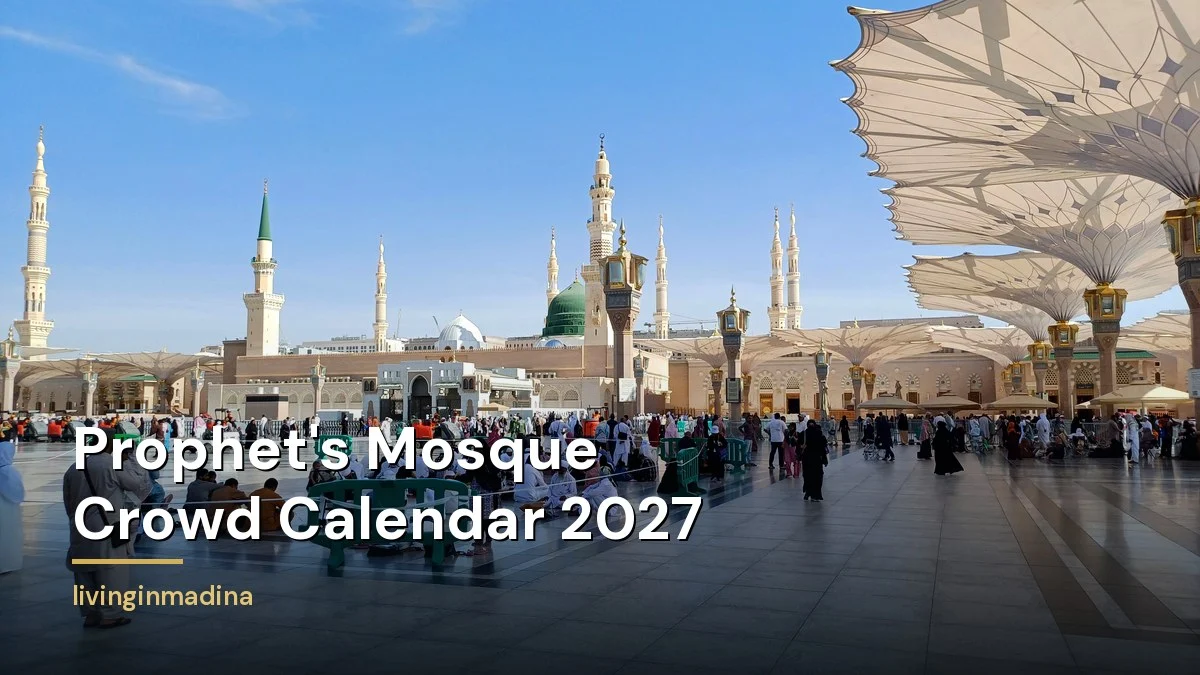
Featured image: "Masjid al-Nabawi 2024 (11)" by Radosław Botev, via Wikimedia Commons, CC BY 3.0 PL; cropped, with title added.