This question comes up often: from employers posting staff to Madinah, from families with relatives of other faiths, and from travellers planning a trip to Saudi Arabia. The answer matters, and it should come from official sources rather than forums.
This guide sets out what those sources say, in plain language. It’s general information, not legal advice, and it makes no claims beyond what the sources state.
Quick answer
Short answer: The official Saudi eVisa terms state that non-Muslims are not permitted to enter the Prophet’s Mosque and its premises in Madinah. Living in Saudi Arabia requires a residency permit through official channels. Rules can change, so check current official visa guidance before you travel or plan a move.
What the Saudi eVisa terms say
The official Saudi tourist eVisa is run by the Ministry of Tourism. Its terms ask every applicant to acknowledge that non-Muslims are not permitted to enter two places (Visit Saudi eVisa terms):
Official eVisa acknowledgement (Ministry of Tourism)
Makkah: non-Muslims are not permitted to enter the Holy Mosque and its premises.
Madinah: non-Muslims are not permitted to enter the Prophet’s Mosque and its premises.
Local laws: visitors accept that they are subject to local laws on entering the Kingdom.
The same terms say the eVisa is for tourism or Umrah, is not a work visa, and allows a maximum stay of 3 months per visit, with the visa valid for one year and multiple entries unless stated otherwise.
Tourist eVisa basics (official terms)
1 year
validity from issue
3 months
maximum length of stay
Check current official visa guidance
Visa rules and conditions can change. Before you travel, or before a family member or colleague does, check current official visa guidance on the Saudi eVisa site. For residency, follow the official process through your employer and Absher.
Living in Madinah: residency rules
Living in Saudi Arabia, in Madinah or anywhere else, requires a residency permit (iqama), normally sponsored by an employer. The tourist eVisa doesn’t allow paid work (Visit Saudi eVisa terms).
Residency services are managed through official platforms such as Absher. We don’t know of any official Saudi page that sets residency conditions by religion for Madinah, so we make no claim either way. Employers should confirm the position for any posting through official channels before a move.
Warning
Don’t rely on social media, forums or travel agents for this question. Follow official signs and the instructions of security staff, and check official sources before you travel.
Hajj-season rules apply to Makkah, not Madinah
Separate seasonal rules apply to Makkah. For Hajj 1447, the Ministry of Interior required residents without a Makkah-issued iqama, a Hajj permit or an approved work permit to obtain an official permit before entering Makkah (DARP). Those rules concern Makkah, so don’t mix them up with Madinah.
Practical guidance for hosts and employers
If you live in Madinah and are hosting colleagues or relatives who aren’t Muslim, plan with respect for the rules above.
Planning a respectful visit
1
Check official sources first: read the eVisa terms and any update from Saudi authorities.
2
Respect the Prophet’s Mosque rule: follow official signs and the instructions of security staff.
3
Confirm with the sponsor: for work postings, ask the employer to confirm through official channels.
4
Keep documents handy: carry your passport, visa or iqama at all times.
Tip
For mixed-faith families, agree a plan before the visit so everyone knows which places each person will go to.
FAQ
Can non-Muslims enter the Prophet’s Mosque in Madinah?
No. The official Saudi eVisa terms state that non-Muslims are not permitted to enter the Prophet’s Mosque and its premises.
Where can I check the current rules?
Check current official visa guidance on the Saudi eVisa site, and follow official signs and staff instructions on arrival.
Can non-Muslims work and live in Madinah?
Living in Saudi Arabia requires a residency permit through official channels. Employers should confirm any posting through official channels.
Last checked 16 November 2026. This is general information, not legal advice. Always confirm with official Saudi sources.
Your iqama (resident ID) is the document your whole life in Madinah depends on. Your lease, bank account, phone contract, children’s school places and Rawdah bookings all rely on it being valid. Small mistakes with it cause problems that take far longer to fix than to avoid.
This guide explains how sponsorship works in practice, who renews what, and the mistakes that cause most delays. We don’t quote fees, because they change; Absher shows the current amount.
Quick answer
Short answer: Most expats in Madinah hold an iqama sponsored by their employer, who handles the worker’s own renewal. Family members and registered domestic workers are renewed by their sponsor through Absher. Deadlines, penalties and fees change, so check the official page on Absher or the Ministry of Interior site before every renewal.
How sponsorship works
For most expats, residency starts with a job. Your employer sponsors your work visa, and after you arrive it arranges your iqama. A tourist eVisa is not a substitute: the official terms say it’s for tourism or Umrah and doesn’t allow paid work (Visit Saudi eVisa terms).
Once you hold an iqama, you can sponsor eligible family members, subject to the conditions shown in Absher and your employer’s policy. Our guide to moving with family covers that process.
Who renews what
The National Platform’s iqama renewal service explains that family members’ and registered domestic workers’ resident IDs are renewed through Absher.
Whose iqama
Usually renewed by
Channel
Private-sector worker
Employer
Employer’s government platforms
Family member
The resident sponsor
Absher Individuals
Registered domestic worker
The sponsor
Absher Individuals
Who handles each renewal
If you’re an employee, your main job is to check your own expiry date and make sure HR has everything it needs in good time.
Deadlines and penalties: check the official page
Renewal deadlines and late-renewal penalties are set by the Ministry of Interior and can change. Rather than rely on figures repeated online, check the official rules on Absher or the Ministry of Interior iqama page before each renewal, and ask HR how your employer handles it.
Checking fees safely
Renewal costs can include more than the iqama fee itself, depending on your category and household. Don’t rely on figures shared on social media. Open Absher, choose the renewal service for the person concerned, and read the amount shown before you confirm. If you’re employed, ask HR what the company covers.
Common mistakes
Avoid these
Leaving renewal to the last few days
Not checking for unpaid traffic fines or other dues
Letting a family member’s passport expire
Mixing up expiry dates for several family members
Paying an unofficial “agent” instead of using Absher or your employer
Not updating your National Address after moving home
Unpaid dues and expired passports are common reasons a renewal won’t go through, so check both a few weeks ahead. If you move house within Madinah, update your National Address, which Saudi Post describes as the address used for deliveries and government services (SPL).
Warning
Never pay anyone who promises to “speed up” an iqama or arrange residency outside official channels. Renewals go through Absher or your employer’s government platforms only.
Why a valid iqama matters in Madinah
Daily life here depends on it. Rawdah bookings on Nusuk, school registration, bank accounts and lease registration on Ejar all ask for valid ID. If your iqama lapses, these services can stop working until it’s renewed.
A yearly residency routine
1
List every iqama: with expiry dates, for everyone in the household.
2
Set reminders: 30 days before each expiry.
3
Clear dues: check for fines or outstanding payments.
4
Check passports: make sure each one is valid.
5
Renew and save proof: take a screenshot of the new expiry date.
Tip
Keep a shared family document with every iqama number, passport expiry and Absher login owner. It saves a lot of stress when renewals cluster in the same month.
FAQ
When should I renew my iqama in Madinah?
Check the official deadline on Absher or the Ministry of Interior site, and start a month ahead to be safe.
Can I renew my family’s iqamas myself?
Yes. The National Platform says family members’ resident IDs are renewed through Absher.
Can I live in Madinah on a tourist eVisa?
No. The official terms say the eVisa is for tourism or Umrah and doesn’t allow paid work. Residency requires an iqama.
Last checked 16 November 2026. Fees and conditions change; always check Absher before paying.
Madinah’s climate shapes almost everything about daily life, from when families go out to how homes are cooled. Knowing the pattern helps you plan school runs, outings, visits to the Haram and even grocery trips. This guide sets out Madinah weather by month using long-term climate averages, then turns them into practical planning tips for residents.
Quick answer
Short answer: Madinah is hot and dry for most of the year. Long-term averages show daytime highs around the low-to-mid 20s °C in winter and around or above 40 °C from June to September, with very little rain. The rain that does fall comes mostly in the cooler months and can arrive as sudden heavy downpours, so check the National Center for Meteorology (NCM) forecast and follow Civil Defense advice.
Key takeaways
January has the mildest days: an average high of 23.6 °C and low of 11.6 °C (WMO normals, 1961–1990).
August has the hottest average high in the same record, 42.2 °C.
Rain is scarce: about 49 mm a year on average, mostly between November and May.
Heat advice: the MOH says don’t wait until you feel thirsty to drink (MOH).
How to read these numbers
The figures below are long-term averages for the Madinah weather station, reported to the World Meteorological Organization for 1961–1990. They show the shape of the year, not the weather on any given day.
Individual years and weeks can be hotter, cooler or wetter than average. For day-to-day planning, use the NCM’s forecast and warning service for the Madinah region.
Madinah climate at a glance (long-term averages)
23.6 °C
average January high
42.2 °C
average August high
49 mm
average yearly rainfall
Madinah weather by month
Month
Avg high (°C)
Avg low (°C)
Avg rain (mm)
January
23.6
11.6
8.0
February
26.1
13.3
1.2
March
30.2
17.4
8.3
April
33.9
20.8
11.9
May
38.9
24.9
4.6
June
41.7
27.9
0.4
July
39.3
28.4
0.2
August
42.2
28.7
0.3
September
41.0
27.1
0.1
October
36.4
21.9
1.1
November
29.7
17.2
9.2
December
25.0
12.9
3.8
Average monthly highs, lows and rainfall (WMO normals, 1961–1990)
Season by season: what it means for families
Winter (December to February) is the most comfortable time for outdoor plans. Evenings can feel cool, so keep a light jacket for children, especially on early-morning trips.
Spring (March to May) warms up quickly. April has the highest average rainfall in this record, and May highs already approach 39 °C. Move outings earlier or later in the day as the weeks pass.
Summer (June to September) is long and very hot. Plan errands, school runs and park visits for the early morning or after sunset, and keep the car shaded and cool.
Autumn (October and November) brings gradual relief. November is one of the wetter months on average, and the WMO’s newer 1982–2011 summary also shows it as the wettest month (WMO).
Staying safe in the heat
The Ministry of Health lists older adults, infants and children, pregnant women and people with chronic conditions among those most at risk from heat. Its advice includes light, loose clothing, staying in cool places, planning outdoor activities carefully and resting in shade.
The MOH also warns never to leave children in cars, which can become dangerously hot. Signs of heat illness include heavy sweating, dizziness, headache and nausea.
Warning
If someone shows signs of heat illness, move them somewhere cool and cool them with water. Give water only if they’re conscious, and take them to the nearest hospital, as the MOH advises.
Rain and flash floods: rare but serious
Rain is uncommon, which is exactly why it can catch people out. When heavy rain is expected, Civil Defense urges people to stay in safe places, keep away from flood channels and valleys, never swim in them, and follow official instructions (Okaz, citing Civil Defense).
Finding a home is one of the biggest decisions when you settle in the city. A good choice makes school runs, work and prayer times easier, while a rushed one can mean months of small problems. This checklist covers housing in Madinah from a tenant’s point of view: licences, the lease, the unit itself, utilities and your daily commute.
Quick answer
Short answer: Deal only with a licensed broker or the owner directly, inspect the unit carefully, and make sure the lease is registered on Ejar, the national rental platform. Record the unit’s condition at handover, pay rent through traceable channels, and plan your commute before you sign. Then follow our first-month checklist to set up your address and services.
Key takeaways
Ejar registration: the landlord must apply to register an unregistered lease; the tenant may also request it (REGA).
60-day window: the other party can object to registered contract data within 60 days of notification.
Auto-renewal: contracts renew automatically unless either party gives notice at least 60 days before the end date (REGA).
Proof of payment: Ejar supports electronic rent payment, including Mada and SADAD (MoMAH).
Start with who you’re dealing with
If a broker shows you the property, ask for their licence number. The Real Estate General Authority’s broker inquiry lets you check a broker’s licence details online before you go further.
If you’re dealing with the owner directly, ask to see that they have the right to rent the unit, and keep all messages and agreements in writing. Avoid paying deposits in cash to someone you can’t identify.
Housing in Madinah: why the Ejar lease matters
Ejar is the national electronic network for rental services, run under REGA. According to the Ministry of Municipalities and Housing, standardized residential contracts documented on Ejar are treated as enforceable instruments, which helps protect both sides if there’s a dispute. You can check a lease or start a request on the official Ejar platform.
The same source notes that, under Cabinet Resolution No. 292, a lease that isn’t registered on the network isn’t considered a valid contract producing administrative and judicial effects. In practice, many services also ask for your registered lease, so it pays to get it right from day one.
Good to know
REGA’s rules on rent increases differ by city. A five-year rent freeze applies to properties in Riyadh. Elsewhere, REGA says rent changes are governed by mutual agreement as set out in the contract, so read the rent and renewal clauses carefully.
Inspect the unit before you agree
Visit at least once in daylight. Madinah summers are long and hot, so the cooling system matters as much as the layout.
Air conditioning: run every unit and check that it cools properly.
Water: open taps, check pressure and look under sinks for leaks or damp.
Electrics: test switches and sockets, and look for exposed wiring.
Safety: Saudi Civil Defense stresses smoke detectors, gas-leak detectors, a fire extinguisher and a fire blanket at home. Check Saudi Civil Defense for its current home-safety guidance.
Access: stairs, lifts and parking, especially for older relatives or a pram.
Warning
Don’t sign or pay anything until you’ve seen the actual unit you’ll live in, not a “similar” one. Keep copies of every payment, and avoid cash deals with no receipt.
Utilities, address and commute
Ask who holds the electricity and water accounts and how meter readings will be recorded at move-in. MoMAH says Ejar partners with service providers so services can be transferred into the name of the person actually living in the unit. The Saudi Electricity Company also has an online meter declaration service.
Then think about daily life. Time the drive or bus trip to work, school and your usual masjid at the hours you’ll travel. Our transport guide and schools guide can help.
Registered on Ejar
Informal, unregistered
Legal standing
Standard contract treated as an enforceable instrument
Not considered a valid contract with administrative and judicial effects
Condition at move-in
Electronic receipt and handover service
Depends on your own photos and notes
Rent payment
Electronic channels such as Mada and SADAD
Often cash, harder to prove
Renewal
Clear auto-renewal and notice rules
Unclear, open to dispute
Registered Ejar lease vs informal agreement
From viewing to moving in
1
Check the broker: look up their licence on REGA before you commit.
2
Inspect and agree in writing: cover rent, payment schedule, term and who maintains what.
3
Register on Ejar: review the contract data carefully when you’re notified.
4
Record the handover: use Ejar’s electronic receipt and take dated photos.
5
Set up services: transfer utilities and register your National Address.
Before you commit
Broker licence checked, or owner identity confirmed
Air conditioning, water and electrics tested
Smoke detector and fire extinguisher in place
Rent, term and renewal clauses understood
Lease registered on Ejar and data reviewed
Commute tested at real travel times
A final word
A careful start saves a lot of stress later. Take your time, keep everything in writing and on the official platforms, and choose a home that fits your family’s daily rhythm in the city.
If you are looking at a whole villa or one floor of a villa, read our guide to renting a villa or floor in Madina for what to check on costs, maintenance and neighbors.
Last checked: 16 November 2026. General information only, not legal advice. Rental rules are set by REGA and can change, so confirm on official channels before you sign. For the wider moving-in overview, see Moving to Medina.
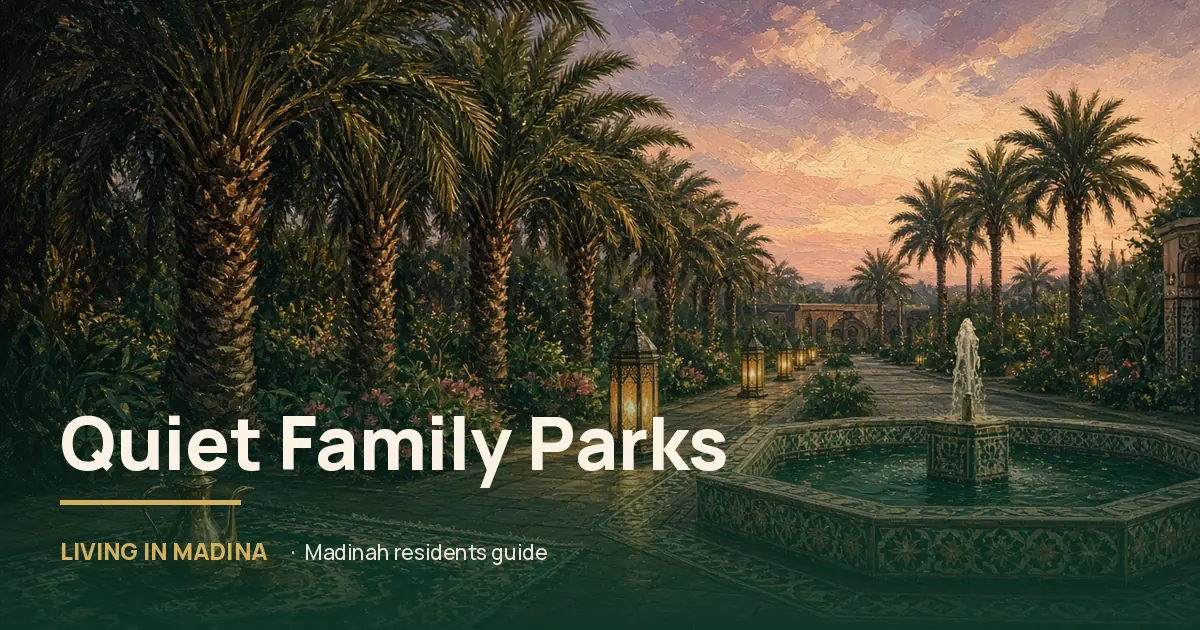
Not every family outing needs a long plan. Sometimes the best evening is a walk under the palms, a playground for the children and a quiet bench for the grown-ups. This guide covers family parks in Madinah and the city’s public walkways, using details from Visit Madinah, the official tourism platform supervised by the Madinah Development Authority.
Short answer: For a calm outing, try King Fahd Park south of the Prophet’s Mosque, Prince Mohammed bin Abdulaziz Park near Mount Uhud, or the Al-Aqiq Valley and Al-Hijrah walkways. Go in the late afternoon or evening, carry water and keep the outing short in hot months. For a weekend that includes Quba Mosque and Uhud, see our family weekend guide.
Key takeaways
King Fahd Park is about 5 km south of the Prophet’s Mosque. Check opening hours before visiting on the official Visit Madinah page.
Prince Mohammed bin Abdulaziz Park near Mount Uhud has free entry; some events need tickets.
Al-Aqiq Valley walkway is 1,600 metres long and open year-round.
MOH heat advice: schedule outdoor activities carefully and rest in shaded areas (MOH).
Why family parks in Madinah work for busy weeks
Madinah’s larger parks and walkways are close to many residential districts. That makes them easy for a short evening visit after school or work, without a big trip across the city.
They also suit families who want something quieter than malls or busy attractions. Children get space to run, older relatives can sit in the shade, and everyone is home in good time. Our weekend guide to Quba and Uhud covers a fuller day out.
Parks and walkways at a glance
5 km
King Fahd Park, south of the Prophet’s Mosque
Check hours
King Fahd Park: confirm opening hours before visiting
1,600 m
Al-Aqiq Valley walkway length
3 km
Al-Hijrah walkway length
King Fahd Park: the all-rounder
Visit Madinah describes King Fahd Park as a family space with green areas and tall trees. Its facilities include walking and running trails, children’s playgrounds, a horse-riding area, an artificial lake, cultural spaces and restaurants.
It also has a heritage quarter and the Madinah Arts Center, so older children can combine play with a look at local culture. Arrive close to opening time on weekdays if you prefer a quieter visit.
Prince Mohammed bin Abdulaziz Park, near Uhud
This park sits on the Ring Road in the Mount Uhud area, north of the city, about 7 km from the Prophet’s Mosque. It has green spaces, seating areas, cafes, children’s games, and rabbit and bird reserves.
Entry is free, though organised events and some activities need tickets. It pairs well with a respectful visit to the Uhud area, which our weekend guide covers.
Walkways for an evening stroll
Madinah’s walkways are popular with residents for exercise and fresh air:
Al-Aqiq Valley walkway, near the Islamic University, is about 6 km from the Prophet’s Mosque. It has shaded rest areas, lighting and non-slip paving, and it overlooks historic sites in a valley mentioned in the Prophet’s biography ﷺ.
Al-Hijrah walkway, along Abbas bin Ubadah Street, about 2.8 km from Quba Mosque, runs about 3 km with greenery, benches and exercise equipment.
Al-Qaswa walkway, in southwest Madinah, was built by Madinah Municipality and includes children’s playgrounds, an interactive fountain and a cycling track.
Tip
Pick the park or walkway closest to your home for weekday visits. Save the bigger outings for weekends, when you have more time.
Planning around the heat
For much of the year, afternoons are hot. The Ministry of Health advises scheduling outdoor activities carefully, resting in shade, wearing light clothing and drinking fluids without waiting to feel thirsty.
The MOH lists infants, children, older adults and pregnant women among the groups most at risk. It also warns never to leave children in cars, which can get dangerously hot.
Warning
If someone feels dizzy, has a headache, nausea or heavy sweating, move them to a cool place and cool them with water. The MOH advises taking anyone with signs of heat illness to the nearest hospital.
Plan a calm park evening
1
Choose by distance: start with the park or walkway nearest your district.
2
Time it well: go in the late afternoon or after sunset in hot months.
3
Pack light: water, a hat for the children, wipes and a bag for rubbish.
4
Head home early: keep it short on school nights so routines stay on track.
Large park
Walkway
Best for
Playgrounds, longer visits
Short walks, exercise
Examples
King Fahd Park, Uhud-side park
Al-Aqiq, Al-Hijrah, Al-Qaswa
Good to know
Some activities may be ticketed
Lit and open long hours
Which outing suits your family?
Park etiquette in the blessed city
Parks are shared spaces for families from many backgrounds. Keep voices and music low, supervise children on play equipment, and leave picnic spots clean.
If you see damaged equipment, broken lighting or cleanliness problems, report it through the Balady app or the 940 municipal line (MoMAH).
Last checked: 16 November 2026. Opening times and facilities can change; check the official Visit Madinah platform before you go.
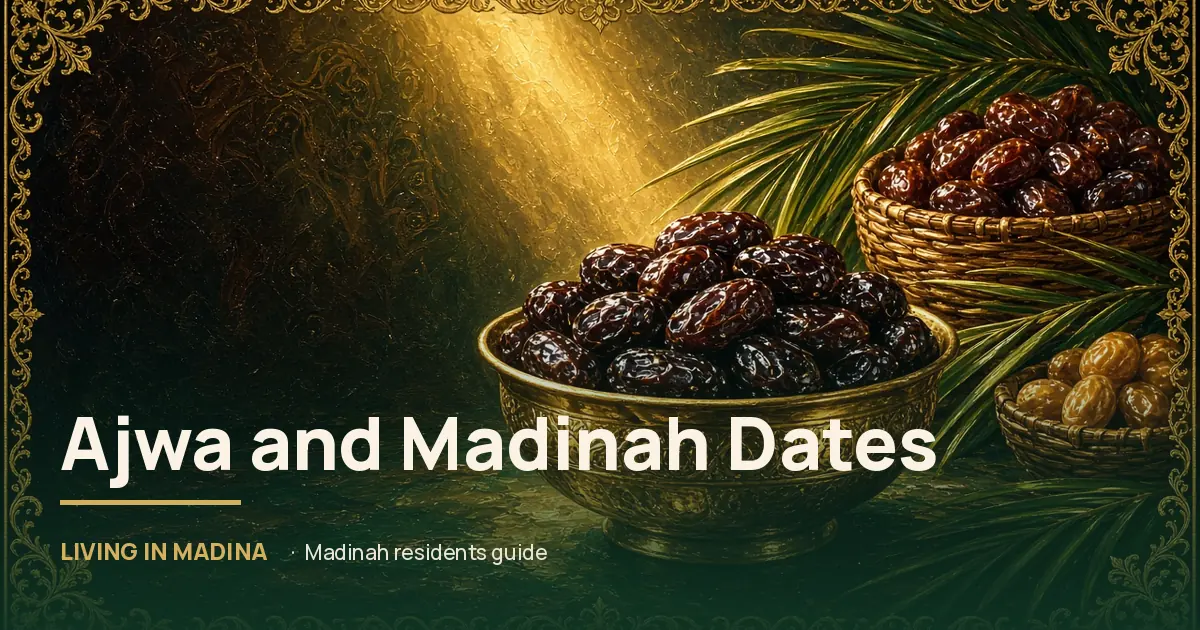
The Madinah Central Dates Market (سوق المدينة المركزي للتمور) is the city’s main market for dates. It sits in the Food City project on the eastern side of Madinah, at the junction of King Khalid Road (Third Ring Road) and Ali bin Abi Talib Road, about 11 km from Masjid an-Nabawi in a straight line. Most people get there by car, taxi or a ride-hailing app. This guide covers where the market is, how to get there, when to go, and how to choose, wash and store Ajwa and other Madinah dates once you’re home.
Quick answer
Short answer: The Madinah Central Dates Market is in Food City, at the junction of King Khalid Road (Third Ring Road) and Ali bin Abi Talib Road, east of the city centre. It opened in September 2025. Date shops stay open while a second phase is being built, but the auctions are paused until that work is finished, which is expected in June 2027. The big Madinah Dates Season runs there in summer. In 2026 it ran from 20 June to 4 August, open daily from 5:00 pm to 11:30 pm. Madinah is best known for Ajwa, and Safawi is one of the easiest local dates to find.
Key takeaways
Ajwa is cultivated in Al-Madinah Province and is dark, almost black, with fine winding lines (Saudipedia).
Safawi dates are medium-sized, black and semi-dry, and found in nearly all Madinah markets (Visit Saudi).
The Central Dates Market opened in September 2025; its first phase covers more than 37,000 m² (SPA).
The SFDA says freezing is the best way to preserve dates (SFDA).
Why dates matter in Madinah
Date palms have shaped Madinah for centuries, and the region remains a major producer. Saudipedia, citing the National Center for Palms and Dates, puts the province at about 4.5 million date palms, including around 800,000 Ajwa palms.
Dates also carry religious meaning for Muslims. In Sahih Muslim, ‘A’isha reported that the Prophet ﷺ said: “A family which has dates will not be hungry.” (Sahih Muslim 2046a, sunnah.com)
About Ajwa specifically, Sa’d reported that the Messenger of Allah ﷺ said: “He who eats seven ‘Ajwa dates every morning, will not be affected by poison or magic on the day he eats them.” (Sahih al-Bukhari 5445, sunnah.com) Many families keep Ajwa at home for this reason. Treat it as a Sunnah to follow, not as a replacement for medical care.
Madinah dates in numbers
4.5 million
date palms in Al-Madinah Province (Saudipedia)
37,000 m²
first phase of the Central Dates Market (SPA)
3 months
longest fridge storage for some date types (SFDA)
Varieties worth knowing
These are the names residents meet most often, as official sources describe them.
Variety
What to expect
Good to know
Ajwa
Round, very dark, distinctive taste
Madinah’s best-known date; popular as a gift
Safawi
Medium-sized, black, semi-dry
Widely available across Madinah markets
Anbara (Amber)
Premium date with a dry taste
Scarce, so it’s usually among the costliest
Khudri
Large, dark red, chewy flesh
One of the most common dates in shops
Sukkari
Golden, sweet, sometimes crisp
Grown mainly in Qassim; widely sold
Common dates you’ll see in Madinah
Saudipedia notes that Ajwa is known locally in two forms: a larger fruit called Ajwat Abi Dhira’a and a smaller one called al-Madradimah. If a seller uses those names, that is what they mean.
Harvest season and timing
Dates are eaten at several stages. Visit Saudi lists four: kimri (unripe, green), khalal (full-size, crunchy, yellow), rutab (ripe and soft) and tamr (fully ripe, sun-dried and dark).
Photo: Date farm.JPG by Faheem siddiq on Wikimedia Commons, CC BY-SA 3.0. Resized to 1200×1600, converted to WebP; the edited version is released under CC BY-SA 3.0.
For Ajwa, Saudipedia says the fruit reaches the khalal stage in the second half of June and the tamr stage by August. Visit Saudi suggests looking for freshly harvested dates in the souqs from August to November.
Late summer is also when the Madinah Dates Season usually runs at the Central Dates Market, with auctions and producers’ stands. In September 2024, SPA reported auctions there featuring some 28 local varieties.
Madinah Central Dates Market: location, timings and how to get there
The Madinah Central Dates Market opened on 9 September 2025 inside the Food City (مدينة الغذاء) project. Its first phase covers more than 37,000 m², according to the Madinah Region Development Authority and SPA. The site also includes the “Dhat Nakhl” dates museum and exhibition.
Where it is
Address: junction of King Khalid bin Abdulaziz Road (Third Ring Road) and Ali bin Abi Talib Road, Food City, Madinah.
Distance: about 11 km east-southeast of Masjid an-Nabawi in a straight line. That is too far to walk, so plan on a car or taxi.
On the map: search for “Madinah Central Dates Market” or “سوق التمور المركزي” in your maps app. That is more reliable than following an old pin for the former dates market.
How to get there
By car: join the Third Ring Road (King Khalid Road) and exit at Ali bin Abi Talib Road. The market is part of the Food City complex at that junction.
By taxi or ride-hailing app: type the market’s name in Arabic or English as your destination. From the central area around the Haram, it is usually a short ring-road drive, but allow extra time after Isha and at weekends.
Outside the season: the retail date shops keep longer daily hours. Map listings show the market open from early morning until late evening, but hours can change, so check the live listing or call a shop before you make a special trip.
Work in progress (November 2026): the operator has started the second phase, which adds retail shops and a separate auction yard. The current auctions are paused, but the shops stay open. Completion is expected in June 2027, as Al-Watan reported on 4 November 2026.
Best time for fresh dates: the freshest dates usually reach the shops from late summer into autumn, during and just after the harvest.
Away from the central market, you can buy dates in ordinary supermarkets and in date shops in most neighbourhoods. Buying from a licensed, established shop with clear labelling is the safest everyday choice.
Tip
New to the city? Make sure your National Address is set up before you order dates for home delivery. Our first-month checklist walks through it.
How to buy good dates
A few simple habits help you avoid a disappointing batch.
Before you buy
Ask to taste a sample, and compare two or three varieties side by side
Split a date open to remove the seed and check it is free of pests (a tip from Visit Saudi)
Check that the colour and texture are even across the box, with no mould or unusual stickiness
Read the label on packaged dates for the variety, packing date and producer
Buy an amount you can store properly rather than one very large box
Buying as a gift?
Ajwa is the classic gift from Madinah. Choose sealed, labelled packs so the dates travel well, and check the import rules of the country you’re sending them to before you post them.
Washing and storing dates at home
The Saudi Food and Drug Authority (SFDA) advises washing dates well under running water before eating. This reduces any pesticide or chemical residues. It also says not to reuse the same washing water for another batch.
For storage, the SFDA describes refrigeration, freezing and drying.
Storing dates the SFDA way
1
Short term (fridge): keep dates in airtight, moisture-proof containers; they last several weeks, and some types up to three months.
2
Long term (freezer): freezing is the best method; use the lowest temperature your freezer allows.
3
Remember ripening continues: enzyme activity does not fully stop in the freezer, so soft dates may keep softening.
4
Dried dates: with moisture reduced to about 20% and storage at 25°C, the SFDA says dates can keep for up to a year.
Warning
Dates are naturally high in sugar. If anyone in your family manages diabetes or another health condition, ask your doctor how many dates suit them.
Making dates part of family life
Many families keep a small dish of dates ready for guests, and children can help sort and wash a new batch.
General information, last checked 20 November 2026. Market arrangements and event dates are set by the authorities and can change; check official announcements before you go.
Moving to Madinah is a big change, and the first month sets the tone. Families who settle fastest tend to work through the admin in a set order, so each step makes the next one easier. This week-by-week checklist focuses on your National Address, the main government apps, healthcare access and home basics. It doesn’t include prices or fixed processing times beyond what the official services publish.
At a glance
Week 1: digital basics (Absher, Tawakkalna, SIM).
Week 2: register your National Address.
Weeks 2–3: Sehhaty and your nearest primary care centre.
Weeks 3–4: home basics and community routines.
Week 1: Get your digital basics working
Absher. The Ministry of Interior’s platform for digital services for citizens and residents. Make sure your login works and your mobile number is correct, because verification codes are sent there and many other services rely on the same national sign-on.
Tawakkalna. The national comprehensive services app, run under the Saudi Data and AI Authority (SDAIA). Install it and look through which services and digital documents are available to you.
A local SIM. If you don’t already have one, a SIM in your own name from one of the major operators makes verification codes and deliveries far easier.
Tip: Make a secure note of your Iqama number, passport details and emergency contacts. Don’t screenshot sensitive documents into shared family chats.
Week 2: Register your National Address
Saudi Post’s National Address gives your home an official, standard address: building number, street, secondary number, district, postal code and city, plus a short address of four letters and four numbers.
According to the National Platform:
Individuals register online after signing in with the national sign-on (Absher credentials).
Activation is shown as ready within 24 hours.
Registered users can later update the address or print a proof-of-address document through the “Managing National Address” service.
Why this matters in Madinah: Districts such as Al-Aziziyah, Shuran or Al-Khalidiyah cover large areas. A precise address and short code save drivers, delivery riders and visiting relatives a lot of phone calls. Save your short address in your phone and share it whenever someone needs to find your home.
Sehhaty. The Ministry of Health’s platform for appointments at eligible facilities, records and other services. Register each family member as the app allows; see our Sehhaty guide.
Your nearest primary care centre. Public care in the region is organized through the Madinah Health Cluster. Find your nearest primary healthcare centre and save its location.
Private insurance. If your employer provides health insurance, check which clinics near your district are in the network.
Electricity and water. Confirm with your landlord which accounts belong to your unit and how readings will be handled at move-in. In the hot months, keep an eye on your air-conditioning use.
Drinking water. Many households arrange bottled water delivery. Choose a supplier with clear contact details.
Groceries. Find your nearest supermarket and a smaller neighborhood shop for quick top-ups. See our groceries tips.
Banking. If you haven’t yet, open an account once your Iqama and address details are in place. Ask your employer which bank payroll uses.
Week 4: Find your community rhythm
Your local masjid. Learn its prayer times and Friday arrangements. Many residents pray locally on most days and plan visits to Masjid an-Nabawi around their schedule.
Getting around. Try the Madinah Bus network for one regular trip and compare it with driving or ride-hailing. See our getting around guide.
Children’s routines. If you have school-age children, start on school registration early. See our schools and tutoring guide for how registration generally works.
Printable first-month checklist
First-month checklist
Absher login and mobile number verified
Tawakkalna installed
Local SIM in your own name
National Address registered and short address saved
Sehhaty set up for each family member
Nearest primary care centre and emergency department saved
Electricity and water accounts confirmed with your landlord
Bank account opened
Local masjid and a regular transport route sorted
A gentle note for new residents
Madinah is a city many people love deeply. A calm, respectful approach (patience in crowded areas, following official instructions, and consideration for neighbors and visitors) helps you settle in, not just to an address but into a community.
General information only. Procedures are set by the relevant authorities and may change; always confirm on official channels. For the wider moving-in overview, see Moving to Medina.
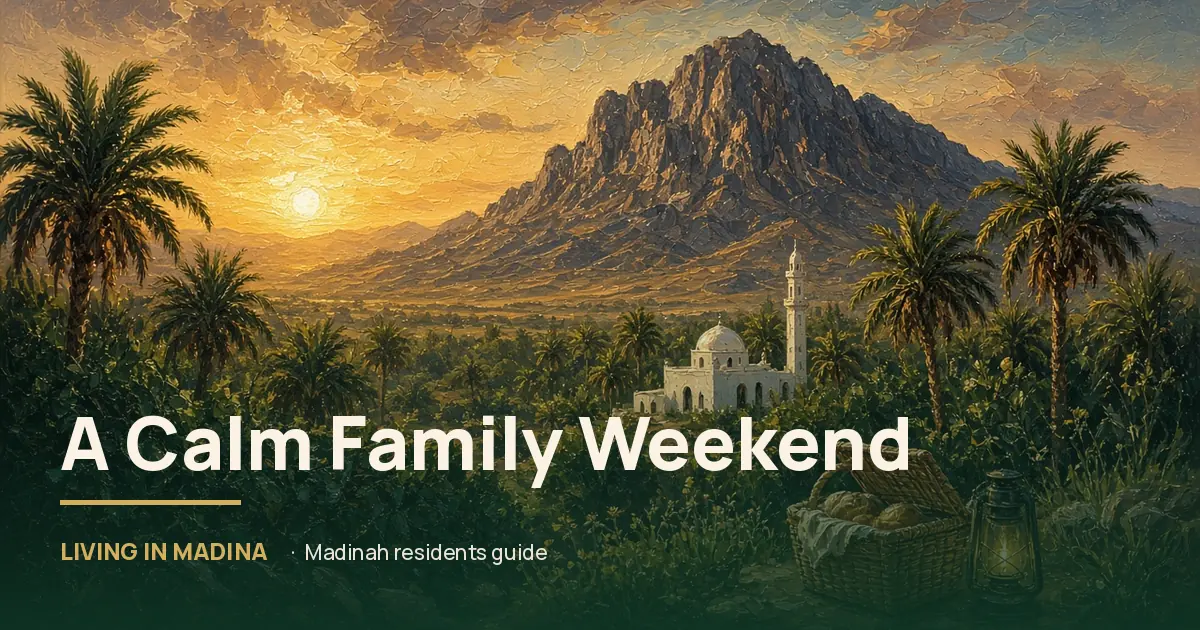
One of the quiet blessings of living in Madinah is that some of Islam’s most significant places are part of the everyday landscape. On a free weekend, many families combine worship, a little history and time outdoors. This guide suggests a gentle, child-friendly way to do that, built around Quba Mosque and Mount Uhud. It focuses on timing, comfort and respect rather than a packed itinerary.
Mount Uhud: calm, respectful, and avoid summer midday.
Friday: keep the morning for Jumu’ah; sightsee Saturday.
Comfort: water, shade and rest stops for all ages.
Start with Quba Mosque
Quba Mosque is in the Quba district, south of the central area. Visit Saudi describes it as a historic landmark among Madinah’s attractions; many residents make a regular habit of visiting.
It is also established in Sahih al-Bukhari that the Prophet ﷺ used to go to the Mosque of Quba every Saturday, sometimes walking and sometimes riding, and that Ibn Umar (may Allah be pleased with them) used to do the same (Sahih al-Bukhari 1193).
Practical tips for families:
Make wudu at home before you leave, to save time at busy facilities.
Go early in the morning or after Asr to avoid the midday heat.
Dress modestly and comfortably, with shoes that are easy to slip on and off.
Keep children close in crowded areas and agree a meeting point with older children.
Getting there: Quba Road links the area with the centre of the city. Families living along the Al-Khalidiyah and Quba corridor can often get there quickly by car. Others can check whether a current Madinah Bus route suits them (see our Quba overview).
Mount Uhud: history with reflection
North of the city, Mount Uhud is closely linked to the Battle of Uhud in early Islamic history. Families often visit to reflect on the Seerah and pay their respects at the martyrs’ burial area at its foot.
Visiting respectfully:
Prepare your children beforehand. A short, age-appropriate story about Uhud from a trusted Seerah book makes the visit far more meaningful than simply turning up.
Keep it calm and dignified near the burial area. Follow posted guidance and staff instructions, and keep your voice low. This is mainstream ziyarah etiquette — no practices beyond what is ordinarily taught.
Respect boundaries. Don’t climb restricted areas, and keep children away from rocky slopes.
Avoid summer midday. There’s little shade on open ground. Early morning is usually the most comfortable time.
Access arrangements, facilities and any posted rules are set by the authorities and can change; follow on-site guidance.
Sample half-day plan (adapt to the season)
Time of day
Suggestion
Early morning
Wudu at home, then pray at Quba Mosque
Mid-morning
Breakfast nearby or at home
Late morning (cooler months only)
A short, respectful visit to Uhud
Midday
Home for rest, especially in summer
Evening
A walk in a neighborhood park, or Maghrib/Isha at your local masjid or Masjid an-Nabawi
In the hottest months, move the outdoor parts to after Asr and keep each stop short.
Fitting the plan around Friday
Friday is the main weekly day off for many families, and it centres on Jumu’ah. Many residents:
Keep Friday morning calm. Prepare for Jumu’ah and pray at their local masjid or at Masjid an-Nabawi, leaving early.
Save sightseeing for Saturday morning or after Asr on Friday.
Plan around traffic near the central area at prayer times.
Water and snacks for every child, plus a small first-aid kit.
Sun protection: hats, light clothing, and shade wherever you can find it.
Rest stops for grandparents and young children.
Health advice: if someone feels unwell from the heat, move them to shade and ask a pharmacist or doctor; MOH services are on Sehhaty. In an emergency, go to the nearest hospital emergency department.
Small habits that make the weekend meaningful
Choose one short dua or story to talk about as a family at each place.
Keep phones away during prayer and take photos considerately, never at the expense of other worshippers.
General information only. Access arrangements at religious and historic sites are set by the authorities and may change. Always follow official guidance and staff instructions on site.
Last checked: 16 November 2026. Rules, fees and services change; confirm on the official sources below before you act.