Tag: absher

  • Absher for Madinah Residents: Services You Will Actually Use

    Absher for Madinah Residents: Services You Will Actually Use

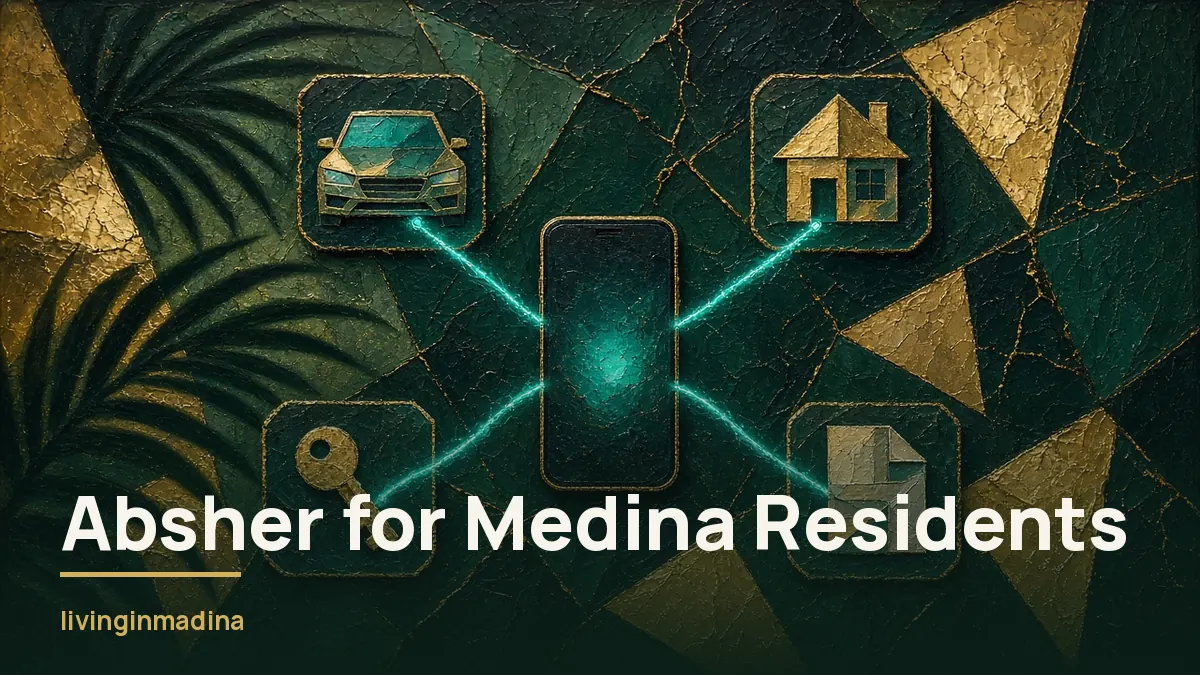
    Absher is the app most Medina residents open more often than they expect. Renewing a child’s iqama, checking a traffic fine, updating a passport: much of the paperwork that once meant a trip to an office now happens on your phone.

    This guide focuses on the services residents actually use, not every menu in the app. Fees and conditions change, so check the amount shown in Absher before you confirm anything.

    Quick answer

    Short answer: Absher is the Ministry of Interior’s official digital platform for citizens, residents and visitors. Medina residents mostly use it for family iqama renewals, passport and visa services, traffic matters and personal records. Register once your residency is issued, use only the official app, and check the fees shown before you pay.

    What Absher is

    According to the platform itself, Absher is the electronic platform of the Ministry of Interior, providing its services digitally to citizens, residents and visitors. Its services cover Ministry of Interior sectors such as Passports, Traffic and Civil Affairs, and have expanded to other agencies (Absher).

    For residents, that means your Absher login is one of the most important accounts you’ll hold in Medina.

    Absher at a glance

    • Run by: the Ministry of Interior (Absher).
    • For: citizens, residents and visitors.
    • Covers: sectors such as Passports, Traffic and Civil Affairs.
    • Family iqamas: renewed through Absher (National Platform).

    The services residents use most

    TaskWho usually does itWhere to look
    Renew a family member’s iqamaThe resident sponsorFamily member services
    Renew a registered domestic worker’s iqamaThe sponsorLabour or domestic worker services
    Passport and visa servicesYou, or the sponsor for dependentsPassports services
    Traffic mattersThe licence or vehicle holderTraffic services
    Common Absher tasks for Medina residents

    The National Platform’s iqama renewal service explains the renewal paths for family members and domestic workers. Menu names can change with app updates, so follow the current labels in the app.

    For driving licences, our licence renewal guide walks through the steps residents use most.

    Setting up your account safely

    Register on the official Absher site or app once your residency details are issued. Download the app only from the official store listing.

    Keep your Absher account safe

    • Use a strong, unique password
    • Keep your registered mobile number up to date
    • Never share one-time codes, even with someone claiming to be from a bank or ministry
    • Log out on shared devices
    • Check messages only inside the official app

    Warning

    Scammers often pretend to be from Absher or a ministry and ask for verification codes. Official staff will never ask you for your one-time code.

    How Absher fits with other services

    Absher works alongside the other accounts you’ll set up in your first weeks: your National Address from Saudi Post, Tawakkalna, Sehhaty and Nusuk. Our Tawakkalna guide and first-month checklist explain how they fit together.

    If you travel to Makkah in the Hajj season, check each year’s rules. For Hajj 1447, residents without a Makkah-issued iqama or an approved permit needed an official permit to enter Makkah (DARP).

    A monthly Absher routine

    Five-minute monthly check

    1

    Check iqama dates: for everyone in the household.

    2

    Check passports: make sure none is close to expiry.

    3

    Check traffic records: for any new notices.

    4

    Check messages: in the official app only.

    5

    Update details: after a move, a new phone number or a new family member.

    Tip

    Set a monthly phone reminder for your Absher check. Problems are much easier to fix when you spot them early.

    When Absher isn’t enough

    Some cases still need your employer, a sponsor’s action or an appointment. If a service doesn’t go through, the app usually shows a reason, such as an unpaid fine or an expired passport. Fix that first, then try again. For emergencies, use the official numbers on the National Platform, not Absher.

    FAQ

    What is Absher used for in Medina?

    Residents use it for Ministry of Interior services such as family iqama renewals, passport services and traffic matters.

    Is Absher official?

    Yes. Absher is the Ministry of Interior’s electronic platform for citizens, residents and visitors.

    Can I renew my family’s iqamas on Absher?

    Yes. The National Platform says family members’ iqamas are renewed through Absher.

    Last checked 16 November 2026. Menu names and fees change; follow the current app and official pages. For the wider moving-in overview, see Moving to Medina. Kingdom-wide Absher menus are also covered on InfoSaudi.
  • Moving to Medina With Family: Dependents, Documents and Timelines

    Moving to Medina With Family: Dependents, Documents and Timelines

    Bringing your family to Medina is a big step. Alongside the excitement, there’s a long list of documents, decisions and deadlines: residency for your spouse and children, school places, a home that works for everyone, and health cover.

    This guide shows how the pieces fit together and gives a practical planning timeline. We don’t quote fees or official processing times, because they vary by case and change; we point you to where to check them.

    Quick answer

    Short answer: Move with family in stages. Secure your own job and iqama first, then apply for your family’s residency through your employer and Absher, prepare attested documents, and arrange a home on Ejar and school places before they arrive. Check the current conditions and fees in Absher, and allow several months for the whole process.

    Step 1: Your own residency comes first

    Family residency for expatriate workers is built on the main sponsor’s iqama. Eligibility and fees depend on your job and circumstances, so start by asking HR and checking the family services shown in Absher.

    Once your family is here, you’ll manage their resident IDs yourself. The National Platform explains that family members’ iqamas are renewed through Absher (National Platform).

    Warning

    Only use your employer and official platforms for family visas and residency. Don’t pay agents who promise faster family visas outside the official process.

    Step 2: Prepare your documents early

    Document preparation is where many families lose time. Requirements vary by nationality and case, so confirm the list with your employer, but most families need some or all of these:

    Documents to gather

    • Passports for every family member, with plenty of validity left
    • Marriage certificate
    • Children’s birth certificates
    • Children’s school records and latest reports
    • Vaccination records
    • Any certificates your employer says must be attested in your home country

    Ask your employer early which documents need attestation and where. Attestation in your home country can take weeks.

    Step 3: A home that works for the family

    Choose the neighborhood around school and work, not just rent. A short school run makes a big difference in Medina’s long, hot summers. Our neighborhoods guide compares areas, and our housing checklist covers what to inspect.

    Register the lease on Ejar before paying, and register your National Address once you’ve moved in. Saudi Post explains that it’s used for deliveries and government services (SPL).

    Step 4: School places

    The Ministry of Education publishes admission rules for resident children in public schools, including how foreign certificates are handled (MOE). Its pre-registration service lists its sign-in options and steps (MOE).

    Private and international schools set their own processes and fees, so contact them directly and visit if you can. Our schools guide explains the options.

    Step 5: Health cover and essential contacts

    Ask your employer what health cover it provides for your family and which hospitals and clinics accept it. Set up Sehhaty for appointments (MOH), and add your dependants to the same health centre.

    Contacts every family should save

    A practical planning timeline

    There’s no official timeline that fits every family. This sequence is a planning aid based on the steps above, not an official processing schedule.

    Planning sequence for a family move

    1

    Before you move: confirm family eligibility and costs with HR and Absher; start document attestation.

    2

    Your first weeks: activate your iqama services, open a bank account, and research neighborhoods and schools.

    3

    Before the family arrives: apply for their residency through official channels, sign and register a lease, and request school places.

    4

    Arrival month: register the National Address, set up Sehhaty and enrol the children.

    5

    Every year after: renew family iqamas through Absher before they expire.

    Tip

    If you can, time the family’s arrival for the school holidays or the cooler months. Children settle more easily when they can start at the beginning of a term.

    FAQ

    Can I bring my family to Medina on my work visa?

    Family residency depends on your circumstances and your employer’s policy. Check the family services in Absher and ask HR.

    Which documents do my children need for school in Medina?

    The Ministry of Education’s admission page explains the rules, including how foreign certificates are handled. Private schools set their own requirements.

    How long does a family move to Medina take?

    It varies by case. Allow several months for documents, residency, housing and school places.

    Last checked 16 November 2026. Conditions and fees change; always check Absher and your employer before you act.

    From our sister guides: Saudi family visit visa: single vs multiple entry (Infosaudia); Saudi residency guide (Infosaudia); Family life in Makkah (Living in Makkah).

  • Madinah Residency for Expats: Iqama, Sponsorship and Common Mistakes

    Madinah Residency for Expats: Iqama, Sponsorship and Common Mistakes

    Your iqama (resident ID) is the document your whole life in Madinah depends on. Your lease, bank account, phone contract, children’s school places and Rawdah bookings all rely on it being valid. Small mistakes with it cause problems that take far longer to fix than to avoid.

    This guide explains how sponsorship works in practice, who renews what, and the mistakes that cause most delays. We don’t quote fees, because they change; Absher shows the current amount.

    Quick answer

    Short answer: Most expats in Madinah hold an iqama sponsored by their employer, who handles the worker’s own renewal. Family members and registered domestic workers are renewed by their sponsor through Absher. Deadlines, penalties and fees change, so check the official page on Absher or the Ministry of Interior site before every renewal.

    How sponsorship works

    For most expats, residency starts with a job. Your employer sponsors your work visa, and after you arrive it arranges your iqama. A tourist eVisa is not a substitute: the official terms say it’s for tourism or Umrah and doesn’t allow paid work (Visit Saudi eVisa terms).

    Once you hold an iqama, you can sponsor eligible family members, subject to the conditions shown in Absher and your employer’s policy. Our guide to moving with family covers that process.

    Who renews what

    The National Platform’s iqama renewal service explains that family members’ and registered domestic workers’ resident IDs are renewed through Absher.

    Whose iqamaUsually renewed byChannel
    Private-sector workerEmployerEmployer’s government platforms
    Family memberThe resident sponsorAbsher Individuals
    Registered domestic workerThe sponsorAbsher Individuals
    Who handles each renewal

    If you’re an employee, your main job is to check your own expiry date and make sure HR has everything it needs in good time.

    Deadlines and penalties: check the official page

    Renewal deadlines and late-renewal penalties are set by the Ministry of Interior and can change. Rather than rely on figures repeated online, check the official rules on Absher or the Ministry of Interior iqama page before each renewal, and ask HR how your employer handles it.

    Checking fees safely

    Renewal costs can include more than the iqama fee itself, depending on your category and household. Don’t rely on figures shared on social media. Open Absher, choose the renewal service for the person concerned, and read the amount shown before you confirm. If you’re employed, ask HR what the company covers.

    Common mistakes

    Avoid these

    • Leaving renewal to the last few days
    • Not checking for unpaid traffic fines or other dues
    • Letting a family member’s passport expire
    • Mixing up expiry dates for several family members
    • Paying an unofficial “agent” instead of using Absher or your employer
    • Not updating your National Address after moving home

    Unpaid dues and expired passports are common reasons a renewal won’t go through, so check both a few weeks ahead. If you move house within Madinah, update your National Address, which Saudi Post describes as the address used for deliveries and government services (SPL).

    Warning

    Never pay anyone who promises to “speed up” an iqama or arrange residency outside official channels. Renewals go through Absher or your employer’s government platforms only.

    Why a valid iqama matters in Madinah

    Daily life here depends on it. Rawdah bookings on Nusuk, school registration, bank accounts and lease registration on Ejar all ask for valid ID. If your iqama lapses, these services can stop working until it’s renewed.

    A yearly residency routine

    1

    List every iqama: with expiry dates, for everyone in the household.

    2

    Set reminders: 30 days before each expiry.

    3

    Clear dues: check for fines or outstanding payments.

    4

    Check passports: make sure each one is valid.

    5

    Renew and save proof: take a screenshot of the new expiry date.

    Tip

    Keep a shared family document with every iqama number, passport expiry and Absher login owner. It saves a lot of stress when renewals cluster in the same month.

    FAQ

    When should I renew my iqama in Madinah?

    Check the official deadline on Absher or the Ministry of Interior site, and start a month ahead to be safe.

    Can I renew my family’s iqamas myself?

    Yes. The National Platform says family members’ resident IDs are renewed through Absher.

    Can I live in Madinah on a tourist eVisa?

    No. The official terms say the eVisa is for tourism or Umrah and doesn’t allow paid work. Residency requires an iqama.

    Last checked 16 November 2026. Fees and conditions change; always check Absher before paying.

  • Moving to Medina: The Complete Guide for New Residents

    Moving to Medina: The Complete Guide for New Residents

    Moving to Medina means settling in a city that many people spend years hoping to visit. Living here is calmer than visiting it, but the first months still involve paperwork, house-hunting, schools and learning how the city moves around the Prophet’s Mosque.

    This guide is the starting point for everything on this site. Each section links to a deeper guide.

    Quick answer

    Short answer: Moving to Medina as an expat starts with a job and residency (iqama) sponsored through official channels, then Absher, a National Address and a lease registered on Ejar. After that, sort schools through the Ministry of Education, set up the MOH’s Sehhaty app, and learn the Madinah Bus network and the Haramain train.

    Key takeaways

    • Residency services: run through Absher, including family iqama renewal (National Platform).
    • Leases: residential contracts are documented on Ejar.
    • Health: the MOH’s Sehhaty app handles appointments and records.
    • Train: Madinah’s Haramain station is in Al Hadra district and opens daily 06:30–00:30 (HHR).

    Step 1: Residency comes first

    For most expats, the move is built on a job offer. Your employer sponsors your work visa and residency, and once you arrive the iqama becomes your key document for banking, renting, phone contracts and healthcare.

    Day-to-day residency services are handled through Absher. The National Platform explains, for example, that family members’ and domestic workers’ iqamas are renewed through Absher (National Platform). Fees and conditions change, so we don’t quote them; check Absher or ask your HR team.

    Warning

    Only follow residency steps from official platforms or your employer. Never pay an agent who promises a “quick iqama” or a visa outside the official process.

    Step 2: Find a home the safe way

    Most newcomers rent an apartment first. Before you pay anything, check that the broker is licensed using REGA’s broker licence inquiry, and make sure the lease is registered on Ejar.

    Neighborhood choice matters more than many people expect. Commutes, school runs and how close you want to be to the Haram all shape daily life. Our Madinah neighborhoods guide compares areas, and the housing checklist covers what to inspect before signing.

    Step 3: Get your address and apps set up

    Register a National Address soon after you move in. Saudi Post explains that it identifies your exact location for deliveries and government services (SPL). Banks and many e-services ask for it.

    Then install the core apps: Absher, Sehhaty for health appointments (MOH), Tawakkalna and Nusuk. Our first-month checklist walks through them in order, and the Tawakkalna guide explains what that app is used for.

    Your first two weeks in Medina

    1

    Activate your iqama services: log in to Absher and check your details.

    2

    Register your National Address: through Saudi Post’s service.

    3

    Sign and register your lease: on Ejar, with a licensed broker.

    4

    Find your nearest emergency department on the MOH interactive map.

    Step 4: Schools and healthcare

    Public schools accept resident children under rules published by the Ministry of Education, which also explains how foreign certificates are handled (MOE). Private and international schools set their own processes and fees, so contact them directly. Our schools guide has more.

    For health, ask your employer which insurance cover you have and which clinics accept it. Our Sehhaty guide explains how to book a primary care visit.

    Step 5: Learn how the city moves

    The Madinah Bus network is run under the Madinah Region Development Authority, and its official site has the current route map (Madinah Bus). Check it rather than relying on old screenshots.

    For trips to Makkah or Jeddah, the Haramain train leaves from Al Hadra, which HHR lists as about 9 km away; the station has around 1,000 parking spaces (HHR). Our station and airport transport guide covers the last mile home.

    Madinah Haramain station (HHR)

    06:30–00:30

    daily opening hours

    1,000

    parking spaces

    9 km

    listed distance from the city

    Step 6: Budget honestly

    There’s no official city-by-city cost table for Madinah. National GASTAT data shows consumer prices up 1.7% in the year to October 2026, with actual housing rents up 3.5% (GASTAT). The reliable method is to price real homes in your chosen area and add school, transport and utility costs yourself.

    Living alongside the Haram

    Life in Madinah follows the rhythm of the Prophet’s Mosque. Fridays, Ramadan and the Umrah peaks bring heavier traffic and crowds near the centre. Plan errands around them, and read our etiquette guide for hosting guests before family visits.

    The official Saudi eVisa terms state that non-Muslims are not permitted to enter the Prophet’s Mosque and its premises (Visit Saudi). Keep that in mind if colleagues or relatives who aren’t Muslim visit you.

    Tip

    Keep digital and paper copies of your passport, iqama, lease and children’s school records in one folder. You’ll be asked for them again and again in the first months.

    Living in Madinah: every guide, by topic

    Use this as your starting point. Each link below goes into one part of settling in properly.

    Residency, documents and apps

    Housing and neighbourhoods

    Money and everyday costs

    Family, health and schools

    Masjid an-Nabawi and the Rawdah

    Getting around and the seasons

    Thinking about Makkah or another Saudi city?

    FAQ

    What do I need first when moving to Medina?

    A job offer and residency sponsored through official channels. Absher, a National Address and an Ejar-registered lease follow.

    How do I find a safe rental in Madinah?

    Use a REGA-licensed broker, inspect the home and register the lease on Ejar before paying.

    Is there a train from Madinah to Makkah?

    Yes. The Haramain High Speed Railway links Madinah’s Al Hadra station with Jeddah and Makkah.

    Last checked 20 November 2026. Rules and fees change; always confirm on the official platform before you act.

  • Your First Month in Madinah: A Settling-In Checklist

    Your First Month in Madinah: A Settling-In Checklist

    Moving to Madinah is a big change, and the first month sets the tone. Families who settle fastest tend to work through the admin in a set order, so each step makes the next one easier. This week-by-week checklist focuses on your National Address, the main government apps, healthcare access and home basics. It doesn’t include prices or fixed processing times beyond what the official services publish.

    At a glance

    • Week 1: digital basics (Absher, Tawakkalna, SIM).
    • Week 2: register your National Address.
    • Weeks 2–3: Sehhaty and your nearest primary care centre.
    • Weeks 3–4: home basics and community routines.

    Week 1: Get your digital basics working

    Absher. The Ministry of Interior’s platform for digital services for citizens and residents. Make sure your login works and your mobile number is correct, because verification codes are sent there and many other services rely on the same national sign-on.

    Tawakkalna. The national comprehensive services app, run under the Saudi Data and AI Authority (SDAIA). Install it and look through which services and digital documents are available to you.

    A local SIM. If you don’t already have one, a SIM in your own name from one of the major operators makes verification codes and deliveries far easier.

    Tip: Make a secure note of your Iqama number, passport details and emergency contacts. Don’t screenshot sensitive documents into shared family chats.

    Week 2: Register your National Address

    Saudi Post’s National Address gives your home an official, standard address: building number, street, secondary number, district, postal code and city, plus a short address of four letters and four numbers.

    According to the National Platform:

    • Individuals register online after signing in with the national sign-on (Absher credentials).
    • Activation is shown as ready within 24 hours.
    • Registered users can later update the address or print a proof-of-address document through the “Managing National Address” service.

    Why this matters in Madinah: Districts such as Al-Aziziyah, Shuran or Al-Khalidiyah cover large areas. A precise address and short code save drivers, delivery riders and visiting relatives a lot of phone calls. Save your short address in your phone and share it whenever someone needs to find your home.

    See our neighborhoods overview if you’re still choosing a district.

    Week 2–3: Set up healthcare access

    • Sehhaty. The Ministry of Health’s platform for appointments at eligible facilities, records and other services. Register each family member as the app allows; see our Sehhaty guide.
    • Your nearest primary care centre. Public care in the region is organized through the Madinah Health Cluster. Find your nearest primary healthcare centre and save its location.
    • Private insurance. If your employer provides health insurance, check which clinics near your district are in the network.

    For more, see our healthcare tips.

    Week 3: Home and household basics

    • Electricity and water. Confirm with your landlord which accounts belong to your unit and how readings will be handled at move-in. In the hot months, keep an eye on your air-conditioning use.
    • Drinking water. Many households arrange bottled water delivery. Choose a supplier with clear contact details.
    • Groceries. Find your nearest supermarket and a smaller neighborhood shop for quick top-ups. See our groceries tips.
    • Banking. If you haven’t yet, open an account once your Iqama and address details are in place. Ask your employer which bank payroll uses.

    Week 4: Find your community rhythm

    • Your local masjid. Learn its prayer times and Friday arrangements. Many residents pray locally on most days and plan visits to Masjid an-Nabawi around their schedule.
    • Getting around. Try the Madinah Bus network for one regular trip and compare it with driving or ride-hailing. See our getting around guide.
    • Children’s routines. If you have school-age children, start on school registration early. See our schools and tutoring guide for how registration generally works.

    Printable first-month checklist

    First-month checklist

    • Absher login and mobile number verified
    • Tawakkalna installed
    • Local SIM in your own name
    • National Address registered and short address saved
    • Sehhaty set up for each family member
    • Nearest primary care centre and emergency department saved
    • Electricity and water accounts confirmed with your landlord
    • Bank account opened
    • Local masjid and a regular transport route sorted

    A gentle note for new residents

    Madinah is a city many people love deeply. A calm, respectful approach (patience in crowded areas, following official instructions, and consideration for neighbors and visitors) helps you settle in, not just to an address but into a community.

    More guides are on the Living in Madinah homepage.

    General information only. Procedures are set by the relevant authorities and may change; always confirm on official channels. For the wider moving-in overview, see Moving to Medina.

    Last checked: 16 November 2026.